


If you trade with a prop firm in 2026, you need more than “good instincts.” You need a simple, repeatable plan that fits firm rules and real market conditions. This guide walks you through ten proven prop trading strategies, when they work, how to enter and exit, and how to size positions.
By the end of this guide, you’ll know which two strategies fit your time and your risk tolerance that you can use at the best prop firm like Atmos Funded. With this, you can trade with confidence instead of guesswork.
Key Takeaways
- Prop strategies that survive 2026 share three traits: specific entry/exit rules, volatility-aware sizing, and a hard daily stop at 70–80% of the firm’s limit.
- Choose strategies by regime fit (trend, range, event) and by rule pressure, including daily loss limits, max drawdown, and trailing/static drawdown.
- Expectancy beats hype: require at least 0.25R expectancy over 100 trades before entering an evaluation.
- Fewer, better trades win. Kill-switches (time-stop, news-filter, spread-filter) protect you from drawdown spirals.
- Match strategies to Atmos Funded challenge types so your edge isn’t suffocated by the wrong risk framework.
Understanding Prop Trading Strategies in 2026
Prop trading strategies differ from typical retail approaches because execution must live inside firm rules, not just market conditions. You’re optimizing two systems at once: the market edge and the evaluation framework.
The key difference is that the selection of prop strategies and sizing starts from the rules backwards. Daily loss limits dictate your maximum per-trade risk; static or trailing drawdown shapes how you take partials, whether you add to winners, and when you stop for the day.
Top Prop Trading Strategies for 2026: Quick Overview
Use this table to shortlist the best prop strategies for your schedule, market, and risk rules. Win-rate and R:R bands are typical ranges you should validate in your own data.
| Strategy | Holding Period | Market Regime Fit | Win-Rate / R:R (band) | Rule Pressure (Daily Loss / Drawdown) |
| Trend Following | hours–days | Strong trend, ADX>25 | 35–45% / 2.0–3.0R | Low daily, Med static; Trailing sensitive on pullbacks |
| Scalping | seconds–minutes | High liquidity, session open | 45–60% / 0.8–1.5R | High daily; Low static; Trailing manageable with quick partials |
| Swing Trading | days–weeks | Moderate trend, clean levels | 40–50% / 1.5–2.5R | Low daily; Med static; Trailing sensitive overnight |
| News Trading | minutes–hours | Event-driven, high IV | 30–45% / 2.0–4.0R | Very high daily; Trailing risky without pre-hedge/partials |
| Range Trading | minutes–hours | Low ADX, bounded volatility | 45–55% / 1.2–2.0R | Med daily; Low static; Trailing fine if you avoid adds |
| Breakout Trading | minutes–hours | Expansion after compression | 35–45% / 2.0–3.0R | Med daily; Med drawdown; Trailing ok with early scale |
| Pairs Trading | hours–days | Correlated instruments | 45–60% / 1.0–1.8R | Low daily; Low static; Trailing safe (delta-hedged feel) |
| Algorithmic/Automated | varies | Any, rule-defined | Depends on system | Depends on system design; control daily run-risk |
| Position Trading | weeks–months | Macro trend | 35–45% / 2.0–3.5R | Low daily; Med static; Trailing tough through pullbacks |
| Global Macro | days–weeks | Cross-asset themes | 30–45% / 2.0–4.0R | Med daily; Med drawdown; Trailing vulnerable on reversals |
Prop Trading Strategy #1: Trend Following
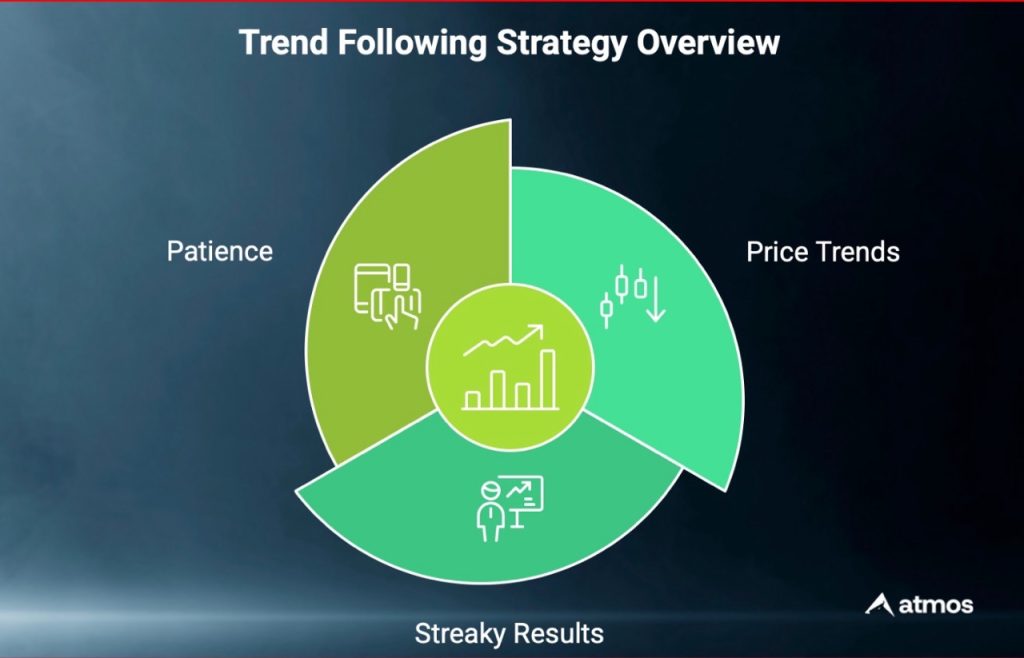
Trend following is like catching a steady wave and riding it for as long as it stays strong. Instead of guessing tops or bottoms, you wait for the price to clearly move in one direction, then join that move on a simple pullback.
Key Considerations
- Works best when price trends cleanly across sessions; avoid mid-range chop.
- Results are streaky: a few big winners drive the month.
- Patience beats tinkering; minor adjustments after the trade proves itself are safer than constant micro-management.
Entry/Exit Criteria
Your rules should be obvious at a glance. Use a trend filter, wait for a pullback, and define how you’ll exit if you’re wrong.
- Entry: MA(20) above MA(50) with ADX>25; buy a pullback to EMA(20) that holds the prior swing high as support.
- Initial stop: 1.2×ATR(14) below the signal low.
- Targets: take a first partial at +1.5R; trail the rest by 1×ATR on H1/H4; exit on a lower-low (in an uptrend) or a VWAP recapture against you.
Timeframes and Market Conditions
Trend following benefits from sessions that hand off cleanly and markets that respect levels.
- Prime windows: London–NY overlap for FX and indices; daily charts tend to guide metals well.
- Skip inside-day conditions and days with conflicting macro drivers.
Prop Trading Strategy #2: Scalping
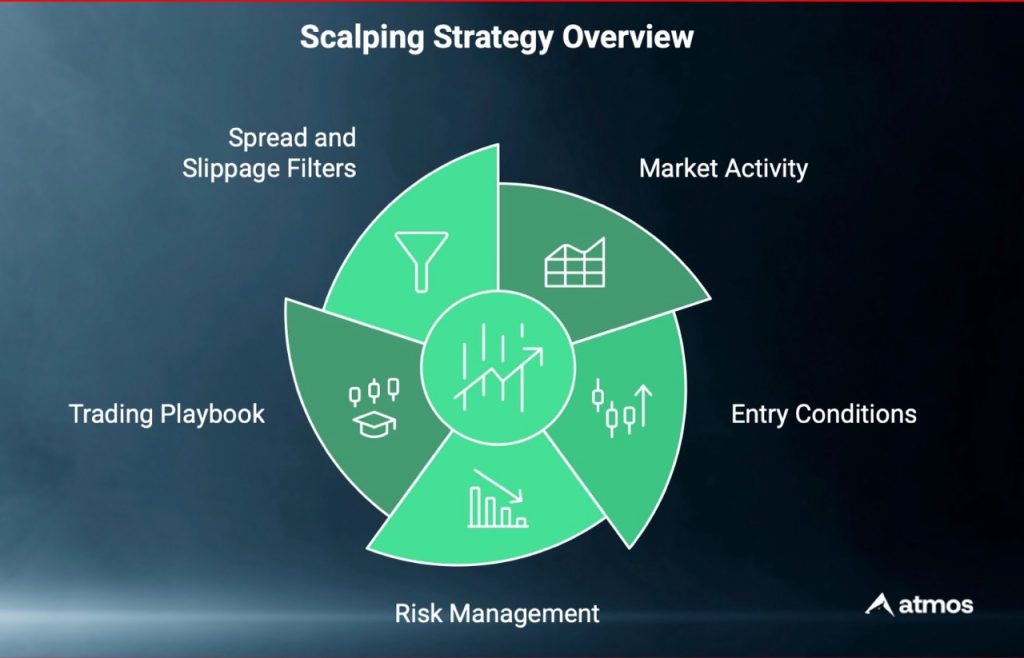
Scalping is a prop firm strategy that focuses on tiny, quick moves that happen when markets are most active, usually right after a session opens. Think “fast hands, strict rules”: take entries only when spreads are tight and volume is healthy, keep losses small, and stop trading when conditions turn messy.
Key Considerations
- High frequency requires a simple playbook: opening drive, VWAP recapture, micro-range break.
- Spread and slippage filters matter more than indicators.
Entry/Exit Criteria
Keep entries mechanical and exits automatic so execution stays consistent under pressure.
- Entry: break of a pre-market micro-range with volume z-score>1.2 and an immediate retest/hold.
- Stop: last micro-swing or 0.6×ATR(14) on M1/M3, whichever is smaller.
- Targets: fixed +1.0–1.2R; optional runner to +2R if order flow persists; exit on a VWAP reclaim against you.
Timeframes and Market Conditions
Scalping thrives when liquidity is deepest, and participation is broad.
- Trade the first 60–90 minutes of London or New York.
- Avoid unscheduled headlines and widened spreads; require a minimum liquidity threshold (e.g., median bid/ask depth).
Prop Trading Strategy #3: Swing Trading
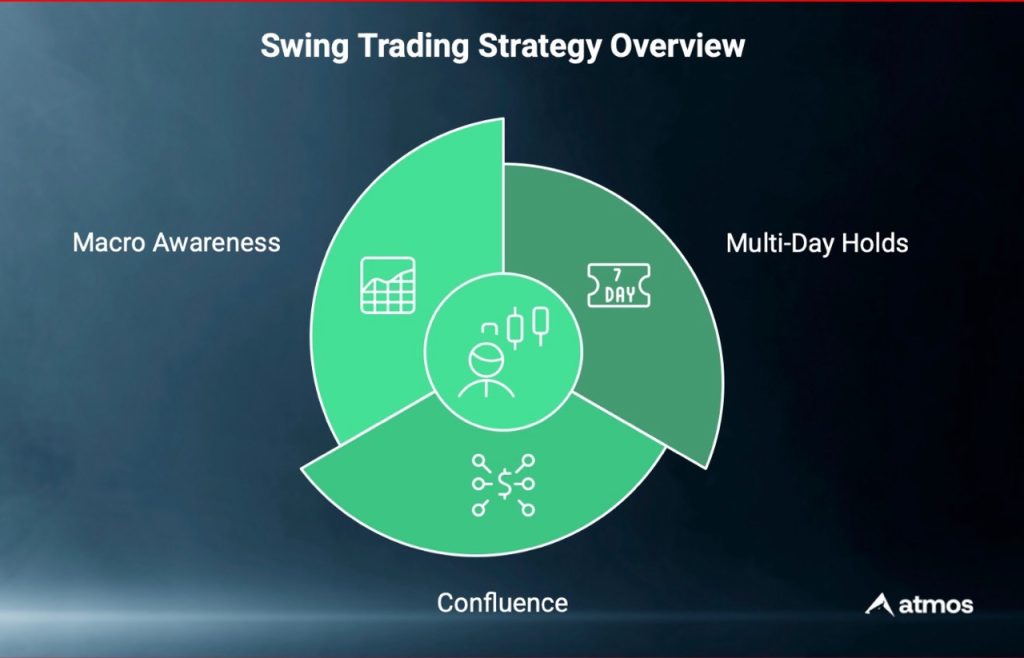
Swing trading looks for moves that play out over several days. Instead of watching every tick, you identify a clear level or pattern on the daily chart and let time do more of the work.
Key Considerations
Think “patient positioning,” not constant action. You trade less, but each decision matters more.
- Multi-day holds mean you don’t need to trade every session; accept overnight risk and gaps.
- Edge comes from confluence: structure + level + momentum, plus basic macro awareness.
Entry/Exit Criteria
Structure first, momentum second. Then let time do the compounding.
- Entry: D1 bull flag resolving above resistance with RSI(14) 45–65 and rising OBV; confirm with an H4 higher low.
- Stop: 1.0–1.5×ATR(14) under structure or below the last swing.
- Targets: partial at +1.5R; roll stops daily under higher lows; exit on a D1 trendline break or momentum stall.
Timeframes and Market Conditions
Look for persistent trends and avoid binary event clusters.
- Works well in steady trends with moderate volatility.
- FX, indices, metals are common; crypto needs wider stops and a smaller size.
Prop Trading Strategy #4: News Trading

News trading aims to profit from sharp moves that happen around scheduled announcements, like inflation data or central bank decisions. Instead of guessing the number, you prepare key levels in advance and trade the reaction only when spreads and price action settle.
Key Considerations
- Build a short list of tier-1 events (CPI, central banks, jobs, PMIs, earnings).
- Define the plays you will and won’t take: fade, continuation, second-leg break.
Entry/Exit Criteria
Anchor around pre-set levels, then let the tape confirm.
- Map pre-news range, prior day’s high/low, and likely liquidity pockets.
- Continuation: first M1/M3 pullback that holds above the impulse high with spreads normalized (≤1.5× baseline).
- Fade: reversal at a pre-news extreme with an exhaustion wick and slowing tape.
- Stop: beyond the impulse low/high or 1.0×ATR(5) of the traded timeframe.
- Targets: partial at +2R; trail by structure; hard time-stop if velocity dies.
Timeframes and Market Conditions
Trade only what you understand deeply.
- Focus on tier-1 events; if spreads or slippage exceed your limits, stand down.
- Best windows: London morning and NY morning for FX and indices.
Why News Trading Works Well With Atmos Funded
Atmos Funded’s Instant Funding is the go-to account for news traders.
- Since Atmos Funded offers payout-on-demand with Instant Funding, traders make the entry within the first trade.
- With the perfect first trade, you can trade with a clearer head, no personal risk, and the patience to wait for the next news that triggers your setup since the account has no time limit.
Prop Trading Strategy #5: Range Trading
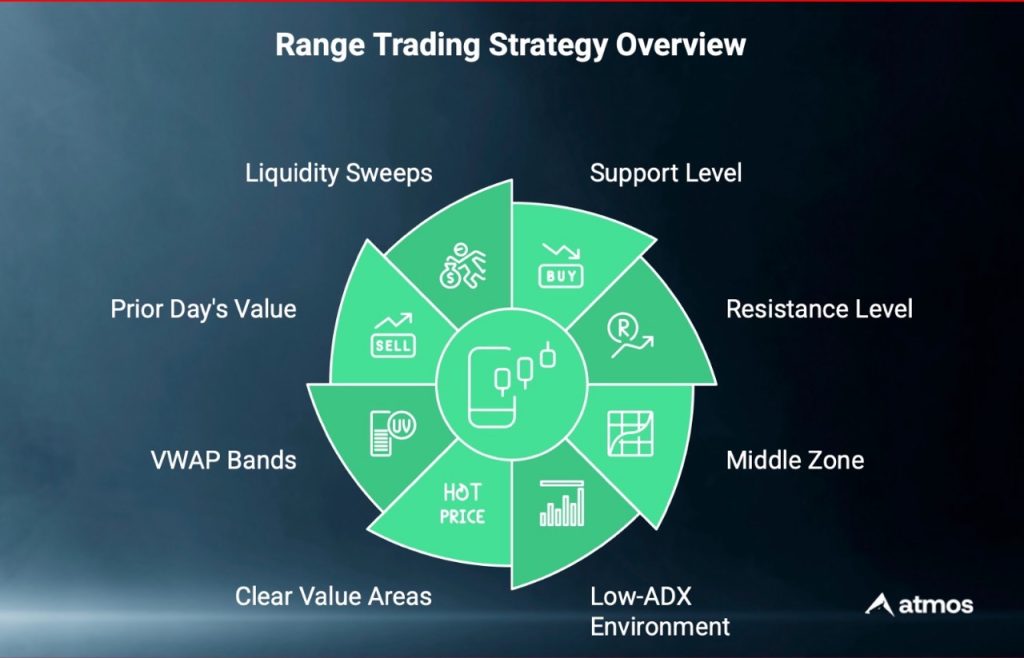
Range trading works when the price bounces between two clear zones, like a ball between the floor and the ceiling. You look to “fade” the edges, buy near support, sell near resistance, and aim for the middle where price often returns.
Key Considerations
Your edge exists only while the range holds; treat breakouts as a different game.
- Works in low-ADX environments with clear value areas.
- VWAP bands, prior day’s value, and liquidity sweeps guide timing.
Entry/Exit Criteria
Wait for an edge at the boundary, then fade back toward value.
- Entry: fade at the range extreme after a sweep and a close back inside value; confirm with delta divergence or a failed hold beyond the VWAP band.
- Stop: 0.8–1.2×ATR(14) outside the boundary or past the sweep wick.
- Targets: partial at mid-range or VWAP; second partial near the opposite band; exit early if ADX>20 and price holds outside value.
Timeframes and Market Conditions
Some sessions are naturally more mean-reverting than others.
- Best during Asia for many FX pairs and mid-day lulls in NY for indices.
- Avoid stacked tier-1 days or opening drives that break structure.
Why Range Trading Works Well With Atmos Funded
Atmos Funded’s rules are designed to make traders win with consistency, and price movement within a range means more consistent trades and a lower risk of breaching rules.
- Static drawdown framework from 2-Step Challenges is friendly to this style.
- Choosing from the 2-Step Standard and 2-Step Plus would be the next good move for range traders.
Prop Trading Strategy #6: Breakout Trading
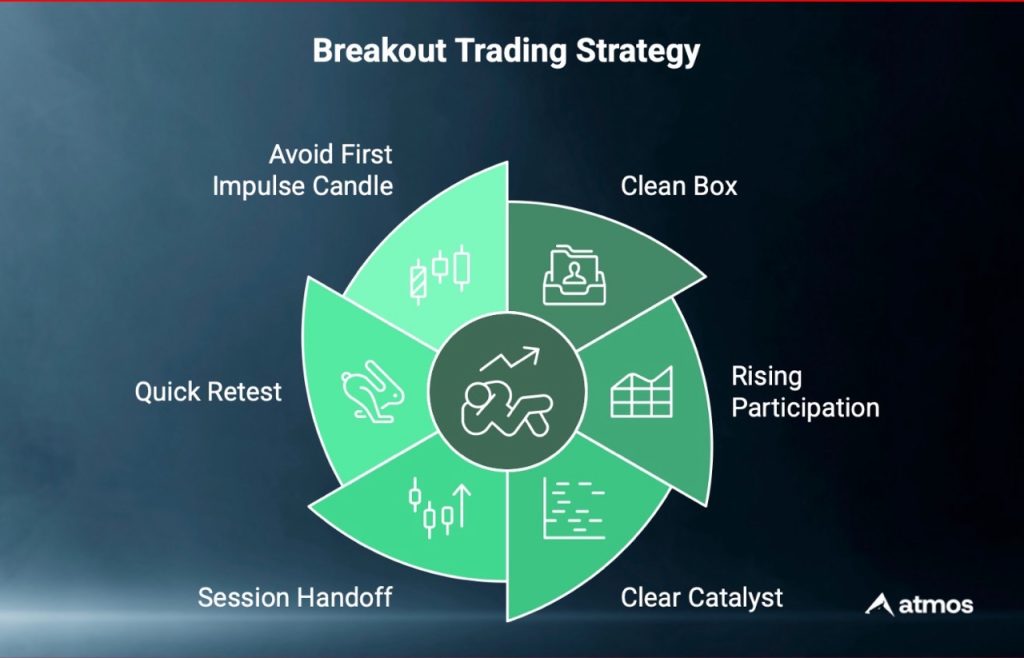
Breakout trading waits for the price to coil into a tight box and then expand with force. You want proof, a strong push, and rising activity before joining the move, and you prefer a quick retest that holds.
Key Considerations
- Look for a clean box, rising participation, and a clear catalyst or session handoff.
- Expect several scratches and a few outsized winners; avoid chasing the first impulse candle.
Entry/Exit Criteria
Make the breakout prove itself, then manage by structure.
- Entry: first close outside the box with volume z-score>1.5 and no immediate rejection.
- Retest rule: prefer a quick retest/hold of the breakout level.
- Stop: 1.0–1.3×ATR(14) beyond the opposite edge or retest low/high.
- Targets: partial at +1.5R; trail by 1×ATR or swing; if price re-enters and holds inside, exit.
Timeframes and Market Conditions
Trade where liquidity supports follow-through.
- Best post-open in London/NY or after scheduled catalysts.
- Avoid flat ADX and value migration within the prior day’s range.
Prop Trading Strategy #7: Pairs Trading (Market-Neutral)
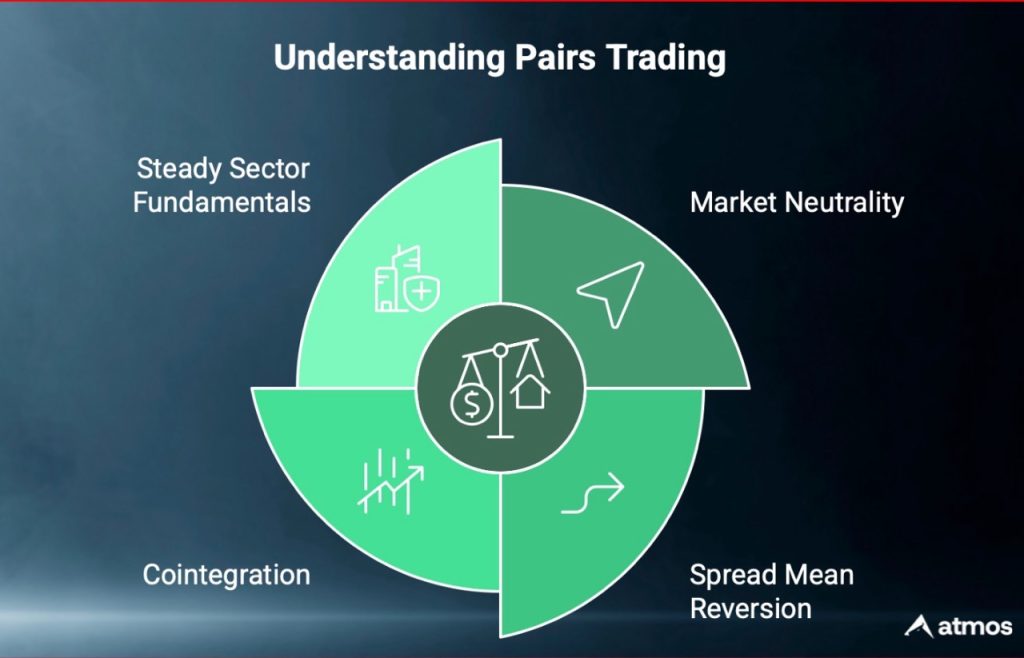
Pairs trading doesn’t rely on guessing overall market direction. Instead, you buy one instrument and sell a related one when their prices drift too far apart, aiming to profit as the relationship returns to normal.
Key Considerations
- Profit comes from spread mean reversion, not market direction.
- Best when cointegration holds, and sector fundamentals are steady..
Entry/Exit Criteria
Trade the spread, not the chart of a single leg.
- Signal: spread z-score breaches ±2.0 with no structural break in correlation.
- Entry: leg into long/short simultaneously; size by spread volatility.
- Stop: spread closes back inside ±1.0 without momentum, or hard stop at ±3.0 if the thesis fails.
- Target: mean at z=0; optional extension to z=±1.0.
Timeframes and Market Conditions
Give the spread time to normalize and avoid event landmines.
- Typical holds: hours to days; avoid earnings, rebalances, or regime shifts.
- In FX, stick to crosses within the same complex and stay session-aware.
Why Pairs Trading Works Well With Atmos Funded
Atmos has 100% fair rules, perfect for this strategy since pairs often glide instead of spike.
- Atmos Funded has low daily loss velocity, suits both static and trailing drawdown.
- Atmos Funded offers just the perfect rules with 2-Step Plus, which lets stats-driven setups mature without forcing trades.
Prop Trading Strategy #8: Algorithmic/Automated Trading
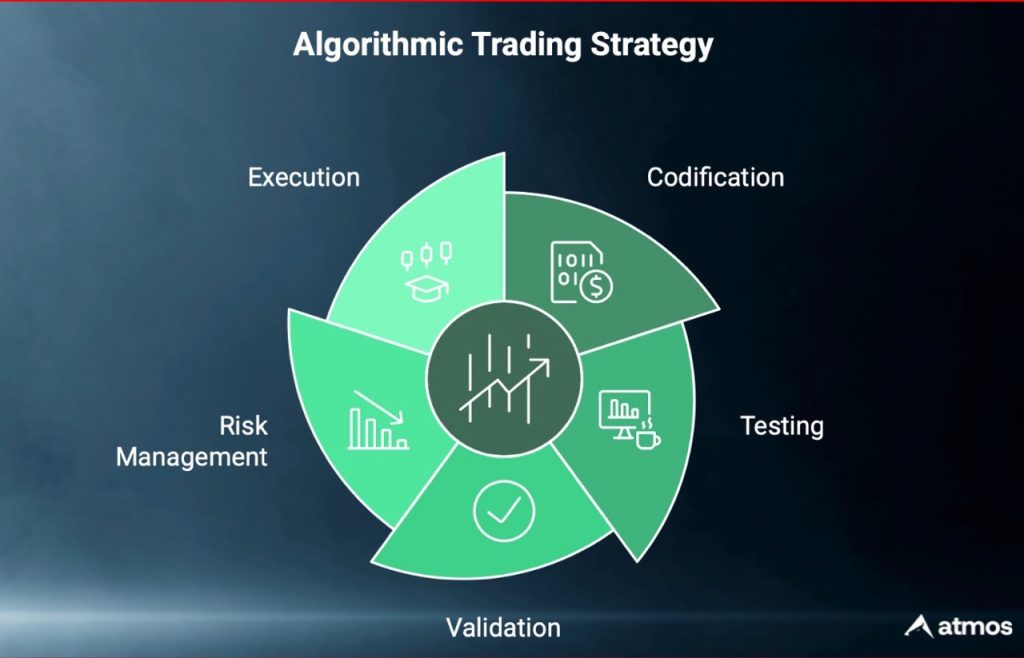
Algorithmic trading turns your written rules into code so the computer follows them the same way every time. You define the setup, filters, and exits; then you test on past data, trial it in a safe environment, and set strict limits for live use.
Key Considerations
- Codify signal, filters, risk, and session windows.
- Invest in data hygiene, robust validation, and strict run-time controls.
Entry/Exit Criteria
Pre-program everything you can so the system behaves the same way every day.
- Signals: VWAP mean reversion, volatility breakouts, trend-with-pullback.
- Filters: spread ceiling, volume floor, news blackout, time-of-day gates.
- Exits: fixed-R, ATR trailing, or time decay, no manual overrides.
Timeframes and Market Conditions
Let regime awareness decide when a strategy is allowed to run.
- Any timeframe works if the system disables itself in the wrong regime (e.g., MR off when ADX>25).
- Diversify across uncorrelated signals to stabilize equity.
Prop Trading Strategy #9: Position Trading (Long-Term)
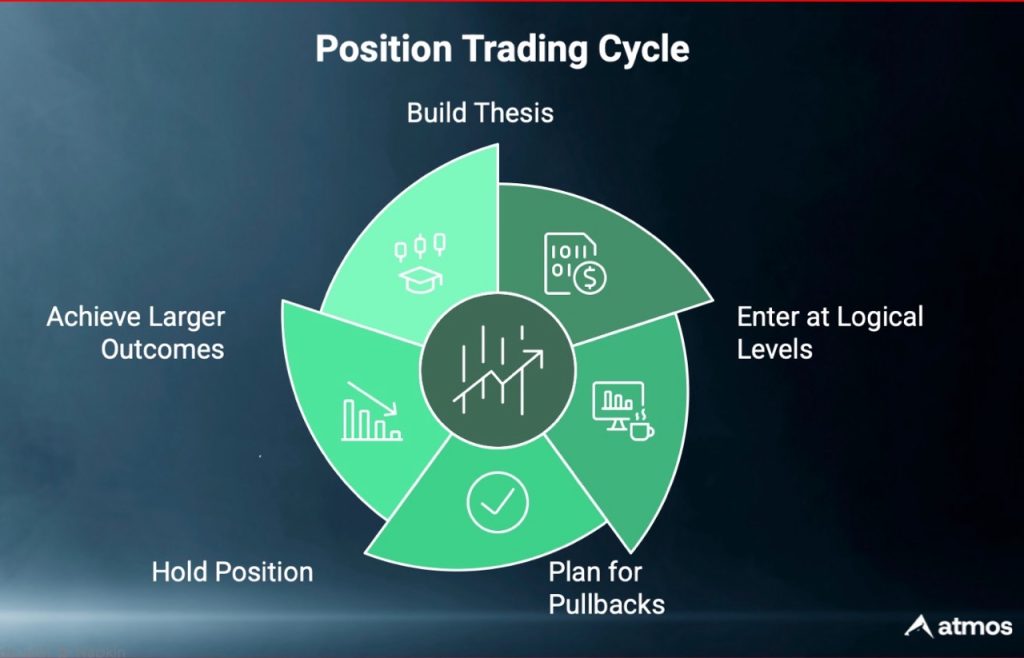
Position trading holds for weeks or months to ride bigger market themes. You build a thesis from the higher-timeframe trend, enter at logical levels, and plan for normal pullbacks without second-guessing every day.
Key Considerations
- Multi-week holds with fewer but larger R outcomes.
- Patience is an edge; micro-management is a tax.
Entry/Exit Criteria
Let the big picture lead and use daily charts to fine-tune entries.
- Entry: weekly breakout from a base with D1 confirmation and a trend filter (e.g., MA(50)>MA(200)).
- Stop: 1.0–1.5×ATR(20) beyond structural invalidation.
- Targets: partial at +2R; trail under weekly higher-lows or a long-term MA stop.
Timeframes and Market Conditions
Choose cleaner macro paths and respect the calendar.
- Best in clear macro trends with steadier policy signals.
- FX, indices, metals work; crypto requires wider buffers.
Why Position Trading Works Well With Atmos Funded
With clearer rules, patience is the only thing needed to pull your setup perfectly.
- Atmos Funded has no time limits, which makes it a natural fit.
- The option to choose static drawdown makes it easier to execute the strategy.
Prop Trading Strategy #10: Global Macro Trading
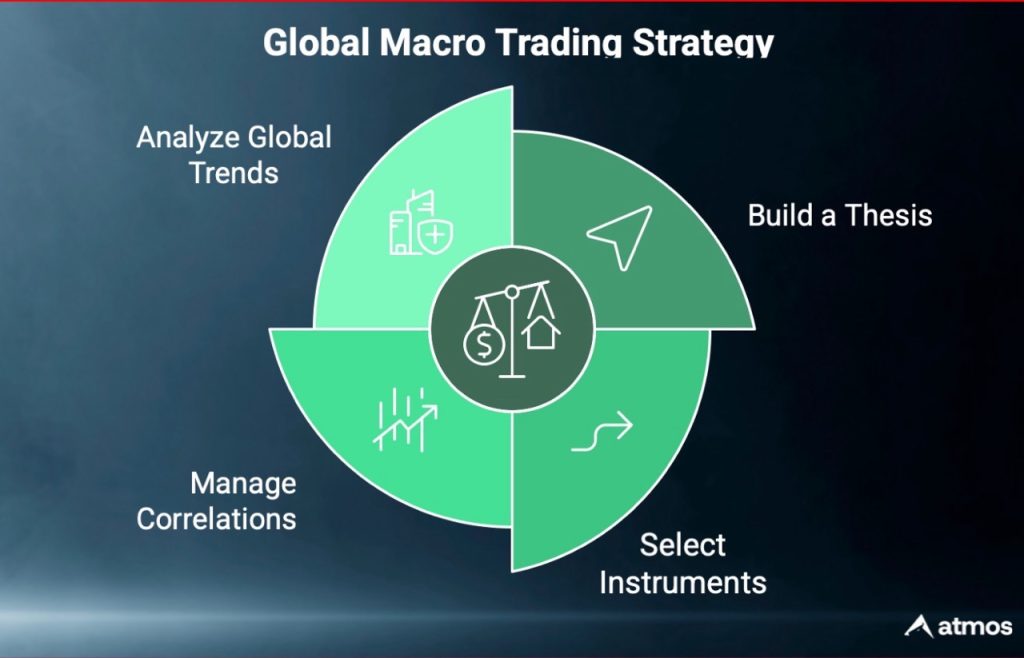
Global macro starts with the big picture, growth, inflation, interest rates, and then picks the cleanest way to express that view through currencies, indices, bonds, or commodities.
Key Considerations
- Build a thesis around growth, inflation, policy, and risk-on/off dynamics.
- Manage correlation clusters so one headline doesn’t hit everything at once.
Entry/Exit Criteria
Prove the thesis, then define invalidation before entry.
- Thesis: data trend + policy path + positioning (e.g., COT extremes) align.
- Trigger: break of a key macro level or a regime shift (e.g., real yields turning).
- Stop: beyond macro invalidation (prior cycle pivot) or 1.2×ATR(20).
- Targets: partial at +2R; rotate instruments as leadership changes.
Timeframes and Market Conditions
Work around the policy calendar and major data.
- Holds last days to weeks; concentrated around policy cycles.
- Avoid over-theming; one clean expression beats three correlated positions.
Prop Trading Strategy Selection Framework: Choosing the Right Strategy for You
Choosing a strategy is less about finding a “holy grail” and more about picking something you can run well, day after day.
Time budget
If you only have short windows, favor session plays; if you have end-of-day time, favor slower edges.
- Under 2 hours/day: Scalping, Range, Breakout.
- 2–4 hours/day: Breakout, Trend, News (selective events).
- 4+ hours/day or end-of-day: Swing, Position, Pairs, Macro.
Tooling comfort
Use the tools you actually understand and will monitor.
- Tape/VWAP/DOM: Scalping, Breakout.
- Statistical toolkits: Pairs, Algorithmic.
- Macro dashboards: Macro, Position.
Risk Management Principles for All Strategies
Risk management is the seatbelt that keeps an otherwise good strategy from failing on a bad day. The idea is to turn firm rules into simple numbers you follow automatically.
Core bands and thresholds
Start with numbers that won’t sink you on a bad day, then scale only after the data supports it.
- Risk per trade
- Scalping/News: 0.10–0.25%
- Breakout/Range: 0.15–0.30%
- Trend/Swing/Position/Macro: 0.20–0.50% (ATR-adjusted)
- Scalping/News: 0.10–0.25%
- Daily loss guardrail: stop at 70–80% of the firm’s daily limit; no “just one more” tickets.
- Expectancy threshold: before any evaluation, require E ≥ 0.25R over the last 100 trades and PF ≥ 1.2 with max drawdown ≤ half of evaluation drawdown.
Control volatility and correlations
Don’t let volatility or theme overlap ambush your P/L.
- Widen stops only if you reduce size; never widen without adjusting risk.
- Use time-stops and news-stops: scratch slow trades; stand down around tier-1 events unless news is your edge.
- Cap correlation: limit theme exposure so one headline doesn’t trip your daily stop across multiple positions.
Hard-code these rules before you size up. The market will test every soft spot; your plan should be too simple to forget and too firm to break under pressure. Make sure to always journal and focus on improving.
Getting Started: Your Action Plan
This is the path from “interested” to “evaluation-ready.” First, pick one main strategy and one backup that fits a different market condition. Write a one-page rules card so entries, exits, sizing, and stop-for-the-day decisions are clear.
- Choose 1-2 prop trading strategies
- Build a one-page rules card
- Backtest on quality data
- Run 50–100 trades in live conditions with your exact rules and daily stop.
- Review and refine
- Start your evaluation with proven sizing
- Weekly operating rhythm
- Tag your top setups, retire the bottom one.
When your data confirms readiness, pick the challenge that matches your cadence and run the plan without improvising. Discipline is the advantage most traders never develop; make it yours.
Conclusion
Successful prop trading isn’t luck; it’s a repeatable prop trading strategy executed inside firm rules. Any of the ten can work; master one deeply rather than skimming many. 2026 favors traders who combine selective entries with volatility-aware sizing and smart tooling.
Atmos Funded provides rule clarity, flexible challenge options, and a structure that rewards consistency. If you’re ready to turn a tested playbook into results, pick the track that fits your strategy and begin your evaluation with confidence.
FAQs
What are the best prop trading strategies for beginners?
Start with Range or Pairs. Both reduce directional stress and teach discipline with entries, exits, and time-stops. Aim for 0.15–0.30% risk per trade, enforce a daily stop at 70–80% of the limit, and don’t scale until you’ve logged 100 trades with PF ≥ 1.2.
How do I know a strategy is ready for an evaluation?
You’ve met three checks: backtest of 200+ trades with PF ≥ 1.2, forward demo of 50–100 trades with E ≥ 0.25R, and strict adherence to your daily stop and session rules. If any check fails, refine and retest, don’t rush the evaluation.
What’s the fastest way to improve my prop strategies?
Kill one low-edge behavior weekly. Add a rule that would have prevented your biggest drawdown spiral (e.g., time-stop, spread ceiling, session cutoff). Keep your best setup, replace the worst, and protect your daily stop. Consistency compounds faster than tweaks.