

Prop trading and hedge funds both sit in the world of professional trading. That is why people often compare them.
But the real difference is not just the strategy. It is the structure behind the trading. A hedge fund manages pooled investor money. A prop trading firm like Atmos Funded gives traders access to a rule-based trading model where performance, discipline, and risk control decide how much reward they can earn.
This guide breaks down how both models work, where they overlap, and where they clearly separate. We’ll compare risk, access, fees, regulation, and trader requirements. By the end, you should have a clearer view of which path fits your goals and where a prop firm like Atmos Funded fits in.
Key Takeaways
- The main difference in prop trading vs hedge fund models is whose money is being traded and who the model serves.
- Hedge funds usually manage money from qualified investors, while prop firms focus on giving traders access to accounts under defined rules.
- Both models depend on market performance, but their risk structure is different.
- Prop trading is usually more accessible for retail traders, while hedge funds are more common in institutional finance.
- Atmos Funded is a prop firm, not a hedge fund. It uses challenge accounts and funded account structures, not pooled investor funds.
How Does a Hedge Fund Work?
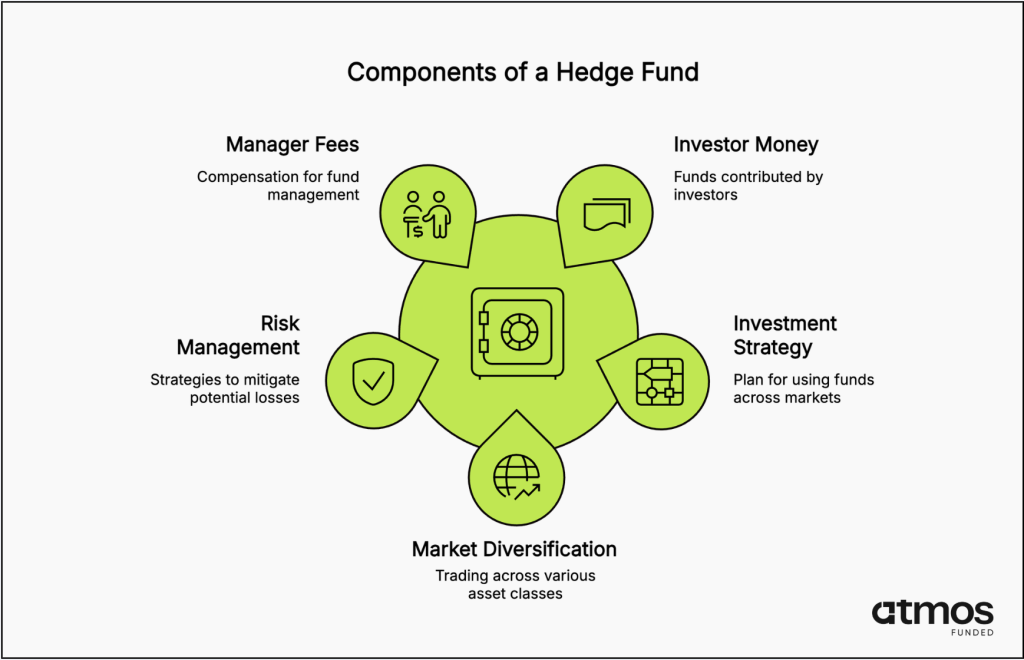
A hedge fund is a private investment fund that pools money from investors and uses that money to trade or invest across different markets. Hedge funds are private funds that pool investor money and invest in securities or other assets with the goal of positive returns.
In simple terms, investors place money into the fund. A manager or investment team then decides how to use that money based on the fund’s strategy.
That strategy may include stocks, bonds, currencies, commodities, derivatives, short selling, leverage, or a mix of several markets. Some hedge funds aim for steady risk-adjusted returns. Others may take more aggressive positions.
Hedge funds are usually not designed for the average retail trader. In the United States, many private fund opportunities are limited to accredited investors. The SEC lists common individual qualification routes, including net worth over $1 million excluding a primary residence, or income over $200,000 individually or $300,000 with a spouse or partner in each of the prior two years.
The manager is normally paid through fees, while investors usually do not place the trades themselves. A common structure is a management fee based on assets under management, plus a performance fee if the fund makes money. Not every hedge fund uses the same fee model, of course, but that fee structure is part of why hedge funds are often seen as an investor-money management business.
How Does Prop Trading Work?
Proprietary (prop) trading allows you to trade financial markets using a firm’s funds rather than your own. You provide the skill and discipline, and the firm provides the funds. If you are profitable, you keep a significant percentage of the earnings (typically 70% to 95%), while the firm has the ability to close or “breach” your account when rules such as loss limits are crossed.
In a prop firm model like Atmos Funded, a trader usually starts by choosing a challenge account, reading the rules, and trading toward a target while staying inside risk limits. Again, the goal is to prove trading skill under clear conditions.
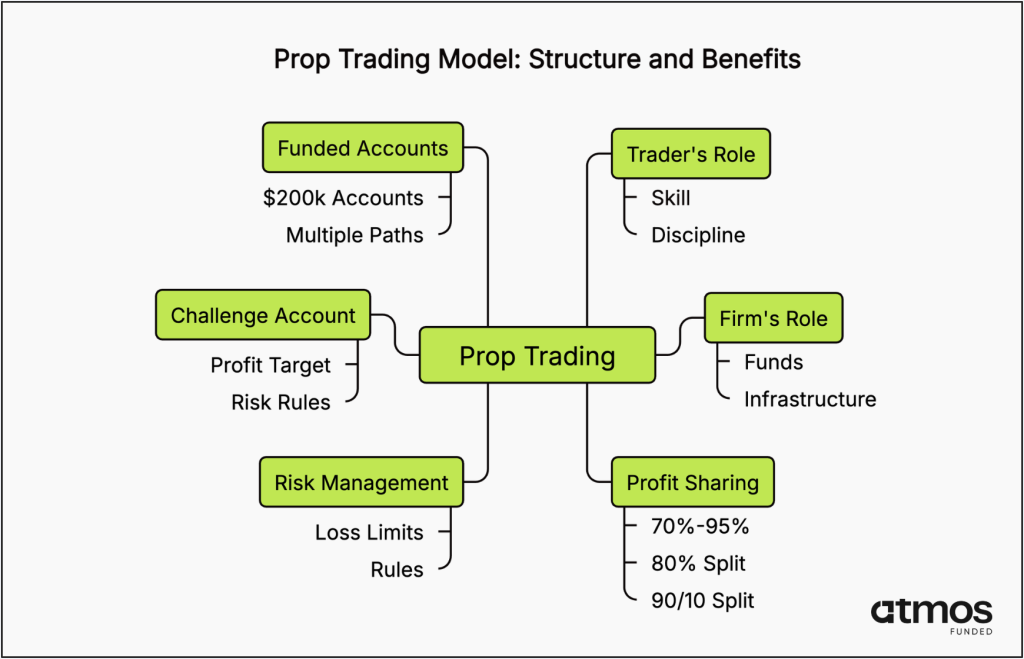
Atmos, for example, lists different challenge structures with different profit targets and risk rules. They offer different paths for different types of traders, each with its own requirements. So knowing which account is right for you is key.
And when trading skill is proven, or a challenge is passed, Atmos Funded gives traders the funds to trade in up to two $ 200k-funded accounts, with an 80% split going to the trader. Atmos Funded also offers a 90/10 split as an add-on.
This is an important distinction in comparisons between proprietary trading and hedge funds. A hedge fund is built around investors. A prop firm is built around traders.
What Are the Main Differences Between Prop Trading and Hedge Funds?
The main differences come down to structure: where the money comes from, who carries the risk, who can access the model, and how people get paid.
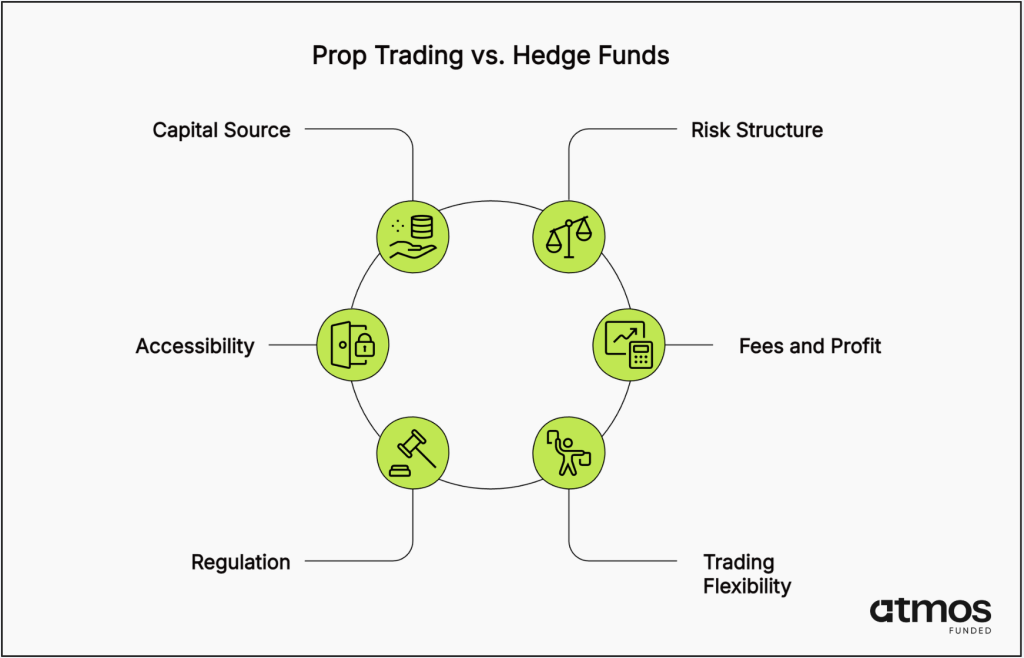
Capital Source
In a hedge fund, the trading funds usually come from outside investors. These may be wealthy individuals, institutions, family offices, pensions, or other qualified investors.
In prop trading, the structure is different. The firm provides the account model and trading conditions. The trader does not manage a pool of investor money in the same way a hedge fund manager does.
This is the simplest way to understand a prop firm vs. a hedge fund comparison:
A hedge fund serves investors. A prop firm serves traders.
Risk Structure
The risk is not the same.
In a hedge fund, investors carry market risk through the money they place in the fund. If the fund loses money, investors may see the value of their investment fall.
In prop trading, the trader usually does not risk the full account size. But that does not mean prop trading is risk-free. The trader can still risk challenge fees, time, account access, and future performance rewards.
That point matters. A more realistic view is that the risk appears in a different form.
Requirements and Accessibility
Hedge funds are often difficult to access from two sides.
For investors, access may require meeting accredited or qualified investor standards. For professionals, getting hired by a hedge fund may require experience, education, a strong track record, or a network in institutional finance.
Prop trading is more accessible. Many modern prop firms allow traders to start with a challenge or evaluation instead of needing a traditional finance background. Atmos Funded even offers a $5 challenge account for traders who want to try out their skill in prop trading and possibly get funded up to a $200k account.
But easier access does not mean easy trading. You still have to follow rules, manage drawdown, and show consistency.
Fees and Profit Model
Hedge funds often earn through management fees and performance fees. The manager gets paid for managing the fund and may earn more if the fund performs well.
Prop firms usually work through a different model. You may pay for a challenge or account, then earn through profit share or performance rewards if they meet the rules. Atmos Funded’s split is 80/20, with 90/10 as an add-on.
Atmos Funded is centered around starting with challenge accounts, getting your funded accounts, and then being awarded your performance rewards.
Regulation
Regulation is one of the most misunderstood areas in hedge fund vs prop trading comparisons.
Hedge funds usually face more investor-facing rules because they manage outside money. Prop firms operate under a different business model, so the regulatory picture depends on the jurisdiction, instruments, account structure, and how the firm is set up.
That is why you should avoid broad claims and read the terms of any firm carefully. Atmos Funded keeps things clear and 100% transparent in their Atmos Help Center.
Trading Flexibility
Prop traders may have more freedom over their own entries, setups, and trading style. But that freedom still sits inside firm rules.
For example, you may choose when to enter a trade (mainly forex), but still need to respect drawdown limits, trading restrictions, and account conditions.
A hedge fund trader may work under a broader portfolio mandate. They may need approval from a portfolio manager, risk team, or investment committee. There may be more structure around position size, exposure, and reporting.
So the trading firm vs hedge fund difference is not just freedom versus restriction. Both serve different people, have different rules, and come from different places.
Prop Trading vs Hedge Fund: Quick Comparison Table
| Category | Prop Trading | Hedge Fund |
| Main purpose | Give traders access to rule-based trading accounts | Manage pooled investor money |
| Who it serves | Traders | Investors and institutions |
| Access | Often challenge or evaluation-based | Often limited to qualified investors or finance professionals |
| Risk | Fees, rule breaches, lost account access, inconsistent results | Investor losses, drawdowns, and manager underperformance |
| Payment model | Profit share or performance rewards | Management fees, performance fees, salary, or bonuses |
| Rules | Drawdown, targets, trading restrictions, and account rules | Fund mandate, investor terms, compliance rules |
| Career path | Independent or remote trader path | Institutional finance, research, or portfolio management path |
Which Is Better for Traders: Prop Trading or Hedge Funds?
Neither model is automatically better. It depends on the person’s goal.
Prop trading may make more sense for a trader who wants a direct, performance-based route. There is less distance between the trader’s execution and the result.
A hedge fund is a different world. It is built around investor mandates, research teams, portfolio decisions, reporting, and institutional responsibility. It is not the cleanest route for a trader who wants to focus on charts, setups, risk, and execution.
It is not really a question of which model is “easier.” Both can be difficult. They simply test different skills.
When Prop Trading Makes More Sense
Prop trading is a better fit for you if you want more direct control over your trading process.
It can make sense for traders who:
- Already have a strategy and want to test it under clear rules
- Prefer trading independently or remotely
- Want a route that does not require hedge fund hiring or investor access
- Understand drawdown, risk limits, and account rules
- Care more about execution than managing investor relationships
This is where a prop firm like Atmos Funded fits into the wider trading landscape. It gives traders a structured way to work through challenge accounts and qualify for performance rewards based on results.
When a Hedge Fund Path Makes More Sense
A hedge fund path may make more sense for someone who wants a more institutional career.
That person may enjoy research, portfolio construction, investment committees, client reporting, and broader fund strategy. They may also be comfortable with more formal hiring standards and investor-facing responsibilities.
This path is less about passing a challenge account and more about building a professional track record inside investment management.
For some traders, that is appealing. For others, it is not the route they want.
How to Start Prop Trading With Atmos Funded
To start, you may choose a challenge account, study the rules, and trade toward the required target while staying inside the risk limits. The exact conditions depend on the account type.
A simple process looks like this:
- Choose the challenge account that fits your style.
- Read the rules before placing trades.
- Trade toward the target while managing drawdown.
- Complete any required verification.
- Pass and move into the funded account structure up to $200k accounts
- Win trades and get your performance rewards 80/20 split (or 90/10 if opted in).
Atmos Funded keeps things simple and easy to understand, even if you’re an experienced trader or a beginner. A path to professional trading will always be available to you if you choose Atmos Funded.
FAQ
What is the main difference between prop trading and hedge funds?
The main difference is that hedge funds manage pooled investor money, while prop trading firms give traders access to firm-backed accounts under defined rules.
A hedge fund is built around investors. A prop firm is built around trader performance, account rules, and risk control.
Do hedge funds do prop trading?
Some hedge funds may trade actively in ways that look similar to proprietary trading. But the structure is still different because hedge funds manage investor money.
That makes them different from dedicated prop firms, where traders usually trade under the firm’s account rules.
Is prop trading riskier than hedge funds?
It depends on whose risk is being measured.
Prop traders face risk through challenge fees, rule breaches, lost account access, and inconsistent rewards. Hedge fund investors face investment losses if the fund performs poorly.
Both models can be risky when leverage, weak discipline, or poor risk management are involved.
Can retail traders join a hedge fund?
Most retail traders cannot join hedge funds as direct investors unless they meet the required eligibility standards.
Retail traders are more likely to access markets through brokers, prop firms, or other trading routes.
Do prop traders manage investor money?
No, not in the same way hedge fund managers do.
Prop traders usually trade under a firm structure and follow account rules. They are not normally managing pooled outside investor money.
How do prop traders get paid compared to hedge fund managers?
Prop traders usually get paid through profit share or performance rewards based on their own trading results, after meeting the firm’s rules.
Hedge fund managers may earn management fees, performance fees, salary, bonuses, or a mix of those, depending on the fund structure.
Is a prop firm the same as a broker?
No. A broker provides market access and trade execution.
A prop firm provides a rule-based trading account structure. Some prop firms use challenges or evaluations before a trader can access a funded account.
Is Atmos Funded a hedge fund?
No. Atmos Funded is a prop firm, not a hedge fund.
It does not operate as a pooled investment fund for outside investors. It gives traders access to challenge accounts and funded account structures under clear rules.