


Max drawdown in prop trading is one of the first rules a prop trader should understand. But it is also one of the easiest to misread because the percentage alone does not show how much room the account really has.
A trader may see a 5%, 6%, or 10% limit and think the rule is simple. In practice, firms like Atmos Funded use drawdown rules to define the account floor, which affects position size, open trades, reward timing, and the overall trading strategy.
This guide breaks down what max drawdown means, how it is calculated, and how daily and max drawdown rules work together. By the end, you should have a cleaner way to track risk before a trade becomes a breach.
Key Takeaways
- Max drawdown is the total loss limit on a prop trading account. It shows the lowest level the account can reach before a breach.
- Daily drawdown and max drawdown are different. Daily drawdown controls one day. Max drawdown controls the full account life.
- The max drawdown formula is simple, but the rule type matters more. Static and trailing both work differently.
- Good drawdown control starts before entry. Check current equity, daily loss room, and max drawdown room before every trade.
What Is Max Drawdown in a Prop Firm?
The simple maximum drawdown definition is the largest drop an account can take from a set reference point before it breaches a rule.
In a prop firm, max drawdown is usually the maximum total loss allowed on the account. For example, if a $100,000 account has a 6% max drawdown, the account floor may be $94,000. If equity or balance falls below that level, depending on the rule, the account will be breached or closed.
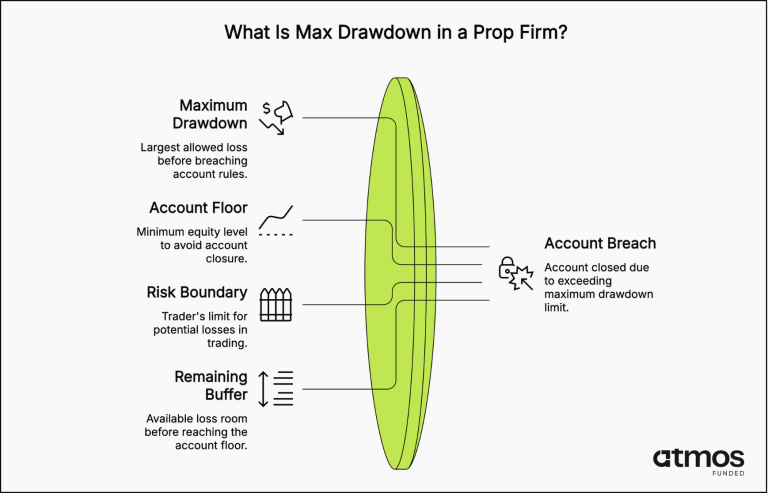
So, what is max drawdown in prop firm terms? It is the account’s risk boundary. It tells the trader how much loss room is available across the whole challenge or funded stage.
That matters because the real risk is not always the full limit. If the account is already at $96,500 and the account floor is $94,000, the remaining buffer is only $2,500.
What are the Factors that Contribute to Max Drawdown in Prop Trading?
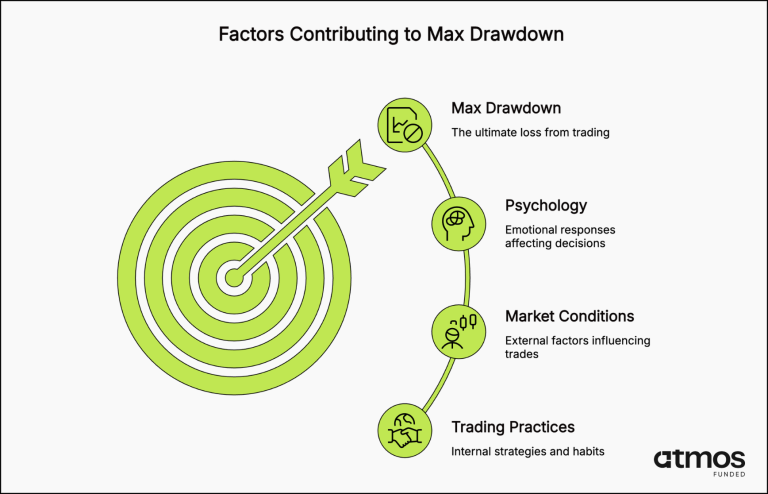
Max drawdown usually builds from repeated small mistakes, not one dramatic trade.
The main factors are oversized positions, correlated trades, open losses, spread widening, slippage, and holding trades through fast market conditions. You may also increase size after a winning streak, then forget that the account floor has moved if you are on a trailing model.
Psychology matters too. Trying to repair losses quickly can turn a normal drawdown into a rule breach.
How Is Max Drawdown Calculated in Prop Trading?
The basic max drawdown formula is:
Max drawdown = starting balance – max drawdown %
Prop firms mention their max drawdown % depending on which type of account you choose. The key question is not only “how much can the account fall?” It is also “what value does the firm use to judge the breach?”
Static vs Trailing Max Drawdown
Static max drawdown keeps the floor fixed. If a $100,000 account has a 6% static limit, the floor stays at $94,000.
Trailing max drawdown moves up as the account grows. If you make a profit, the floor may rise too, so you must track the new floor after profitable periods. In this case, adding one more box to a trading setup checklist is key when trading accounts with trailing models.
Static drawdown is easier to monitor but usually has slower cycles due to its path. Trailing drawdown still works well, especially since it gives access to faster reward cycles most of the time, but it has a slight learning curve after the account moves into profit.
Daily Drawdown vs Max Drawdown: What’s the Difference?
Daily drawdown limits how much an account can lose in one trading day. Max drawdown limits how much the account can lose overall.
| Rule | What it controls | Main risk |
| Daily drawdown | One trading day | A bad session or revenge trades |
| Max drawdown | Full account life | Cumulative losses or floor breaches |
| Both together | Total risk structure | Losing the account before the setup plays out |
Why Prop Traders Need to Track Both Limits
A trader can pass the daily rule and still move close to the max drawdown floor.
A trader may lose $1,000 per day for several days. Each day may stay inside the daily limit, but the total buffer keeps shrinking. That is why drawdown management needs both numbers.
Typical Prop Firm Drawdown Rules: Daily and Max Limits
Typical prop firm drawdown limits, daily and max, often sit around 3% to 5% daily loss and 5% to 8% maximum loss.
But the percentage alone does not tell the full story. A 6% static drawdown can feel very different from a 6% trailing drawdown.
At Atmos Funded, drawdown rules depend on the account type. Some accounts use static drawdown, while others use trailing drawdown that may lock or reset around reward requests.
For example, 1-Step Standard uses a 3% daily loss limit and 6% trailing max drawdown, while 2-Step Plus uses a 3% daily loss limit and 6% static max loss. Instant Funding uses a 3% daily loss limit and 5% trailing drawdown.
This is why traders should compare rule mechanics, not just headline percentages.
What Are The Common Max Drawdown Mistakes in Prop Trading?
The biggest mistake is sizing trades from the full account, instead of the remaining drawdown room.
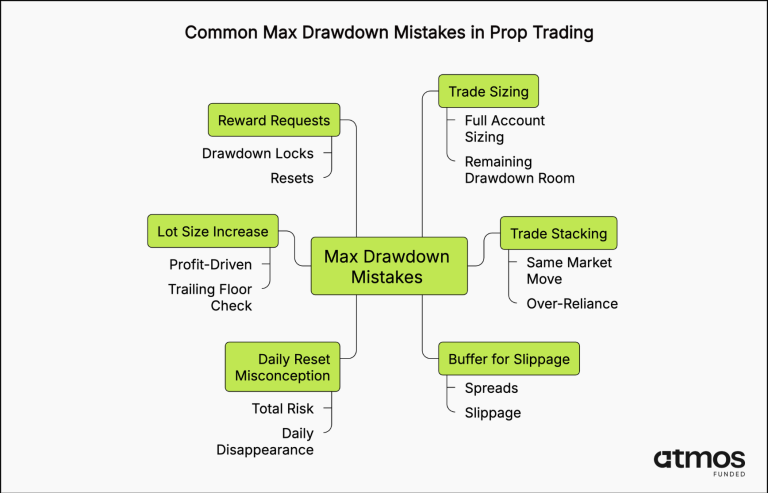
Other common mistakes include:
- Stacking trades that depend on the same market move.
- Leaving no buffer for spreads or slippage.
- Treating the daily reset as if total risk has disappeared.
- Increasing lot size after profit without checking the trailing floor.
- Requesting rewards without checking whether drawdown locks or resets.
Most breaches come from one decent setup being traded too large for the account floor.
How Can Traders Manage Max Drawdown Rules?
Managing max drawdown starts with a small checklist.
Before each trade, a trader should know current equity, daily loss room, and total drawdown room. Size from the smallest buffer.
Check the Account Floor Before Every Trade
The account floor is the lowest level the account can touch.
On a $100,000 account with a $94,000 floor, a trader at $97,200 has $3,200 of total room left. That matters more than the original $6,000 limit.
Keep Risk Below the Maximum Allowed Loss
A trader should never risk the full remaining buffer.
If there is $1,200 of daily room left, risking $1,000 on one trade leaves almost no room for spread, slippage, or a second setup. A smaller size keeps the account alive.
Reduce Position Size After Losses
After losses, the account has less room. The lot size should usually come down with it.
The goal is not to win money back quickly. It is to keep the next trade small enough that one more loss does not end the account.
Max Drawdown Examples in Prop Trading
Examples make max drawdown easier to read because the rule becomes a floor, not just a percentage.
Case Study 1: Large-Scale Max Drawdown in Prop Trading
A trader has a $100,000 account with 6% max drawdown. The starting floor is $94,000.
The trader grows the account to $110,000. On a trailing model that keeps following the high-water mark, the floor may rise with that profit. If the floor moves to $104,000, a drop to $103,900 can breach the account even though the trader is still above the original $100,000 starting balance.
The lesson: profit does not always mean more freedom. On a trailing model, profit will still have the same trading room as when you started.
Extra note: In all of Atmos Funded’s trailing models, the floor does not go above the initial balance, or in this case, $100,000, but rather locks there and becomes static, making it easier to scale up your profits.
Case Study 2: Managing a Small-Scale Max Drawdown in Prop Trading
A trader has a $10,000 account with a 5% max drawdown. The total room is only $500.
If the trader risks $150 per trade, three losing trades can put the account near breakeven. A better plan may be $40 to $60 risk per trade, especially after the first loss.
Small accounts need tighter sizing because the dollar buffer is smaller.
How Atmos Funded Structures Max Drawdown Rules
Atmos Funded is a useful example because its account types do not all use the same drawdown model.
| Rule | Challenge phase | Funded account |
| 1-Step Standard | 3% max daily loss and 6% trailing max total loss. The trailing drawdown locks at the initial balance when reached or when a reward is requested. | Same structure after funding. |
| 1-Step Plus | No max daily loss. 3% trailing max total loss that locks at the initial balance. Tighter than Standard but lower entry price. | Same trailing structure, plus drawdown resets back down after a reward request. |
| 2-Step Standard | 5% max daily loss and 10% static max total loss across the two evaluation phases. | Same static loss structure after funding. |
| 2-Step Plus | 3% max daily loss and 6% static max total loss across the two evaluation phases. Tighter than Standard but lower entry price. | Same static loss structure after funding. The first reward request is on demand. |
| Instant Funding | No challenge phase because traders start funded immediately. | 3% max daily loss and 5% trailing max total loss. The trailing drawdown locks at the initial balance when reached or when a reward is requested. |
| Nova | 4% daily drawdown, 8% maximum overall loss, and trailing drawdown during the challenge phase. Only $5 entry. | 4% daily drawdown, 8% maximum overall loss, and trailing drawdown. The trailing drawdown locks at the initial balance when reached or when a reward is requested. |
Atmos rules explain that drawdown and loss limits vary by plan, with daily loss limits, total drawdown, and, on some trailing drawdown plans, lock or reset rules when rewards are requested. Its in-depth Atmos Help Center has all the information you need, from which accounts have static drawdown for beginners, and which accounts have faster rewards and scaling with trailing drawdown.
If you want clear rules, 100% fair conditions, 100% transparent expectations, extremely fast reward processing, and a solid community, Atmos Funded gives you a structured place to start. Check the rules, choose the account that fits your risk style, and build the plan around the drawdown floor first.
FAQ
What is max drawdown in a prop firm?
Max drawdown in a prop firm is the maximum total loss an account can take before breaching the rules. It acts as the account floor.
What is the difference between daily drawdown and max drawdown?
Daily drawdown limits one trading day. Max drawdown limits the full account. A trader must stay inside both.
How do you calculate max drawdown?
Use the max drawdown formula: peak value minus the lowest value after that peak. For percentage drawdown, divide by the peak value and multiply by 100.
What are typical prop firm drawdown limits, daily and max?
Many prop firms use daily limits of around 3% to 5%, and max limits of around 5% to 10%. Calculation method matters too.
Should traders choose a prop firm with static or trailing drawdown?
Static drawdown is easier to track. Trailing drawdown may suit traders who can monitor the moving floor after profits.
Can slippage cause a drawdown breach even with proper stop losses?
Yes. Slippage can make the exit worse than planned, especially during fast markets, news, or thin liquidity. Traders need a buffer.
Does max drawdown reset after a payout?
It depends on the firm and account type. Some accounts lock the floor. Others reset the baseline. Check the exact rule before requesting rewards.
What happens if a trader breaches the max drawdown?
A max drawdown breach usually means the account fails or closes. You may need to restart with a new challenge, depending on the firm’s rules.