


Many traders search for the cheapest prop firm challenge because they want a lower-cost way to test their skills. That makes sense.
But the lowest price alone does not always mean the best choice. A cheap challenge only matters if the rules still give the trader a fair path to pass and eventually get rewarded. If the account has too many vague terms, strict consistency rules, forced trading days, or a tight time limit, the “cheap” entry can feel less useful once trading starts.
That is why Atmos Funded Nova stands out. It gives traders a $5 starting point, one phase, no consistency rule, on-demand rewards, no minimum trading days, no time limit, and on-demand rewards. For traders comparing the cheapest prop firm challenges in 2026, that mix is hard to beat. Atmos also lists account sizes from $10K to $200K on the Nova path.
Key Takeaways
- Atmos Funded Nova is the best overall, cheapest prop firm challenge for 2026 because it starts at $5 and keeps the rules 100% fair and transparent.
- A low entry fee is only useful when the rules are still fair, clear, and realistic to trade.
- Traders should compare phases, consistency rules, minimum trading days, time limits, drawdown rules, reward access, and support.
- Some low-cost firms are real alternatives, but many add more steps or heavier conditions.
- Nova is built for traders who want a cleaner start: one phase, no consistency rule, no minimum trading days, no time limit, and on-demand rewards.
What Is a Prop Firm Challenge?
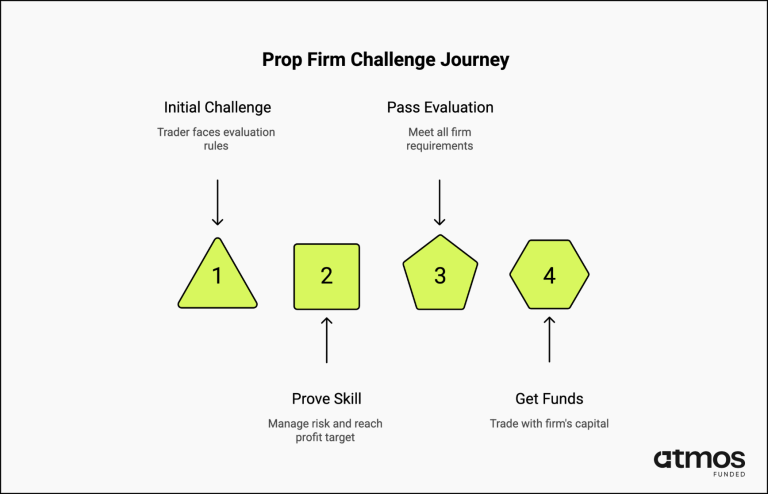
A prop firm challenge is an evaluation where a trader follows set rules to prove they can manage risk and reach a profit target. When they prove their skill, the prop firms give them funds to trade with and split the profits, with 70-90% going to the trader.
The firm sets the account size, profit target, daily loss limit, max loss limit, and any extra rules. The trader’s job is simple in theory: hit the target without breaking the rules, pass the evaluation, get the funds, and earn rewards.
In practice, the rules matter as much as the price.
A $5, $15, or $39 challenge can look attractive at first. But if the rules force rushed trades, punish one strong trading day, or require multiple phases, the trader is not just buying a cheap challenge. They are buying a tougher path to rewards.
That is the part many traders miss.
The best budget-friendly challenge should do three things well:
- Keep the starting cost low
- Keep the rules clear
- Give traders enough room to trade their actual setup
This is where Atmos Nova has a clear edge. It keeps the offer simple and direct: start for $5, trade one phase, with no consistency rules, and pass without waiting for a minimum number of trading days. Basically, you can get one strong day with your A+ setup and pass the Nova Challenge.
Why Traders Search for the Cheapest Prop Firm Challenges
We are all looking for the cheapest prop firm challenges because cost matters, especially when still testing strategies.
A lower entry point gives traders more room to start without putting heavy pressure on one attempt. That can help newer traders, but it also helps experienced traders who want to test a firm’s rules before choosing a bigger path.
Still, cheap should not mean weak. A trader should not only ask, “How much does this challenge cost?”
A better question is:
“Does this challenge give me a fair shot to trade my edge?”
That means looking beyond the first price and checking the conditions around it.
For example, a trader using swing setups may care more about no time limit. A trader with a strong but uneven profit curve may care about no consistency rule. A trader who does not want to force trades may care about no minimum trading days. A trader who doesn’t want to wait for bi-weekly or monthly reward cycles would look for on-demand rewards.
Atmos Nova checks all four.
That is why the $5 starting point isn’t the only thing that matters. It is not just cheap. It is cheap with an absolutely clear structure behind it.
Comparison of the Cheapest Prop Firm Challenges in 2026
A fair comparison should look at price and structure together. That is where Atmos Nova becomes the benchmark.
Other firms may compete on promos, account types, instant funding, or brand recognition, but Nova is the top challenge option that combines a $5 with on-demand rewards, one phase, no consistency rule, no minimum trading days, and no time limit.
| Prop firm | Budget-friendly option | Starting point | Structure | Best for | Verdict |
| Atmos Funded | Nova Challenge | $5 | 1-step, 4% daily drawdown, 8% max drawdown, no consistency rule, no minimum days, no time limit, on-demand rewards | Traders who want the cleanest, affordable challenge | Best overall |
| The5ers | Bootcamp | $22 | 3-step path, 48-hour completion time limit per stage, 14-day reward cycle | Traders who have a consistent daily setup | Solid, niche to specific traders |
| FundedNext | Stellar Lite | $33 | 2-step, 5 minimum trading days, 1 device & IP address rule, 21-day wait for first reward | Traders who want a mainstream name | Good option, with more time friction |
| FXIFY | Two-Phase Challenge | $59 | 2-step, comes with custom options like trailing or static drawdown, 3-5 minimum trading days, etc. | Traders who want platform flexibility | Flexible, high entry |
| Maven Trading | $2k 3-Step Challenge | $13 | 3-step, no time limit, 2% daily drawdown, 3% max drawdown | Affordable and good for small-account testing | Cheap, but tight trading room |
| Goat Funded Trader | Pay-later model | $5 | 1-step, 2% max loss per trade, 3% daily drawdown, 6% max drawdown, 20% consistency rule | Traders who want a $5 entry with different platforms | Good $5 entry, but tighter rules |
Atmos Funded Nova Challenge – Best Overall
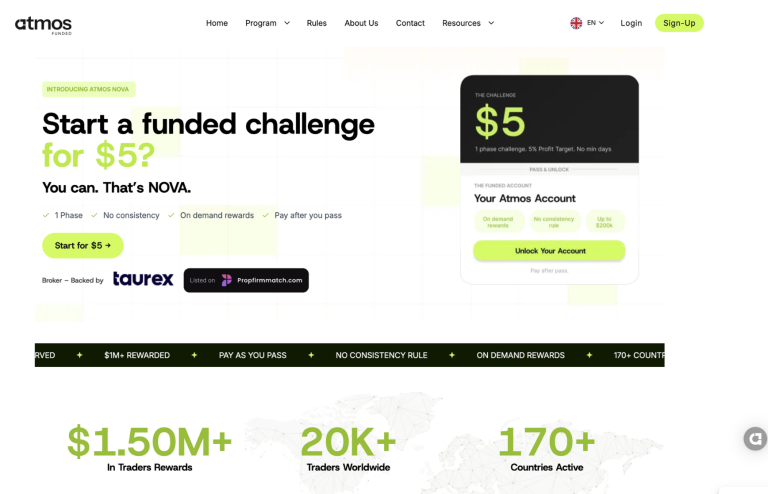
Atmos Funded Nova is the strongest pick for traders searching for the cheapest prop firm challenge in 2026 because it combines a $5 start, one phase, no consistency rule, no minimum trading days, and no time limit.
The reason is not only the $5 start. Other firms can run discounts. Some can offer small account tiers. Some can make the first number look low.
Nova is different because the structure stays clean.
Traders get:
- $5 starting point
- 1 phase
- No consistency rule
- No minimum trading days
- No time limit
- 5% profit target
- 4% daily loss
- 8% max loss
- On-demand rewards
- Account sizes from $10K to $200K
For a cheap prop firm challenge, that is a serious setup.
The no minimum trading days point is especially important. Many traders fail cheap challenges because they feel forced to trade when the setup is not there. Nova removes that pressure. If the trader reaches the target while staying inside the rules, they are not held back by a calendar.
The no consistency rule also matters. Some traders do not make a profit in a perfect straight line. A strong setup may deliver more than several smaller trades combined. Nova gives traders more room to let their best trades matter.
This is why Atmos can be bold here. Nova is not just one of the cheapest funded account starting points. It is one of the best cheap challenge structures for traders who want a fair, fast, and simple route.
The5ers Bootcamp – Best for Consistent Traders
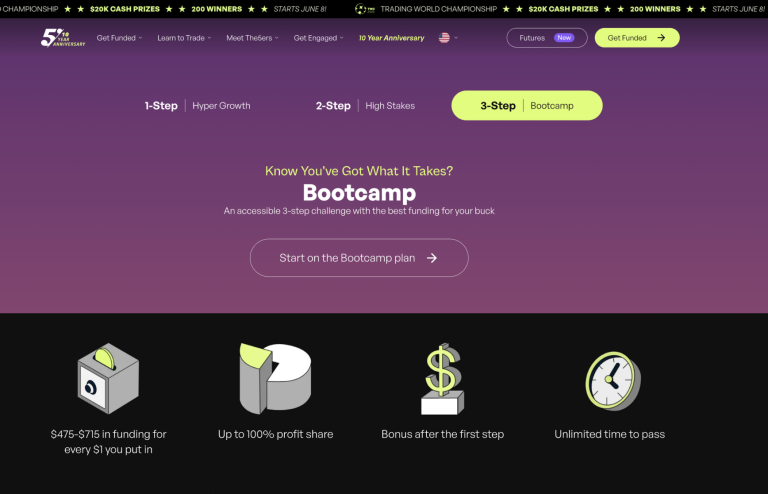
The5ers Bootcamp is a real alternative for traders who prefer a slower, more structured path and, of course, has a consistent daily setup due to its 48-hour completion-time limit per stage rule.
The5ers presents Bootcamp as a low-entry-cost challenge where traders prove their skill first, with the rest handled only after they have passed.
That can appeal to consistent day traders. The5ers has built a name around discipline, risk control, and longer-term trader development. And their Bootcamp program specifically looks for traders who can do 5% within 48 hours.
The5ers Bootcamp may suit experienced traders who want a consistent structure and thrive under time pressure. Atmos Nova, on the other hand, could be a better fit to avoid forced trades with no time limit and play your A+ setups when they come.
FundedNext Stellar – Solid Mainstream Option

FundedNext is one of the more recognized names in the prop firm space, and Stellar Lite is a budget-friendly option worth knowing.
Its Stellar Lite rules include a 4% daily loss limit, 8% maximum loss limit, at least 5 separate trading days, and are restricted to only one device and one IP address per account.
Although this path takes 31 days before a possible reward (5 minimum trading days each phase + 21-day first reward rule), their minimum trading day rule can make the process feel more measured.
FundedNext is a good budget mainstream option. Atmos Nova is the best cheap challenge for traders who want less time friction and device/location flexibility.
FXIFY Two-Phase Challenge – Best for Promo Pricing
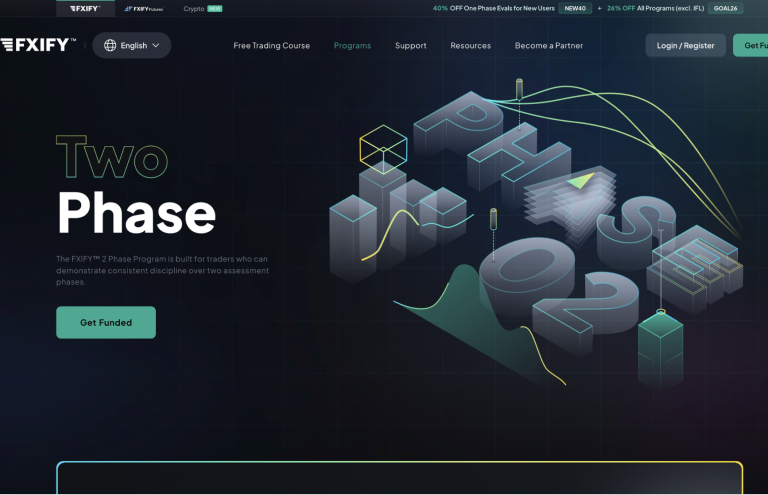
FXIFY is best understood as a flexible prop firm option. It offers different challenge types, platform choices, and add-ons for traders who want more control over the setup. FXIFY’s own two-phase page highlights trading platforms such as MT5, DXtrade, and TradingView.
That flexibility can be useful. But flexibility is not the same as the best cheap challenge.
FXIFY may suit traders who care more about platform choice and customization, but at a higher price point. Atmos Nova gives traders the main things they came for: a low price start, fast reward cycles, no consistency rule, no minimum trading days, and no time limit.
A trader does not need to decode several models before starting. They can see the path quickly and decide if it fits.
Maven Trading – Solid Low-Cost Challenge
Maven Trading is a real low-cost alternative for traders.
That makes Maven useful for traders who want a fair, small account. It is cheap enough to be considered in this category, and the firm is often discussed among budget prop options.
But the daily loss limit could be tighter than usual, as their $2k 3-step challenge only has a 2% daily drawdown, leaving only a $40 trading room. This leaves traders split between actually funding themselves for flexibility or spending $13 for a $40 trading room.
Atmos Nova starts at $5, has options from $10k-$200k with a 4% daily drawdown, and 8% max drawdown. This gives traders enough room to earn and scale.
Maven can be a practical small-account test. Atmos Nova is the stronger pick for traders who want to access funded trading opportunities more easily.
Goat Funded Trader – Best for Market Access
Goat Funded Trader is one of the closest alternatives because it also markets a $5 starting point on its pay-later style model. You can start with $5 and access funded accounts up to $100K.
That makes Goat Funded’s challenge a possible choice with no time limits, but it has tighter rules with 2% max loss per trade, 3% daily drawdown, 6% max drawdown on its funded stage, and a 20% consistency rule.
Atmos Nova offers the same $5 starting point, same one phase, same no time limit, but the main difference is that Nova has no consistency rule, and has account sizes up to $200K.
The same pay-later model applies to Atmos Funded’s Nova as well. And Nova has the better pricing with $79 giving access to a funded $10k account; meanwhile, Goat Funded offers $78 for a $5k funded account. That’s twice the funds, twice the possible gains.
Goat is definitely a part of cheap entry comparison lists, especially if you want platforms other than MT5.
How to Vet a Budget-Friendly Prop Firm Challenge and Pick a Valid One
A budget-friendly prop firm challenge should not be judged by price alone.
The right question is whether the challenge gives traders a fair setup to execute their plan. Cheap challenges can be useful, but only when the rules are clear and the firm has enough proof behind them.
Here is what traders should compare.
Drawdown Rules and Profit Targets
Drawdown rules decide how much room a trader has before the account is breached.
This is one of the most important parts of any cheap challenge. A low fee does not help much if the drawdown model is too tight for the trader’s normal strategy.
Traders should compare:
- Daily loss limit
- Max loss limit
- Profit target
- Static vs trailing drawdown
- Phase count
- Rule changes between stages
Atmos Nova keeps the main evaluation structure easy to understand: 5% profit target, 4% daily loss, and 8% max loss. Meanwhile, the Goat Funded Pay-Later model offers 3% daily loss and 6% max loss. More room gives traders a clearer shot at the profit target without turning the challenge into a long multi-trade process.
For many traders, that matters more than a small difference in fee.
A cheap challenge should help a trader focus on risk and execution. It should not create confusion before the first trade.
Reward Terms and Scaling Potential
Reward access is another major part of the comparison.
Some traders only look at the entry fee, but the better question is how the firm treats traders after they perform. A budget challenge should still have a serious reward framework behind it.
Atmos Nova stands out here because it includes on-demand rewards. That is a major trust signal for traders who want speed, fairness, and less waiting.
Atmos also has broader proof behind the brand:
- $2M+ in trader rewards
- $1.7M+ verified through Prop Firm Match
- 20K+ traders worldwide
- 170+ active countries
- Broker-backed structure
That combination matters.
A cheap challenge with weak proof can feel risky. A cheap challenge backed by real trader activity and fast reward processing feels different.
Time Limits, Restrictions, and Hidden Costs
Time pressure can ruin a cheap challenge.
If a trader has to force entries just to meet a deadline or minimum trading day rule, the challenge may push them away from their normal plan. That is not ideal, especially for traders who rely on patience.
A trader should check:
- Is there a time limit?
- Are there minimum trading days?
- Is there a consistency rule?
- Are there strict limits on trading style?
- Are the rules easy to understand before starting?
Atmos Nova removes three common friction points:
- No time limit
- No minimum trading days
- No consistency rule
That is one of the biggest reasons Nova deserves the top spot.
A trader can wait for the setup, trade when the market gives a real chance, and avoid forcing low-quality entries just to satisfy the rulebook.
Reputation, Support, and Free Trial Options
A cheap prop firm challenge still needs a serious company behind it.
Traders should look for signs that the firm is active, trusted, and responsive. That can include public reward proof, third-party listings, a real trader base, clear rules, and accessible support.
Atmos is strong here because it is not only selling a low entry point. It has a larger ecosystem around the trader.
The Atmos Community Hub adds another layer. Traders are not just starting a challenge and being left alone. They get access to a community environment built around trading, learning, updates, and support.
That matters more than most traders think.
A trader can have a good strategy and still make mistakes because of pressure, confusion, or poor rule understanding. A strong community and support system can reduce that friction.
What Are the Risks of Low-Cost Challenges and How to Reduce Them?
Low-cost challenges can be useful, but traders still need discipline.
The main risk is that cheap entry can make traders careless. Because the starting cost is low, some traders may overtrade, oversize, or treat the challenge like a quick shot. That is usually the approach that breaches accounts.
A cheap challenge should still be traded like a serious evaluation.
The best way to reduce risk is to create rules before starting:
- Risk a small fixed amount per trade
- Stop trading before reaching the firm’s daily loss limit
- Avoid chasing the first move after the news
- Trade only setups already tested
- Keep a journal of mistakes and rule pressure
- Do not increase the size just because the entry fee was low
Atmos Nova helps because its structure reduces unnecessary pressure. No minimum days means traders do not need to force trades. No time limit means there is no need to rush. No consistency rule gives traders more room to let strong setups work.
But the trader still has to execute.
That is the honest part. Nova gives the best path possible for all lower entries. The trader still has to bring discipline.
Final Thoughts
For traders comparing the cheapest prop firm challenge in 2026, Atmos Funded Nova is the best overall pick because it gives traders a $5 start, one step, no consistency rule, no minimum trading days, no time limit, on-demand rewards, and loss limits with a lot of trading room.
Not because it simply starts at $5.
It is the full structure around that $5 start that makes Nova stand out. Other firms can be useful alternatives. The5ers has a structured path. FundedNext has mainstream recognition. FXIFY offers flexibility. Maven gives traders low-cost small-account testing. Goat is a real $5 competitor.
But Nova has the cleanest low-cost starting experience. That is the real difference.
For traders who want a cheap prop firm challenge that still feels fair, fast, and serious, Atmos Nova is the strongest choice. Start with the structure that fits where traders actually are: $5, one phase, no consistency rule, no minimum days, and no time limit.
Atmos Funded also brings the parts traders care about after choosing a firm: 100% transparent rules, 100% fair conditions, extremely fast reward processing, and the Atmos Community Hub for support and connection.
That is why Nova is not just another cheap challenge. It is the best starting point for traders who want to prove their skill without unnecessary friction. If you are looking to start with a low entry, scale, and go pro, Atmos Nova is the best place to start.
FAQ
What is the cheapest prop firm challenge?
The cheapest prop firm challenge is Atmos Funded’s Nova, the best overall low-cost pick for 2026, because traders can start for $5 with one step, no consistency rule, no minimum trading days, no time limit, on-demand rewards, and fair rules.
Some of the cheapest prop firms offer low-cost small accounts or promo pricing, but Nova has the strongest mix of price and clean rules.
Are budget-friendly prop firm challenges worth it?
Budget-friendly prop firm challenges can be worth it when the rules are fair and clear.
A cheap challenge is not worth much if it forces rushed trades, has unclear restrictions, or adds too many steps. Traders should compare the full rule structure, not just the entry fee.
Atmos Nova is worth considering because it keeps the starting point low while removing common friction points like minimum trading days, time limits, and consistency rules.
What should traders compare before signing up for a budget prop firm challenge?
Traders should compare the starting price, number of phases, profit target, daily loss, max loss, time limits, minimum trading days, consistency rules, reward access, support, and community.
The best cheap challenge is not always the one with the lowest number. It is the one that gives the trader the fairest path to pass.
What is the difference between a cheap challenge and a standard one?
A cheap challenge usually has a lower starting price or smaller account size. A standard challenge may offer larger sizes, different rule options, or a more traditional evaluation structure.
The key is not whether a challenge is cheap or standard. The key is if the rules match the trader’s style.
A cheap challenge with one step and clear rules can be better than a standard challenge with more friction.
Is the Nova Challenge good for beginners?
Yes. Atmos Nova is the best choice for beginners because it starts at $5 and keeps the structure simple.
There is one step, no consistency rule, no minimum trading days, and no time limit. That gives newer traders more room to focus on risk control, setup quality, and discipline instead of rushing through extra conditions.
It is also strong for experienced traders who want a low-cost way to see if Atmos Funded is worth it to switch to, without starting with a larger challenge.