

The truth about forex in 2026 is simple: strategies win, opinions don’t. Markets are fast, crowded, and unforgiving, especially inside prop rules. So the edge isn’t a secret indicator; it’s a repeatable playbook you can execute on your best and worst days.
This guide walks through the 10 best forex trading strategies for 2026. what they are, when they shine, and where they break, so you can choose the best strategy for forex trading that fits your rules. You’ll see the pros, the trade-offs, and the exact context each one needs to work so you’re not forcing setups in the wrong conditions.
And because practice without guardrails is just expensive experimentation, we’ll tie each approach to a funded-account workflow. Atmos Funded lets you pressure-test your good forex strategies in live markets under clear daily and overall limits. So you can build skill, protect capital, and grow with discipline.
Key Takeaways
- Forex trading techniques in 2026 provide structured methods to decide entry and exit points in currency markets, highlighting effective forex trading strategies and practical forex strategies you can follow.
- Popular strategies include price action, range trading, trend trading, position trading, day trading, and scalping.
- Choosing the right strategy depends on your trading goals, risk tolerance, time availability, and trading style.
- As a trustworthy forex prop firm, Atmos Funded enables prop traders to practice these strategies under defined risk conditions, enhancing learning and profitability.
- No single strategy is universally best; success comes from aligning your approach with your individual strengths and market conditions.
What is a Forex Trading Strategy?
A forex trading strategy is a set of rules and guidelines that a trader uses to make decisions about when to buy or sell currency pairs. It’s a plan that helps traders identify potential trading opportunities and manage their risk. These strategies for forex can be based on technical analysis, fundamental analysis, or a combination of both.
Foreign exchange trading strategies generally include:
- Criteria for entering and exiting trades
- Methods to identify market trends and patterns
- Rules for risk management and position sizing
How to Develop a Forex Trading Strategy

Creating an effective forex trading strategy involves clear steps designed to match your unique goals and risk profile:
- Set Clear Trading Goals: Define realistic objectives. Are you aiming for quick gains or steady, long-term profits?
- Choose Your Trading Style: Decide between day trading, swing trading, scalping, or long-term position trading based on your lifestyle and preferences.
- Conduct Market Analysis: Use technical indicators (e.g., RSI, moving averages) and fundamental analysis (economic news, interest rates) to guide decisions.
- Implement Risk Management Techniques: Establish stop-losses, position sizing rules, and adhere strictly to drawdown limits to protect your trading account.
Atmos Funded, for example, supports structured trading by clearly defining rules—such as daily and maximum drawdown limits—that encourage discipline and protect traders from excessive losses.
10 Best Forex Trading Strategies
Forex Strategy Comparison Table
| Strategy | Timeframe | Volatility Fit | Screen Time | Risk Level |
| Price Action | Any | Medium to High | Moderate | Medium |
| Range Trading | Short to Medium | Low | Moderate | Low to Medium |
| Trend Trading | Medium to Long | Medium | Low to Moderate | Low to Medium |
| Position Trading | Long | Low | Minimal | Medium to High |
| Day Trading | Intraday | High | High | High |
| Scalping | Very Short | High | Very High | High |
| Swing Trading | Multi-day | Medium | Low to Moderate | Medium |
| Carry Trade | Long | Low | Minimal | Medium (Macro Risk) |
| Breakout | Any | High | Moderate to High | High (False Breakouts) |
| News Trading | Intraday | Very High | High (Timed) | Very High |
Price Action Trading
Price action trading is a method of making trading decisions based solely on the movements of a security’s price over time, without relying heavily on technical indicators.
It involves analyzing price charts to identify patterns, trends, and key levels like support and resistance to anticipate future price movements. This approach assumes that all relevant market information is reflected in the price, making it a “naked” or pure form of technical analysis.

Pros:
- Simple and clean charts, minimizing confusion
- Highly adaptable to various timeframes
- No reliance on lagging indicators
Cons:
- Requires strong understanding of market psychology.
- Subjective interpretation can vary among traders.
Atmos Funded’s flexible structure supports price action traders who rely on clear chart-based setups without restrictions on specific technical indicators.
Range Trading Strategy

A range trading strategy aims to profit from a security’s price movement within defined support and resistance levels, effectively trading sideways markets.
AI can be employed to automate this strategy by identifying these ranges, placing trades at support and resistance levels, and managing risk through algorithms and machine learning. This can lead to more efficient and less emotionally driven trading.
Pros:
- Effective in sideways, non-trending markets
- Clearly defined entry and exit points
- Suits traders who prefer a structured approach
Cons:
- Less effective in strongly trending markets
- Risk of breakouts causing significant losses
With clear daily loss limits at Atmos Funded, traders using range strategies can systematically control risks associated with unexpected price breakouts.
Trend Trading Strategy

Trend trading is a strategy that involves identifying the prevailing direction of a market (upward, downward, or sideways) and then taking positions (buying or selling) in alignment with that direction, aiming to profit from the continuation of the trend.
It relies heavily on technical analysis to identify trends and determine optimal entry and exit points.
Pros:
- Captures significant market moves
- Relatively easy to follow once trend direction is confirmed
- Suited for various timeframes and currency pairs
Cons:
- Challenging in choppy or sideways markets
- Entry signals can lag market turning points.
At Atmos Funded, trend traders can benefit from flexible time limits, enabling them to capture substantial trend moves without pressure to trade daily.
Position Trading

Position trading is a long-term trading strategy where traders hold positions for extended periods, typically from weeks to months, to profit from significant price movements.
It involves identifying and riding broader market trends, focusing on the fundamental analysis of assets and their potential for long-term appreciation.
Pros:
- Potential for significant profits from long-term market moves
- Minimal screen time required, suitable for part-time traders
- Less vulnerable to short-term volatility
Cons:
- Capital is tied up for extended periods
- Requires patience and emotional discipline
- Higher exposure to overnight risks and news events
All of Atmos Funded’s accounts can accommodate position traders, allowing overnight and long-term holding with defined risk rules, helping traders manage long-term market exposure effectively.
Day Trading Strategy
Day trading is a trading strategy where traders buy and sell financial instruments, like stocks or cryptocurrencies, within the same trading day, aiming to profit from small price fluctuations.
This approach differs from traditional buy-and-hold strategies by focusing on short-term price movements rather than long-term investment gains.
Pros:
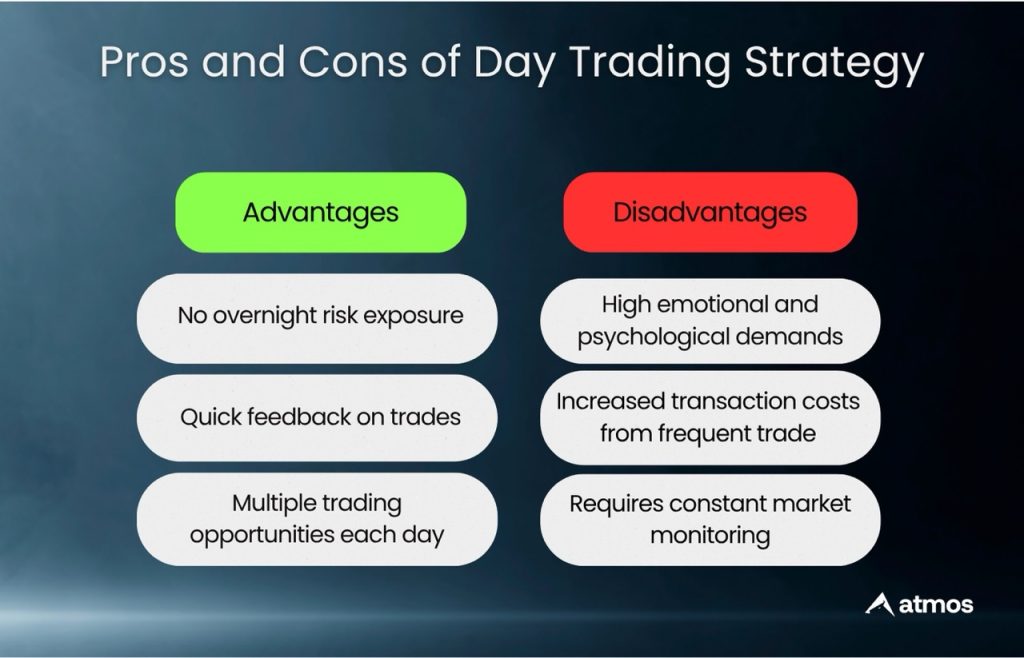
- No overnight risk exposure
- Quick feedback on trades, allowing rapid adjustment
- Multiple trading opportunities each day
Cons:
- High emotional and psychological demands
- Increased transaction costs from frequent trades
- Requires constant market monitoring
Atmos Funded supports day traders with clearly defined intraday risk limits, enabling traders to maintain discipline and avoid excessive losses.
Scalping Strategy
Scalping is a short-term trading strategy focused on making quick profits from small price changes in a market.
Traders who use this approach, known as scalpers, execute a high volume of trades throughout the day, holding positions for very brief periods, sometimes just seconds or minutes. The goal is to accumulate numerous small gains, rather than aiming for larger, less frequent profits.

Pros:
- Numerous trading opportunities every day
- Quick entry and exit reduce exposure to major market moves
- Rapid accumulation of small gains
Cons:
- Demanding, requiring constant screen attention
- Transaction costs can significantly impact profitability
- Small profit margins leave little room for error
Atmos Funded allows scalping as long as it does not exploit execution/latency, rather than normal scalping, which targets market edge. They offer clear daily drawdown limits that encourage tight risk control for rapid intraday trades.
Swing Trading
Swing trading is a short-term forex trading strategy where traders hold positions for multiple days, aiming to capture intermediate price moves between support and resistance levels. It sits between day trading, where positions are held for minutes or hours, and long-term investing, where positions are held for months or years.
Swing traders use technical analysis to identify potential entry and exit points, aiming to profit from price fluctuations within a trend.

Pros:
- Captures larger price movements compared to day trading or scalping
- Flexible time commitment, suitable for part-time traders
- Lower stress levels due to fewer daily trades
Cons:
- Exposure to overnight and weekend market gaps
- Requires patience and discipline to hold trades through short-term volatility
- Potential capital lock-in for multiple days
Atmos Funded supports swing traders effectively by allowing overnight positions, helping manage overnight market risks.
Carry Trade Strategy
A carry trade strategy involves borrowing money in a currency with a low interest rate and using it to invest in a currency with a higher interest rate, aiming to profit from the interest rate difference.
This strategy is most commonly used in foreign exchange (forex) markets, but can also be applied to other assets like bonds.

Pros:
- Generates steady interest income when market conditions are favorable
- Ideal in stable, risk-on environments with clear interest rate disparities
- Minimal screen time once positions are established
Cons:
- Vulnerable to shifts in market sentiment, especially in volatile or uncertain conditions
- Potential losses from adverse exchange rate movements can outweigh interest gains
- Requires a solid understanding of macroeconomic factors
At Atmos Funded, carry trade strategies for forex are permissible within guidelines, allowing traders to leverage macroeconomic trends effectively while managing risk through clear rules.
Breakout Strategy
A breakout strategy in trading involves identifying when an asset’s price moves beyond a defined support or resistance level, indicating a potential continuation of the price movement in that direction.

Traders using this strategy aim to capitalize on the momentum that often follows such breakouts.
Pros:
- Clear entry signals based on price action
- Opportunity to capture strong momentum moves early
- Suitable across multiple timeframes (intraday, swing, long-term)
Cons:
- Prone to false breakouts (“fakeouts”), which can trigger losses
- Requires quick decision-making and strong execution skills
- Demands disciplined stop-loss management to limit downside
Atmos Funded accommodates breakout strategies with clearly defined daily loss limits, enabling prop traders to minimize the impact of false breakouts and manage risk effectively.
News Trading
News trading in forex involves making trading decisions based on the release of economic news and data, aiming to profit from the resulting price movements.

It focuses on fundamental analysis and understanding how various events, like interest rate decisions or employment reports, impact currency values.
Pros:
- Quick, potentially significant profits due to market volatility
- Predictable trading opportunities around scheduled news events
- Minimal holding time, reducing exposure to long-term risk
Cons:
- High volatility can cause slippage and execution risks.
- Market reactions to news are unpredictable, increasing potential for losses.
- Requires fast decision-making and reliable real-time data
Atmos Funded restricts trades within two minutes of high-impact news on funded accounts, helping prop traders avoid excessive volatility and maintain consistent risk management.
How to Compare Forex Trading Strategies?
Comparing the best forex trading strategies 2025 involves evaluating several critical factors, including volatility, required time commitment, risk management, and market liquidity. Compare the top 10 forex strategies and see which fits your style.
Volatility
High-volatility strategies (news trading, breakout trading) offer quick profits but require careful risk management. Low-volatility methods (carry trades, range trading) provide steadier returns with fewer surprises.
Time at the Desk
Forex strategies like scalping and day trading demand extensive real-time market monitoring, while swing trading, position trading, and carry trades require less screen time and offer greater flexibility.
Risk Management
Forex strategies with frequent trading (scalping, news trading) need tighter stop-losses and rigorous risk management. Longer-term approaches (position trading, swing trading) allow wider stops but demand larger margin considerations.
Market Liquidity
Highly liquid currency pairs (EUR/USD, GBP/USD) suit short-term strategies, reducing transaction costs and slippage. Less liquid pairs or exotic currencies are better suited for longer-term, lower-frequency strategies due to wider spreads and higher execution costs.
Atmos Funded traders benefit from clearly defined risk parameters that help match their strategy choices with effective risk management practices, ensuring consistency and long-term profitability.
Which Forex Trading Strategy is Best for Fast Gains?
To find the best forex strategy for fast gains, traders must evaluate risk, volatility, time commitment, and execution speed:
- Market volatility: Higher volatility strategies (news, breakout, scalping) provide rapid profit opportunities but also increase risk.
- Time commitment: Rapid-gain strategies typically demand significant daily focus, limiting suitability for traders with limited availability.
- Risk tolerance: Fast-profit strategies usually involve higher risks, requiring disciplined stop-loss management and emotional control.
- Transaction costs: Frequent trading, common with scalping and news trading, can increase transaction costs substantially, affecting overall profitability.
Atmos Funded supports fast-paced forex strategies with clear and fully transparent rules, enabling traders to manage risks efficiently while pursuing quick returns. All while helping you identify the best strategy for forex trading for your profile.
Frequently Asked Questions (FAQs)
What Are the Most Popular Forex Trading Strategies for Prop Traders?
The most popular strategies among prop traders include trend trading, breakout trading, scalping, and swing trading, due to clear risk-reward setups and adaptability within structured trading rules like those at Atmos Funded.
How Do I Choose the Right Forex Strategy for My Trading Style?
The best forex strategies for 2026 are actually based on your personal traits (risk tolerance, patience), your available time (day trading requires constant attention, swing or position trading less so), and compatibility with your funded account rules and limits.
Are Trend-Following Strategies Better for Funded Accounts?
Trend-following strategies align well with funded accounts due to their clear risk management rules, defined entry/exit points, and suitability for capturing sustained market moves, matching well with prop firm rules.
Can Prop Traders Use Automated Strategies in Forex?
Yes, prop traders can often use automated trading (EAs, bots), provided they follow rules defined by the firm. Atmos Funded allows custom-built EAs, subject to risk guidelines and drawdown rules.
How Do Breakout and Mean Reversion Strategies Differ?
Breakout strategies trade in the direction of price movements beyond key levels, expecting continuation. Mean reversion strategies anticipate price moves back to historical averages after short-term deviations.
What Role Does Risk Management Play in These Strategies?
Risk management is crucial, controlling potential losses and ensuring long-term account survival. Atmos Funded encourages traders to know which Atmos account is best for their style, as different accounts are designed for different risk management tolerances as well.
How Often Should I Adapt or Change My Forex Strategy?
Adaptation depends on market conditions and performance. Regularly review your trading journal every few weeks or months, making incremental changes based on consistent evidence rather than impulsive decisions.
Is News Trading Effective for Prop Traders Using Leverage?
News trading can be effective but risky due to high volatility. Prop traders must manage leverage carefully, adhering to risk limits defined by funded programs like Atmos Funded.
Do Funded Trading Programs Favor Specific Strategy Types?
Generally, funded programs prefer strategies with clear risk management, disciplined execution, and consistent profitability. Trend-following, breakout, and swing trading strategies are typically favored due to clear rules and structured risk control.
How Can I Backtest a Forex Trading Strategy Before Going Live?
The best strategy in forex for 2026 should be effective with charts from a year ago. Backtest using historical data and platforms like MT4/MT5 or specialized software (TradingView, Forex Tester). Validate strategy effectiveness, refine risk management, and ensure consistent execution before applying it in a funded account scenario, such as Atmos Funded provides.
What are the common mistakes in applying Forex Trading Strategies?
Overfitting a system to past data, then forcing it in the wrong market. Oversizing, skipping stops, and trading outside your session rules. For funded traders, the big one is ignoring daily and overall limits.
How to test Forex Trading Strategies before going live?
Backtest across multiple charts with fixed rules and no curve-fitting. Then forward test on a demo for execution, slippage, and alerts. Go live small only when results match your tests and your plan fits Atmos Funded risk limits.
What historical data is crucial for Forex Trading Strategies?
To be specific, it depends on your strategy. But the rule of thumb is at least 6–12 months covering trends, ranges, and high-volatility events. Include session times, spreads, and major news days to see real drawdowns. The goal is to validate edge durability, not just best-case runs.
Can Forex Trading Strategies be profitable in volatile markets?
Absolutely. Most effective traders thrive in volatile markets due to their opportunity-giving nature. But for long-term consistency, be strict with your strategy. A volatile market will either make your checklist for entries more frequent or not. The key is to make your strategy volatile and dead market-proof.
How does volatility affect Forex trading?
Higher volatility expands ranges, slippage, and emotional pressure. It can boost opportunity but punishes late entries and oversized trades. This is why we recommend adjusting size, being strict with your strategy, and tightening your no-trade filters around news.