


You just closed your charts, heart still racing, wondering how the day went off the rails so fast. Maybe it was one bad trade, maybe a string of them; either way, your PnL is red and your confidence is shot. This isn’t about pretending it didn’t happen; it’s about slowing down, protecting your account, and figuring out how to recover from trading losses without digging a deeper hole.
To deal with trading losses, start by accepting that setbacks are normal and then apply a simple, repeatable process within your prop firm risk limits.
This guide keeps it practical, covering what to do after a loss, how to reset size and expectations, and how funded traders in a prop firm environment (including those with Atmos Funded) can protect their accounts while rebuilding confidence.
Key Takeaways
- Losses are part of the edge; cap damage first (risk per trade, daily stop) before chasing recovery.
- Managing psychological factors in day trading matters as much as entries, use a checklist to enforce strategy psychology and how to avoid emotional decisions in prop trading.
- Journal every loss (setup quality, execution, emotions) to separate bad strategy from bad luck and to spot fixable patterns.
- If you trade a funded account, follow firm drawdown rules and scaling paths; process consistency keeps access to capital.
- Stress tools aren’t optional. How do prop traders manage stress? With predefined cool-off breaks, session limits, and a written reset plan, core habits for day trading loss control.
- You don’t need to trade daily. If your A-setup doesn’t print, stay flat—discipline beats boredom trades.
What Are Losses In Trading?

Trading losses are a regular part of the markets. A losing trade simply means you closed a position for less than you opened it, so your account takes a hit. Recognising why losses happen helps you build better risk rules and improve results over time.
What Are The Main Types Of Trading Losses?
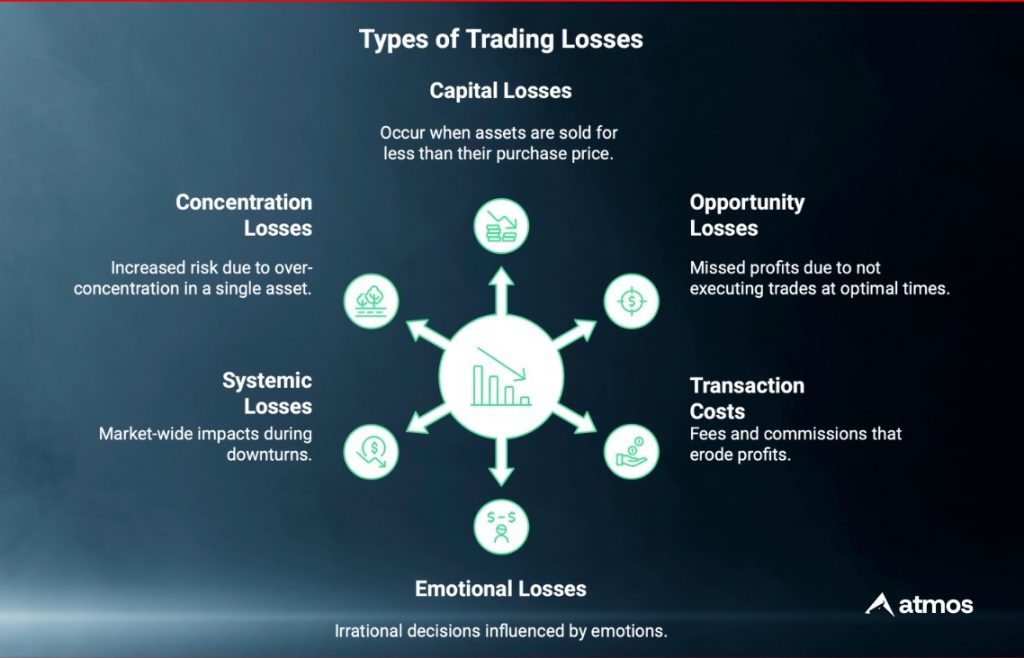
- Capital Losses: These occur when financial instruments or assets are sold for less than their purchase price, often due to market declines or mistimed trades.
- Opportunity Losses: This type arises when traders miss potential profits by not executing trades at optimal times, often influenced by risk aversion or insufficient information.
- Transaction Costs: Fees and commissions paid to brokers can erode profits, leading to net losses despite positive trade performance.
- Emotional Losses: Decisions influenced by emotions like fear or greed can lead to irrational trading choices, resulting in financial setbacks.
- Systemic Losses: These losses affect the overall market or economy during downturns, impacting all market participants simultaneously.
- Concentration Losses: When a trader’s portfolio is overly concentrated in a single asset or sector, the risk of losses increases significantly if that asset underperforms.
What Are the Common Reasons for Trading Losses ?
According to our observations, traders usually lose money for two reasons: the market (news, volatility, gaps) and the mind (fear, greed, overconfidence). Now we have listed the traps people most commonly fall for:
- Insufficient Risk Management: Failing to set stop-loss orders or manage position sizes can lead to larger-than-expected losses.
- Lack of a Trading Plan: Trading without a clear strategy can result in inconsistent decision-making and losses.
- Emotional Decision-Making: Allowing emotions to dictate trades can lead to poor choices and substantial financial losses.
- Inadequate Market Knowledge: Lack of understanding of market dynamics can cause inexperienced traders to make misguided decisions
- Overconfidence: Overestimating one’s abilities can lead to excessive risk-taking, which may amplify losses when trades turn unfavourable.
- Failure to Learn from Mistakes: Not analysing losing trades prevents traders from identifying areas for improvement, potentially resulting in repeated errors and accumulating losses.
- Recognising these factors not only aids in dealing with trading losses but also emphasises the importance of a disciplined approach in the trading process.
What Are The Best Coping Strategies To Recover From Trading Losses?

Losses happen. The job is to reset quickly, protect capital, and return to your plan, without letting emotions steer the next decision. Below is a clear, trade-ready playbook (not theory) you can run the same way every time.
Reset Before Any New Action (2–5 Minutes)
A fast emotional reset prevents the next click from being a revenge trade. Keep it simple and repeatable.
- Step away and breathe; don’t revenge trade.
- No charts/orders until you can see your setup actually playing out.
- Sip water, stretch, reset posture, tiny physiology shifts lower chances of tilting.
Rebuild Control With If/Then Rules
Pre-commitment creates automatic brakes when pressure spikes, especially useful on funded trading accounts.
- “If I’m down −2R, then I stop for the day.”
- “If spread > 2× normal, then no new risk.”
- Keep a buffer under firm limits so slippage can’t force a breach.
Narrow The Plays, Reduce Noise
Focus shrinks mistakes. Trade only where your edge is proven.
- One market, one setup, one trigger for the next 30–60 sessions.
- No-trade windows: high-impact news ±15 min, thin late session, abnormal spread.
- Place stops where the idea fails (structure break + small ATR buffer).
- No setup, no trade. A flat day is a good day when the playbook never showed.
Use A Micro Journal To Fix One Thing Fast
Journaling is for behavior change, not poetry. Keep it lightweight and daily.
- Log screenshot, why now, rules met/not met, emotion 0–10.
- Tag loss A/B/C (strategy/execution/emotional).
- Fix the highest-frequency tag next session, one change per week.
Size And Pace For Stability
Smaller size plus clear exits tamps down volatility in your P/L and head.
- Cut size by 50% for the next two sessions; A-setups only.
- Add a time stop, if price stalls two rotations, exit or half.
- No stop widening mid-trade, ever.
Intraday Guardrails (To Stop Day Trading Losses Early)
Rails cap damage before it snowballs; this is where most traders slip.
- Risk 0.25%–0.5% per trade; hard −2R daily stop.
- Avoid the first pullback after a parabolic move; wait for structure.
- Don’t stack correlated ideas (three USD-longs = one big bet).
Re-Entry After A Drawdown (Staged, Not Heroic)
Come back methodically so you don’t undo the recovery in one session.
- Require two rule-clean sessions (even if flat) before scaling.
- Restore size only after the plan is followed, start-to-finish, with no breaches.
- If a rule breaks, reset the count and stay at reduced size.
Learning how to recover from trading losses is a process, and those who have the discipline to improve each time will get the rewards.
Reset your state, let rules make decisions, trade only your A-setup at a smaller size, and change exactly one behaviour at a time. Atmos Funded offers unlimited days for you to pass a challenge, so there will always be time to wait for your setup.
Developing A Resilient Mindset
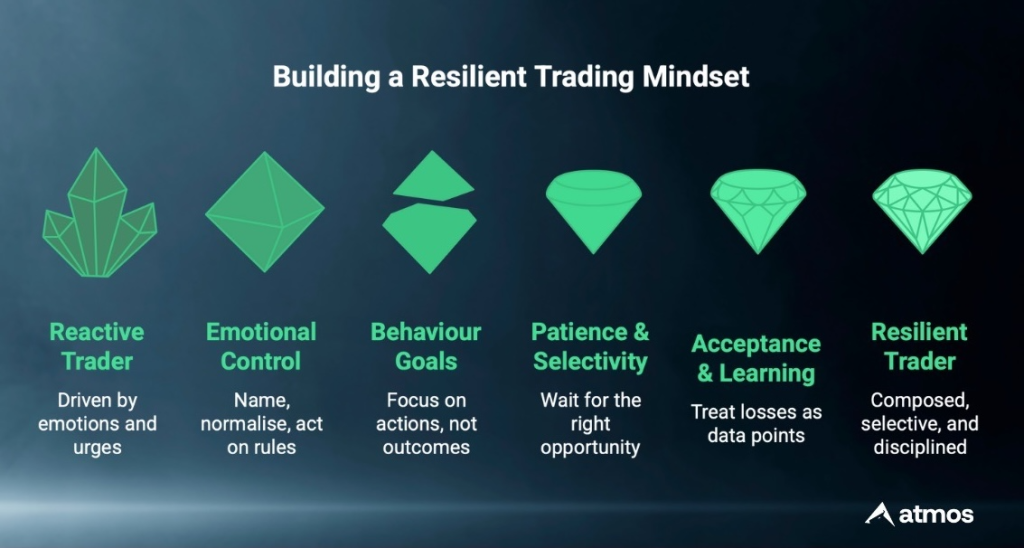
Managing psychological factors in day trading is one of the biggest skills that impact good and bad entries. This section reframes losses as data inside expected variance and shows how to act on rules instead of urges.
We’ll cover practical emotional tools (naming, urge-surfing), behaviour goals that outlast P/L swings, and the patience/selectivity that seasoned prop traders use to manage stress without derailing the process. This is the simplest path to trading loss recovery without overhauling your system.
Expectations & Growth
- Losses are tuition. Treat them as data points inside the expected variance.
- Swap outcome goals (“make $X”) for behaviour goals (“take two A-setups in London; no revenge trades”).
Emotional Stability Toolkit
- Name → normalise → act on rules. “I’m anxious (normal). My rule says no new trades after −2R.”
- Urge surfing: when you feel the impulse to “get it back,” set a 10-minute timer. Most urges pass if you don’t feed them.
Goal Setting & Habits that Stick
- Daily checklist (5 items max): session window, A-setup only, stop with entry, partial at 1.5R, journal before close.
- Weekly review: keep one thing, cut one thing, add one micro-rule.
Emotional Intelligence in Practice
- Overconfidence control: after a big win, reduce the size of the next trade; wins distort risk perception.
- Loss aversion guard: pre-write your exit reason; when it triggers, execute, don’t renegotiate.
Patience & Selectivity
- Bias for inaction until the picture is right. Timing and accuracy > frequency.
- Regime filter: trend days, ride pullbacks; range days, fade edges. Forcing the wrong play builds trading losses quickly.
Acceptance & Red Flags
- Normal loss: inside planned risk, rules followed. Log it and move on.
- Red flag: rule breach, revenge trading, or >−6R in a week. Action: mandatory pause, size cut, and review with a peer.
Treat losses as data, act on rules instead of urges, and anchor to behaviour goals; composure and selectivity are what keep the equity curve intact.
Resources For Traders
Short-term fixes help, but a durable recovery needs people, habits, and a simple toolkit. Here’s a compact stack you can put to work right away, no fluff, just things that move the needle.
- Mentorship & Peer Review: A weekly 30-minute review with a mentor or trusted peer surfaces execution leaks faster than solo grind. Bring charts, not vibes: three best, three worst, one change.
- Why it works: outside eyes cut blind spots; accountability turns “know” into “do.”
- Why it works: outside eyes cut blind spots; accountability turns “know” into “do.”
- Professional Support (when to escalate): If trading stress starts touching sleep, mood, or relationships, speak to a professional. A clear head is part of edge maintenance.
- Why it works: if you wouldn’t ignore a recurring hardware error, don’t ignore a recurring stress signal.
- Why it works: if you wouldn’t ignore a recurring hardware error, don’t ignore a recurring stress signal.
- Education, But Sequenced: Pick one book or course. Apply it for 30 sessions before adding the next. It will be interesting to see how depth beats information overload.
- Why it works: one new concept → one change in rules → measured in your journal.
- Why it works: one new concept → one change in rules → measured in your journal.
- Community With Standards: Join groups that review process, not share signals. Post your plan pre-session and results post-session.
- Why it works: accountability and shared checklists > hot takes and hindsight charts.
- Why it works: accountability and shared checklists > hot takes and hindsight charts.
- Trading Journal (lightweight, daily): Log four things: screenshot, why now, exact rules met, emotion 0–10. Tag errors as strategy, execution, or emotional.
- Why it works: patterns show up in a week, not a year; one fix per week compounds.
- Why it works: patterns show up in a week, not a year; one fix per week compounds.
- Decision Frameworks to Curb Emotion: Use if/then rules: “If I’m down −2R, I stop.” “If spread >2× normal, no new risk.” Pair with a 2–5 minute reset (breathe, name the feeling).
- Why it works: urges pass; rules make the next choice obvious.
- Why it works: urges pass; rules make the next choice obvious.
- Diversification & Risk Hygiene: One clean position often beats three correlated ones. Size from risk per trade, not confidence; stops where the idea fails.
- Why it works: lower correlation and fixed R reduce the emotional load of any single trade.
- Why it works: lower correlation and fixed R reduce the emotional load of any single trade.
- Bias Checks You Can Actually Run: After a win, cut next trade size (overconfidence). After a loss, pre-write the exit reason and follow it (loss aversion).
- Why it works: small frictions that prevent big mistakes.
- Why it works: small frictions that prevent big mistakes.
- Tooling & Dashboards: Keep it boring: real-time equity, drawdown room, MAE/MFE, and rule alerts. Exportable logs for weekly review.
- Why it works: see risk as it is, not as you feel it, then act on the plan, not the spike.
Wrapping Up on How to Recover From Trading Loss
Losses aren’t a verdict, they’re feedback. The traders who bounce back fastest run the same simple loop: reset emotions → enforce risk rails → take only A-setups → review and adjust one thing.
Quick recap you can run tomorrow:
- Reset protocol: 2–5 minute break, name the feeling, then act on pre-written if/then rules (e.g., “at −2R, I stop”).
- Risk architecture: fixed R per trade, daily/weekly brakes, correlation cap, stops where the idea fails (with a small ATR buffer).
- Narrow focus: one market, one setup, one trigger for 30–60 sessions; no trades during high-impact news ±15 minutes.
- Execution routine: stop with entry, partial at 1.0–1.5R, time stop if price stalls; no renegotiating exits mid-trade.
- Journal that changes behaviour: screenshot, why now, rules met, emotion 0–10; tag errors (strategy/execution/emotional), and fix the highest-frequency one first.
- Staged recovery: half size until you stack two process-perfect days; protect daily/overall limits like the account depends on it, because it does.
If you’re ready to put a rules-first plan to work on firm capital, start an evaluation with Atmos Funded. Trade on MT5, follow clear drawdown math, and keep your edge steady, standard 80/20 profit share with an optional 90/10 add-on when you want more upside. Choose your challenge, run your playbook, and let consistency do the compounding.
FAQs
1. What percentage of trading losses is considered normal for beginners?
Normal early on is losing 40–60% of trades, but the real story is progress. In the first 30–50 trades, judge yourself by rule compliance and drawdown control (keep DD within 5–10%; ≤1 rule breach per week), not by P/L.
Here’s a realistic path to profitability
- Weeks 1–4 (30–40 trades): Stabilise. Risk 0.25%–0.5% per trade, stop moving stops, and cut correlation. Aim for average loss = −1R, average win ≥ +1.2R.
- Weeks 5–12 (60–120 trades): Breakeven window. Win rate may still be 45–55%, but expectancy turns slightly positive as execution errors drop.
- Months 3–6 (100–200+ trades): Consistency. Positive expectancy (+0.2–0.4R per trade) with smaller variance; monthly P/L tilts green more often than not.
- Months 6–12: Durable edge. Same win rate, better average win (1.4–1.8R), fewer C-grade trades. This is where “profitable more months than not” becomes normal.
It’s not unreasonable to see consistent profitability after 150–300 trades (≈3–6 months) of rules-first execution. Even with a 45–50% win rate, you can be net positive if your average win is ≥1.5× your average loss and you keep daily/weekly breaks intact.
2. How much should I risk per trade to minimise the impact of trading losses?
Keep it 0.25%–1.0% of equity per trade; for funded accounts, many traders settle at 0.25%–0.5%.
Use a formula, not feel:
Position size (lots) = (Equity × risk%) ÷ (stop pips × pip value).
3. When should I take a break from trading after experiencing losses?
If you hit your daily stop (e.g., −2R) or break a rule, step away for the rest of the session. After a 5R week or multiple rule breaches, pause for 1–3 days, review your journal, and resume at half size.
4. How do I know if my trading losses are due to a bad strategy or just bad luck?
Analyse a 30–50 trade sample of rule-compliant A-setups. If expectancy (Avg Win × Win% − Avg Loss × Loss%) is negative and your market filter is on, it’s likely a strategy issue; if expectancy is positive but results lag, it’s execution or emotions.
5. Should I try to recover losses quickly by increasing my position sizes?
No. “Getting it back” with a bigger size is how small drawdowns become large ones. Use a staged recovery: cut size by 50%, take only A-setups, and require two process-perfect sessions before scaling.
6. How can I tell if I’m emotionally ready to trade again after significant losses?
You can follow your if/then rules in a simulator, watch a move without chasing, and your journal reads objective (not venting). Sleep is normal, and you’re comfortable passing on marginal setups.
7. What’s the difference between a normal trading loss and a red flag that I should stop trading?
A normal loss stays within planned risk and follows your rules. Red flags: moving stops, revenge trades, adding to losers, or hitting > −6R in a week, those trigger an immediate pause and a plan review.
8. How long does it typically take to recover from major trading losses?
It depends on risk and edge. Rough guide:
Trades to recover ≈ Drawdown% ÷ (risk% per trade × expectancy in R).
Example: a 10% drawdown with 0.5% risk and 0.3R expectancy ≈ 10 ÷ (0.5 × 0.3) = ~67 trades, often weeks to months, not days.
9. Can I claim trading losses on my taxes?
You generally can’t claim the firm’s trading losses as your own. Here at Atmos Funded, we follow prop firm rules; the positions and P/L belong to the firm; your drawdowns or a breached account are not personal capital losses and don’t flow to your tax return.
10. What’s the most important lesson to learn from trading losses?
Treat losses as data, not identity. Protect downside with fixed risk, enforce rules in real time, and make one measurable improvement per week; that’s how consistency compounds.
11. Do I have to trade every day to make progress?
No. Progress comes from rule-clean sessions, not trade count. If your setup never appears, staying flat is a win; it preserves capital and confidence. Atmos Funded offers unlimited days for you to pass a challenge, so there will always be time to wait for your setup.
12. How to minimize losses in intraday trading?
Keep risk 0.25%–0.5% per trade with a hard −2R daily stop, avoid high-impact news ±15 minutes, place stops where the idea fails (ATR-buffered), and use a time stop when price stalls. One session, one setup, one trigger, this trims noise and cuts day trading losses before they snowball.