

Want a shot at trading real capital without putting your savings on the line? Prop firm challenges are the audition; your chance to prove you can follow rules, manage risk, and grow an account under pressure.
In plain terms, a challenge is a structured tryout. You trade a virtual account under clear parameters (profit targets, drawdown, daily loss), and your job is to show steady, rule-based execution. It’s hands-on, realistic, and—when done right—your bridge to a funded account.
You can trade familiar markets, like forex, indices, commodities, and more. If you pass a challenge, the prop firm (and its partner broker) walks you through the next steps toward managing real capital.
The virtual capital piece matters. It lets you practice in live conditions without risking personal funds, build confidence, and tighten your process. For traders aiming to transition to live funded accounts, this format helps you refine your edge and manage risk before it truly counts.
So what does that look like in practice? Here’s what a prop firm challenge really is.
What is a Prop Firm Challenge?
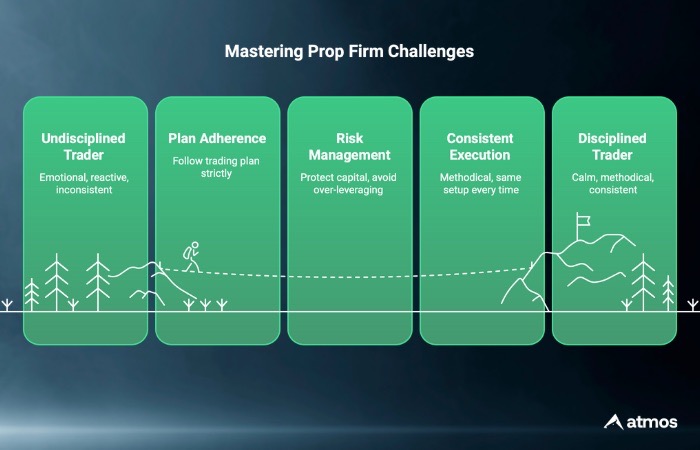
Think of a prop firm challenge as a live tryout. You get a virtual account, clear rules (profit target, max drawdown, daily loss), and a set window to show you can trade with discipline. Your mission isn’t “hit a home run”; it’s to prove you can follow a plan, protect capital, and grow the account steadily. Do that, and you’re on the path to managing firm capital.
Under the hood, it’s simple: you trade real markets with simulated funds, stick to the risk limits, and document consistent execution. The outcome firms look for is a calm, rules-first approach that would survive beyond the challenge — not one big lucky trade. Platforms like Atmos Funded make these parameters explicit so there’s no guesswork about what “passing” looks like.
The most impactful factor: emotional discipline
- Handle pressure: make decisions from your plan, not from fear or FOMO.
- Avoid revenge trading: one loss doesn’t justify the next trade.
- Size with intent: no over-leveraging to “catch up” to targets.
- Execute methodically: same setup, same entry/exit rules, every time.
Traders who keep a cool head and follow their checklist tend to pass more often. The skill isn’t just spotting setups — it’s staying consistent when the market speeds up, slows down, or fakes a breakout.
Different Types of Prop Firm Challenges
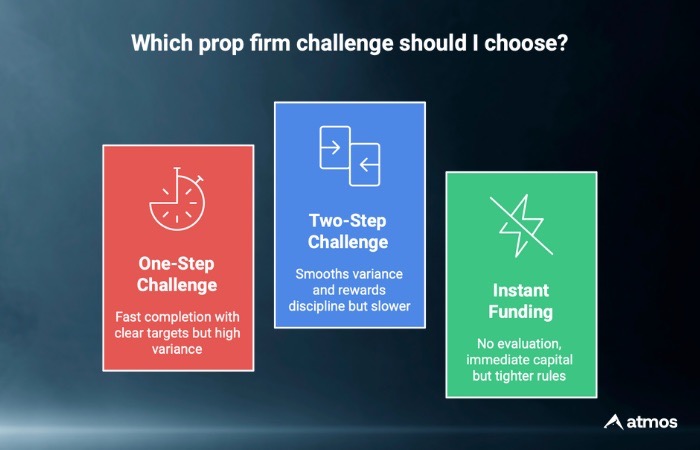
Prop firm challenges come in different shapes for different trading styles. Instead of guessing, match the evaluation to how you actually trade. Here’s a simple, up-to-date breakdown of Atmos Funded’s programs so you can pick the lane that fits your goals and risk tolerance.
-
One-Step (Single-Phase)
One evaluation with a clear profit target and strict risk limits (daily and overall). Fast to complete, but the single phase concentrates variance: size and pacing matter.
-
Two-Step (Two-Phase)
A classic two-phase prop firm goes like this: Phase 1 focuses on hitting a target; Phase 2 proves consistency and risk control with a smaller target. Slower than one-step, but the structure smooths variance and rewards discipline.
-
Instant/Direct Funding
No evaluation stage; you trade funded capital from day one under tighter drawdown rules and usually smaller initial allocations. Great for experienced, low-variance traders.
Atmos Funded challenge types
- 1-Step Standard: One straightforward evaluation with a 10% target, 3% max daily loss, and 6% trailing max loss that locks at your initial balance (and after payouts). Payouts every 14 days; up to $400k allocation. Leverage up to 1:50 FX (metals/indices/crypto vary).
- 1-Step Plus: Easier 6% target, no daily loss rule listed (still manage risk!), 3% trailing max loss that resets on payout, and quick payouts every 14 days. Up to $400k; same leverage profile.
- 2-Step Standard: Classic two-phase evaluation with 10% → 5% targets, 5% max daily loss, and 10% static max loss. Payouts every 14 days; up to $400k.
- 2-Step Plus: Two phases with 6% → 6% targets and 3% daily limit; 6% static max loss; first payout on demand after funding. Up to $400k.
- Instant Funding: No evaluation. Trade funded capital from day one with on-demand payouts, 3% daily, and 5% trailing max loss that locks at initial balance (and after payouts). Max allocation $200k.
Quick Picks
- Want one-and-done, classic feel? 1-Step Standard.
- Want a lighter target and faster payouts? 1-Step Plus.
- Prefer traditional two-phase with static drawdown? 2-Step Standard.
- Want first profits early after funding? 2-Step Plus.
- Need to trade funded capital immediately? Instant Funding.
How to Join a Prop Trading Challenge?
Joining a funded account challenge is relatively straightforward. Here’s the process broken down into simple steps:
- Sign up for an account with a prop trading firm such as Atmos Funded.
- Explore the available challenges and choose the one that aligns with your trading goals and style.
- Register for the challenge and complete the payment of the required entry fee.
- Once registered, the trader can begin the evaluation process under the guidelines defined by the prop firm.
Once you register, you start the evaluation process set by the prop firm. Most firms give you a fixed window, often about 90 days, to hit targets while staying within the rules.
Meet the profit goal, respect daily loss and total drawdown, and follow any extra conditions, and you can move forward toward funding. If you miss the rules or the deadline, your challenge account closes, and you’ll need to sign up again.
What are the Evaluation Criteria in Prop Firm Challenges?
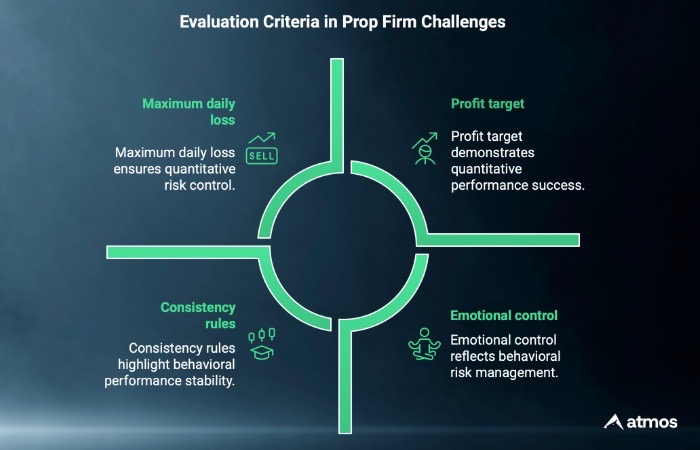
Prop firms use clear, simple rules to judge if you can trade well under pressure. The goal isn’t just making money once—it’s showing you can follow a plan, manage risk, and stay consistent.
Core Performance Metrics
- Profit target: The % gain you must reach to pass. It proves your strategy can actually produce returns.
- Maximum daily loss: The most you can lose in one day. This protects the account when a session goes wrong.
- Total (overall) drawdown: The largest allowed drop from your peak or starting equity. It keeps long slides under control.
- Minimum trading days: A small required number of active days. This encourages consistency over one lucky trade.
- Consistency rules: Some firms ask for balanced results (no single outsized day) to show stable execution rather than gambling.
Risk Management and Behavior
- Position sizing: Lot size must match account rules and stop distance, not “feel.”
- Leverage discipline: Avoid oversized trades; firms watch for excessive exposure.
- Daily loss limits: Stop when you hit your cap.
- Emotional control: No revenge trading after a loss; no overtrading in chop. Firms care about your process as much as your P/L.
How Firms evaluate you
- Can you hit the profit target without breaking risk limits?
- Do you follow rules every day (session timing, news restrictions if any)?
- Is your equity curve reasonable—small pullbacks, no wild swings?
- Do you journal and adjust (even basic notes) so mistakes don’t repeat?
Common Metric Examples (and Why They Matter)
- Profit goal: e.g., 8%–10%. Shows edge exists.
- Max daily loss: e.g., 3%–5%. Prevents blowups from one bad session.
- Overall drawdown: e.g., 6% trailing or 10% fixed. Keeps long-run risk contained.
- Minimum days: e.g., 5–10 days. Proves repeatability, not luck.
How Atmos Funded sets criteria
1-Step Standard Challenge
- Structure: 1 phase; profit target: 10%.
- Risk limits: Max daily loss: 3%; max total loss: 6% trailing (locks at initial balance and after payouts).
1-Step Plus Challenge
- Structure: 1 phase; profit target: 6%.
- Risk limits: Max daily loss: none; max total loss: 3% trailing (locks at initial balance, resets on payout).
2-Step Standard Challenge
- Structure: 2 phases; profit targets: 10% → 5%.
- Risk limits: Max daily loss: 5%; max total loss: 10% static.
2-Step Plus Challenge
- Structure: 2 phases; profit targets: 6% → 6%.
- Risk limits: Max daily loss: 3%; max total loss: 6% static.
A good challenge isn’t about a single big day; it’s about steady decisions under clear rules. If you respect risk, stay consistent, and keep your emotions in check, funding becomes a result, not a surprise.
What Are the Benefits of Participating in a Prop Firm Challenge?
You can join more than one challenge, and each one can have a different account size and rule set. In most 2-Step challenges (or 1-Step Prop Firm Challenges), you complete Step 1 and Step 2 on separate phase accounts (new credentials), but always check the firm’s process, some keep the same login while changing account parameters.
Atmos Funded offers competitive leverage inside a clear risk framework, so you can aim for growth without ignoring drawdown rules. Profit share depends on the specific challenge you choose, and the split is stated up front, so there are no surprises.
If you want to know more, see: Best Atmos Challenges
To keep the playing field fair, most firms include some restrictions. These are common:
- Limits on leverage, daily loss, and overall drawdown
- No latency or platform exploitation
- Possible rules around news trading, HFT, or arbitrage
Always check the challenge terms and conditions. The rules should be easy to find and written clearly, so you know exactly how to trade within them.
What Are the Common Pitfalls in Prop Trading Competitions?
Most failures come from behavior, not edge. Here are the big ones and how to avoid them:
-
Ignoring Risk Limits
Going past daily loss or overall drawdown ends the challenge. Fix: pre-set a daily max R (for example, −2R) and stop when you hit it.
-
Chasing After a Loss (Revenge Trading)
Emotions take over, size creeps up, rules go out the window. Fix: two-strike rule: after two losers, take a reset (walk, timer, journal).
-
Over-sizing to “Hit the Target Faster”
It works until it doesn’t. One move wipes the account. Fix: keep risk per trade steady (0.25%–0.75% common for challenges).
-
Inconsistency
One huge win plus many random trades looks bad in reviews. Fix: one setup, one market, same session. Build a repeatable profile.
-
Trading During Restricted News or Thin Liquidity
Spreads widen, slippage hurts, and rules may forbid it. Fix: trade only your approved windows; stand aside when rules say so.
-
Strategy Hopping Mid-Challenge
Hard to show consistency if you change plans every week. Fix: lock a playbook for the full phase; review after, not during.
Atmos looks for rule-following and risk control as much as profit. Calm execution and a clear process tend to pass more often than flashy P/L.
Free vs. Paid Prop Firm Challenges: Pros and Cons
Choose the path that fits your goals, budget, and timeline.
Free Challenges
| Free Challenges Pros | Free Challenges Cons |
| Low risk to try the rules and platform; good for practice and process building. | Limited features, smaller size, slower path to real funding. |
| Often more lenient on pace so you can learn without pressure. | Some “free” options are leaderboards or trials with no payout. |
Paid Challenges
| Paid Challenges Pros | Paid Challenges Cons |
| Clear funding path, better resources, and faster review cycles. | Upfront fee and stricter enforcement; failing means re-entry costs. |
| More serious commitment tends to improve focus and discipline. | Pressure can rise—have a plan to manage emotions. |
Atmos Funded offers structured one-phase and two-phase options with clear rules, support, and realistic risk limits. If you’re new or testing a strategy, a lower-cost or trial path helps you learn.
If you’re ready, choose a paid challenge that matches your style and time window, then stick to the rulebook.
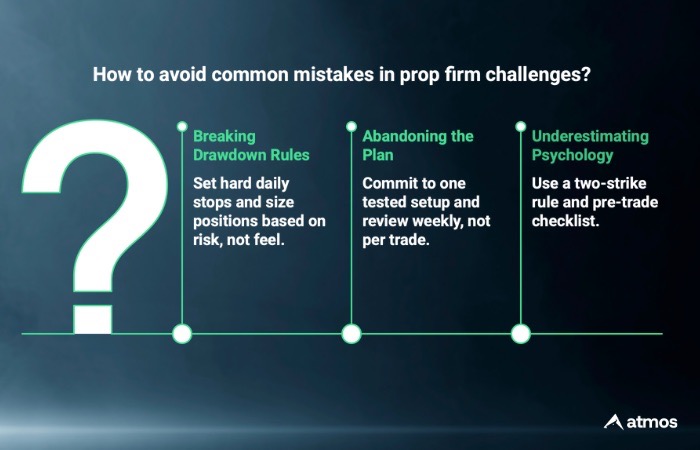
What are the Top 3 Mistakes Traders Make in Prop Firm Challenges?
-
Breaking Drawdown Rules
Many traders focus on the profit target and forget the daily loss cap or total drawdown. One big slip can end the challenge.
Fix: set a hard daily stop (for example, −2R). If you hit it, stop trading for the day. Size every position from risk per trade and stop distance, not from “feel.”
-
Abandoning the Plan
After a few losses, traders switch setups, timeframes, and even markets. This resets learning and adds randomness.
Fix: commit to one tested setup for the whole challenge. Track it the same way each session (entry, stop, target). Review weekly: adjust once, not every trade.
-
Underestimating Psychology
Revenge trades, FOMO, and overconfidence after a win streak are common. Emotions push size up and discipline down.
Fix: use a two-strike rule (two losses in a row → 20-minute break). Pre-trade checklist: session, setup quality, stop, size, and news window. No checklist, no trade.
Atmos Funded publishes clear rules on daily loss, overall limits, and news windows. Following those guardrails makes these mistakes less likely and keeps the account eligible for funding.
How to Choose the Right Prop Firm Challenge for You
Choosing the right challenge is about fit, not hype: match your trading style, risk tolerance, and cash-flow needs to a rule set you can execute every day. Start by deciding whether you thrive with a single-phase pace, prefer the structure of two steps, or need instant capital with tighter limits.
Start with Your Trading Style
- Intraday scalper: Trade often, smaller targets, tighter stops. You need lighter daily limits and clear news rules.
- Swing trader: Fewer trades, wider stops, hold overnight. You need a reasonable overall drawdown and static rules.
- Hybrid or session-based: Trade London/NY only with a defined playbook. You need simple guardrails and predictable payout timing.
Match Rules to Your Risk
- Daily drawdown: If you stack entries, favor a 5% daily cap (or no daily cap) over 3%.
- Overall drawdown: Pick static if you hold swings. Pick trailing if you prefer to lock gains and keep risk narrow.
- Consistency rules: If your P/L is lumpy, avoid strict “profit per day” caps.
Pick Payout Cadence and Platform
- Payouts: Need quick cash flow? Choose on-demand or weekly. Comfortable batching? Biweekly is fine.
- Platform and symbols: Confirm MT5/MT4 access, spreads, and the exact instruments you trade (forex, metals, indices, crypto).
Choose Size and Fee with Math
- Start smaller than your peak drawdown: Pick the smallest tier that keeps your normal risk inside the daily/overall caps.
- Compare fee-to-size value: A slightly higher fee can be a better value if rules fit your edge (e.g., static overall vs tight trailing).
- Know refunds: Instant tracks are usually non-refundable; 1- or 2-step may be refunded on the first payout.
Which Atmos Challenge is Right for You?
- Choose 1-Step Standard if you want a straightforward single evaluation with payout-lock protection.
- Choose 1-Step Plus if you want faster payouts and a lighter 6% target with a lower entry.
- Choose the 2-Step Standard if you prefer the classic prop firm model with static drawdown.
- Choose 2-Step Plus if you want a first payout on demand with low entry risk.
- Choose Instant Funding if you want to skip evaluations and start trading funded capital from day one.
Choose the track whose rules protect your downside and let your edge play out. Base your decision on your own trading style, strategy, and trader psychology. Average strategies could be more effective if paired with the right path.
Wrapping Up on Prop Firm Challenges
Proprietary trading firms like Atmos Funded provide traders with advanced tools to help them succeed during the evaluation process. These tools include real-time market data, performance tracking, and risk management software, all of which are essential for strategies like forex scalping.
With these technologies, traders can easily track their performance, execute strategies quickly, and follow the firm’s guidelines. By making the most of these tools, traders can improve their chances of passing the challenge and securing funding.
In addition to the tools mentioned, technology is key to improving trade execution and reducing latency. High-speed platforms allow traders to place trades faster and more accurately, which is crucial for successful forex algorithmic trading.
Automated trade tracking and reporting systems also help traders stay within the firm’s set limits by providing instant feedback on key metrics like daily drawdown, open risk, and profit targets. With real-time monitoring, traders can quickly adjust their strategies to stay compliant and improve their performance.
Prop firm challenges not only let you showcase your trading skills but also offer a route to real capital. If you have questions about a specific challenge, a prop trading firm like Atmos Funded offers multilingual support at different times, so you can get the help you need while working through your trading challenge.
If you want to learn more about the challenges we offer, you can also visit our website at https://atmosfunded.com/ or contact us at [email protected].
FAQs
How can I buy prop trading challenges?
Choose a prop firm, compare challenge types (one-phase, two-phase, instant funding), and purchase directly on their site. At Atmos Funded, you pick the account size, review the rules, and checkout: your login and challenge details arrive right after payment.
How do I join a prop firm trading challenge?
Create an account with the firm, select the challenge that fits your style, and complete payment. Read the rules carefully (daily loss, overall drawdown, time limits), then log in to the platform and start trading within the guidelines.
How to qualify for a prop firm challenge?
Most firms don’t require experience; anyone can enter. What matters is passing: hit the profit target, respect daily and overall drawdown, follow news/session rules, and meet any minimum trading days. Atmos Funded outlines all the criteria on the challenge page.
Is it possible to trade without challenges?
Yes. Your own brokerage account doesn’t require a challenge, like a Taurex account. The trade-off: you fund the account yourself and absorb all risk. Challenges exist to prove consistency so you can access firm-backed capital and profit splits.
Are there any free prop firm challenges available?
Some firms offer free trials or demo contests with limited features. They’re useful for practice but usually don’t lead to funding. Atmos Funded focuses on paid evaluations with clear rules and a direct path to a funded account.
How can AI trading tools assist in successfully completing a prop firm challenge?
Use AI to speed up research, create checklists, and review journals for errors and patterns. Keep execution simple: your plan should decide entries, stops, and size; AI should support discipline, not replace it.
What are the typical mistakes traders make during prop firm challenges?
Breaking daily loss limits, changing prop trading strategies mid-challenge, and revenge trading after losses. Prevent them with fixed risk per trade, a pre-trade checklist, and a two-loss cooldown rule.
What is the time limit for completing a prop firm challenge?
Atmos Funded has no time limit for all challenges. This way, you can wait for your setup indefinitely; most effective traders prefer this. But for most prop firms, it is commonly 30 to 90 days per phase. Always check the specific timer and minimum trading days.
Is it possible to withdraw profits from multiple challenges at the same time?
Once funded, many firms allow payouts from each funded account per their schedule and rules. Check the payout frequency, minimums, and any scaling requirements. Be sure to check with Atmos Funded since payout on demand is also offered, but on specific accounts only.