


Every successful trader, whether in stocks, forex, commodities, or cryptocurrencies, knows that profitable trading isn’t about luck—it’s about strategy. A well-thought-out trading strategy provides the roadmap to navigate the unpredictable nature of financial markets. Without a strategy, trading becomes little more than gambling, with decisions based on emotions rather than logic or data.
In this guide, we’ll walk you through how to build a profitable trading strategy from the ground up, highlighting the key steps to turn your ideas into a structured, actionable plan. Whether you’re new to trading or looking to refine your approach, this step-by-step guide will help you stay focused, disciplined, and consistently profitable.
Key Takeaways
- Profitability comes from risk discipline, consistency, and adaptability, not a 100% win rate.
- Simple beats complex: one setup, one market, and tight risk rules often outperform a crowded chart.
- Backtesting, demo, then live, each step reduces guesswork and tightens execution.
- Position size flows from risk per trade and stop distance; never the other way around.
- Funded traders must show process consistency; accounts are kept by following rules as much as by P/L. Atmos Funded emphasizes discipline, drawdown control, and steady execution over flashy wins.
What Makes a Trading Strategy Profitable?
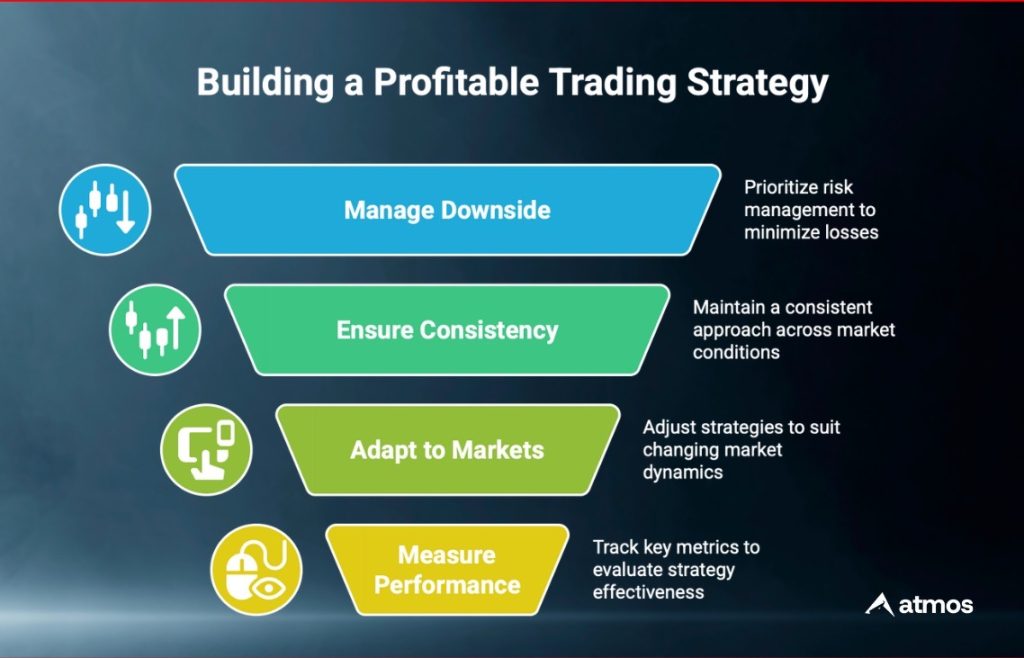
Before you pick indicators or patterns, define what “profitable” means in practice: small losses, scalable wins, and rules you can actually follow. The points below distill those characteristics so you can stress-test your own approach against them.
- It manages downside first. Great systems assume losses happen and keep them small. A favorable risk/reward ensures that a few winners pay for several small losers.
- It is consistent. Same market conditions, same setup, same entry/exit logic. Consistency turns randomness into measurable statistics.
- It adapts. Markets rotate between trend and range. Profitable strategies either work across regimes or have a clear switch (e.g., trend filter turns the system off during chop).
- It is measurable. You can answer: What’s the win rate? Average R multiple? Worst drawdown? Time-of-day effects?
- At Atmos Funded, we advise this: to keep a funded account, traders must show rule-following and risk respect day after day. Profitability is the outcome of discipline; the goal for your account is to stay funded, not just getting funded.
If any item above feels hard to prove with data, that’s your next improvement ticket. Profit tends to follow when each box is measurable, repeatable, and enforced in real time.
Types of Forex Trading Strategies
Not every style fits every trader, or every prop rule set. Use this quick map to align your time, temperament, and risk limits with a strategy you can execute consistently.
| Strategy type | Time in trade | Strengths | Trade-offs | Best fit |
| Scalping | Seconds–minutes | Many opportunities; fast feedback | High execution demands; higher costs via spread | Traders with quick decisions and stable connectivity |
| Day trading | Minutes–hours | Daily closure reduces gap risk | Requires screen time and energy | Structured routines; session-focused traders |
| Swing trading | Days–weeks | Fewer trades; cleaner signals | Overnight risk; patience required | Those with day jobs or calmer pace |
| Position trading | Weeks–months | Macro alignment; lower noise | Long capital tie-up; wider stops | Macro-oriented, patient traders |
Match style to rules. If your firm’s daily drawdown is tight, very short-term high-frequency tactics can conflict with limits. Strategies with fewer, higher-quality trades often align better with funded-account constraints and review cycles (e.g., Atmos Funded performance checks).
At Atmos Funded, we tell our traders to choose one lane and commit for 30–60 sessions before you judge results. Consistency of style reduces variance and keeps you inside firm drawdown limits.
4 Most Profitable Forex Trading Strategies
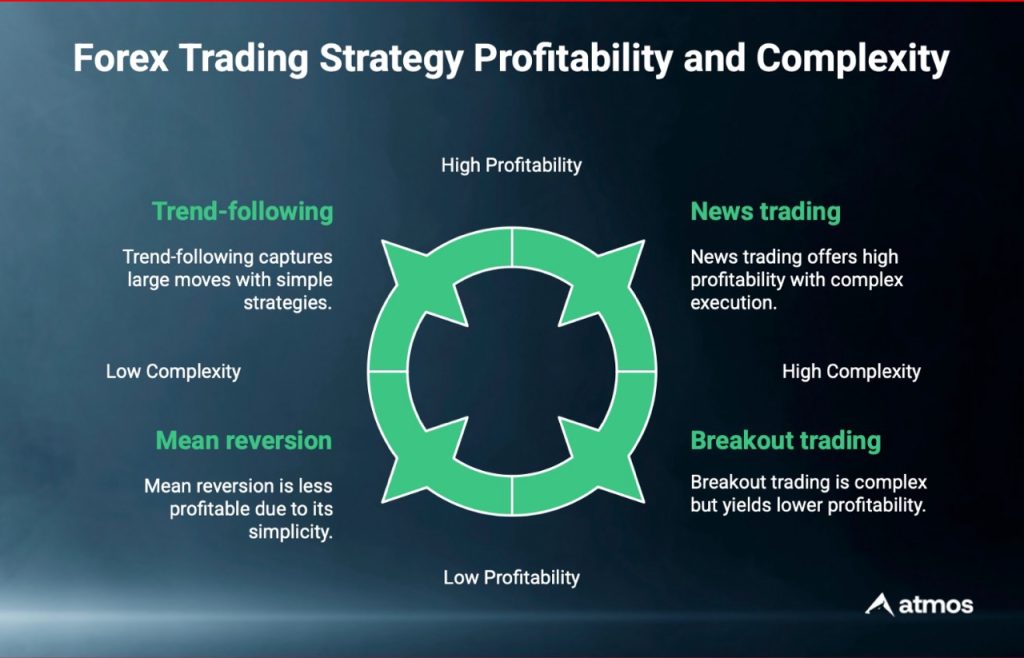
These four archetypes recur across markets and timeframes; the edge comes from execution, not complexity. Skim the summaries, then pick one playbook to test end-to-end.
1) Trend-following
Ride the dominant direction where the large R-multiples live; your edge is letting the trend do the heavy lifting. Identify higher-timeframe bias, then take low-risk pullbacks during liquid sessions.
- Why it can be profitable: Captures the largest directional moves where most of the R-multiples live.
- How it works: Use a simple trend filter (e.g., price above a rising moving average; higher highs/higher lows). Enter pullbacks; ride until structure breaks.
- Example setup: Pullback to a prior swing + momentum candle in trend direction; stop below the swing; partials at 1.5R and trail under higher lows.
- Risk note: Fewer trades, larger targets; keep position sizing small enough to survive inevitable consolidations.
2) Breakout trading
Compression stores energy; when price clears a well-defined boundary, momentum often carries it further than expected. Trade the break-and-retest (or a strong close beyond), not the first tick through.
- Why it can be profitable: Volatility expansion from compression often travels far quickly.
- How it works: Define a range (session box, prior day high/low). Enter on a confirmed break and retest, or on a momentum close beyond the level.
- Example setup: London session range breaks; enter on retest rejection; stop inside the box; measured-move target equals box height.
- Risk note: False breaks happen; require session liquidity and a retest or momentum follow-through.
3) Mean reversion
Ranges pull price back toward value after emotional extensions. Fade exhausted moves at the edges with strict filters, and stand aside on clear trend days.
- Why it can be profitable: Markets frequently revert to a value area after extensions.
- How it works: Fade extremes into a well-defined band or prior value; exit at the midline/mean.
- Example setup: Price spikes beyond a volatility band and prints a rejection; stop beyond the extreme; target at the mean.
- Risk note: Trending days punish fades, use a trend filter to disable the system during strong one-way sessions.
4) News trading
Catalysts reprice markets fast, but the clean opportunity is often the first structure after the spike. Pre-plan scenarios with small size, or wait for the post-news consolidation and break.
- Why it can be profitable: Catalyst-driven repricing creates fast moves.
- How it works: Trade planned events with predefined scenarios and strict risk; or stand aside during the release and trade the first clean post-news structure.
- Example setup: After a high-impact release, wait for the first consolidation and break in the new direction; stop inside the consolidation; target 1–2× the initial impulse.
- Risk note: Slippage and widening spreads; size conservatively and respect firm rules around news exposure to avoid avoidable drawdowns (especially for funded accounts like Atmos Funded).
Whichever you pick, keep size modest and logs meticulous. It will be interesting to see how a single, well-defined setup outperforms a rotating mix of half-tested ideas.
Features of the most profitable trading strategy
The best strategies look boring on paper because every decision is pre-decided. Use the checklist below to pressure-test whether your plan is truly trade-ready.
- Clarity. A one-page ruleset that anyone could follow.
- Specific entries/exits. Named patterns or objective triggers; no “vibes.”
- Stops first. Every trade has a pre-placed stop where the idea is wrong.
- Sizing formula. Position size = account risk per trade ÷ (stop distance × pip value).
- Adaptability. A trend/range filter or a volatility switch.
- Backtesting + forward testing. Validate, then rehearse live mechanics.
- Journaling + review. Screenshots, notes, and metrics lead to iteration.
- Professional conduct. Funded programs (e.g., Atmos Funded) value rule-following, consistency, and controlled drawdown as much as raw profit.
If you can’t check these boxes now, simplify until you can. On the other hand, adding more rules rarely helps; enforcing fewer, clearer ones usually does.
8 Steps to Build a Profitable Trading Strategy
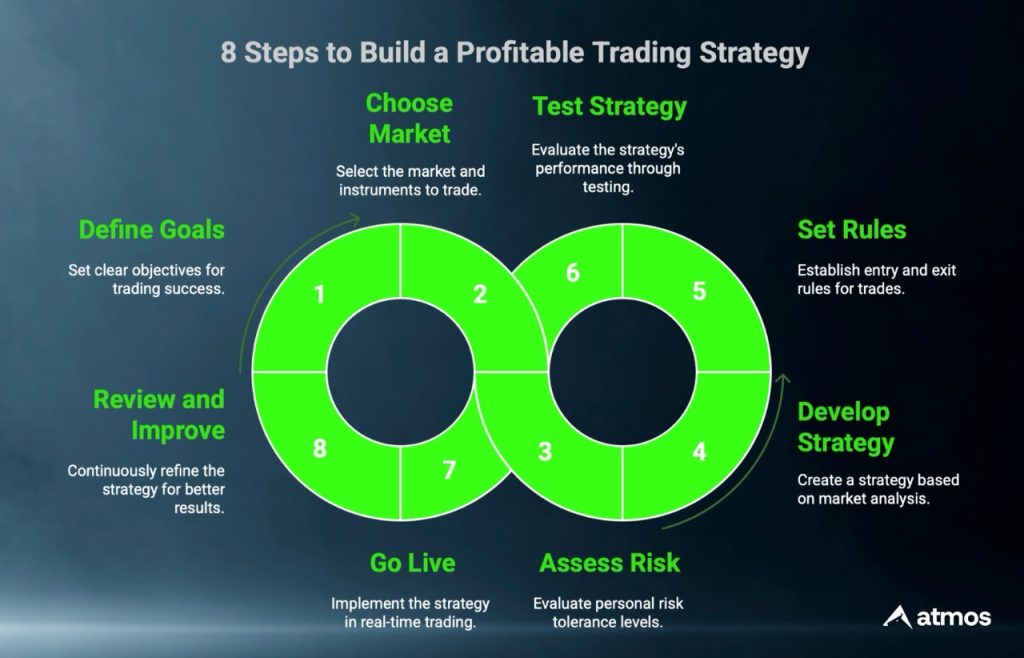
Define Your Trading Goals:
The first step in creating a profitable trading strategy is to clarify your goals. Your goals will determine your trading style, time horizon, and risk tolerance. Ask yourself the following questions:
- What are you trying to achieve with trading? (e.g., supplemental income, full-time trading, wealth accumulation)
- How much capital are you starting with, and how much are you willing to risk?
- What is your desired return on investment (ROI)?
- How much time can you realistically dedicate to trading each day or week?
For example, if you’re aiming for short-term profits, you might gravitate toward day trading or scalping, which involves making many trades in a single day. Alternatively, if you’re more focused on long-term wealth building, swing trading or position trading might be better suited to your goals, as these involve holding positions for days, weeks, or even months.
Your trading goals will influence every other aspect of your strategy, so it’s critical to be clear about them from the outset.
Choose Your Market and Trading Instrument:
The next step is to choose your market and the assets you will trade. Different markets have different characteristics, and your choice will depend on your interests, expertise, and risk tolerance. Here are some popular options:
- Forex (Foreign Exchange): Trading currency pairs. Known for high liquidity and leverage but can be volatile.
- Commodities: Trading physical goods like gold, oil, or agricultural products. Can be useful for diversification.
- Indices: Trading market indices like the S&P 500 or FTSE 100. A good option for those who want exposure to broader market movements rather than individual stocks.
Each market has its own dynamics, trading hours, and liquidity profiles. For example, forex markets operate 24 hours a day, while stock exchanges have set hours. Knowing the market’s behaviour will help you time your trades and choose the right strategy.
Understand Your Risk Tolerance:
A profitable trading strategy isn’t just about maximizing gains—it’s about managing risk. Before you start trading, it’s important to assess your personal risk tolerance. Some traders can handle high levels of risk for higher returns, while others may prefer safer, more conservative strategies. Consider:
- Capital at Risk: How much are you willing to lose on a single trade? Most experts suggest risking no more than 1-2% of your total trading capital on any given trade.
- Risk-to-Reward Ratio: A good rule of thumb is to ensure that for every $1 you risk, you aim to make at least $2 or $3 in profit. This is known as the risk-to-reward ratio, and a profitable strategy should aim for a ratio of at least 1:2.
- Stop Loss: Implementing stop-loss orders is a must. These predefined price levels at which you’ll exit a losing trade help protect your capital from major downturns.
Your strategy should be designed with risk management built into it. Remember, even the most successful traders lose money occasionally, but they minimize the damage with proper risk controls. If you’re unsure about the consequences of losing money on a funded account, check out our detailed guide on managing losses and maintaining your funded account status.
Develop a Trading Strategy Based on Analysis:
Your trading strategy will be grounded in either technical analysis, fundamental analysis, or a combination of both. The type of analysis you prefer will influence how you make decisions.
Technical Analysis involves studying price charts and identifying patterns or signals that predict future market movements. Here are some popular tools and indicators used in technical analysis:
- Moving Averages: Help smooth out price action and identify trends.
- Relative Strength Index (RSI): A momentum indicator that signals overbought or oversold conditions.
- MACD (Moving Average Convergence Divergence): Indicates momentum and potential trend reversals.
- Candlestick Patterns: Visual representations of price action that indicate potential market reversals or continuations.
Fundamental Analysis involves analysing economic, financial, or company-specific data to determine the intrinsic value of an asset. For instance, stock traders may examine earnings reports, news events, or economic indicators like interest rates and employment figures to make decisions.
Many traders combine technical and fundamental analysis to form a well-rounded view of the market. For example, a trader might use technical indicators to time entries and exits while considering fundamental news to assess broader market conditions.
Understand Entry and Exit Rules:
Moreover, every good trading strategy needs clearly defined entry and exit rules. These rules determine when you will enter a trade and when you will close it, either to take profit or cut losses.
Your entry rules should be based on specific criteria, such as:
- A particular chart pattern forming (e.g., head and shoulders, double bottom).
- A technical indicator crossing a threshold (e.g., RSI below 30 indicates oversold conditions).
- A specific price level being reached, such as a support or resistance level.
Exit rules are just as important as entry rules. You need to have a plan for when to take profits or cut your losses. There are two types of exit rules:
- Take-Profit: Predetermined levels at which you will exit a trade to lock in profits. You could set a take-profit target based on a key resistance level or a specific percentage gain.
- Stop-Loss: A price level that, if reached, will automatically trigger an exit from the trade. This is crucial to limit potential losses.
Make sure your strategy is clear about both, as this will remove emotion from your trading and ensure you’re following a disciplined approach.
Put Your Trading Strategy to the Test:
Before committing real capital to your trading strategy, it’s essential to back-test it. Back-testing involves running your strategy on historical market data to see how it would have performed. This gives you insight into the potential profitability and risks of the strategy under real market conditions. To back-test effectively:
- Use a trading platform that allows for back-testing (most modern trading platforms like MetaTrader, TradingView, or ThinkOrSwim offer this feature).
- Test your strategy over a long period and in different market conditions to ensure it works consistently.
- Pay attention to your win rate, risk-to-reward ratio, and drawdown levels. A good back-test should show steady profits over time, not just during specific periods of market volatility.
While back-testing won’t guarantee future success, it’s a critical step to refine and validate your trading plan before going live.
After back-testing, the next step is to run your strategy in real market conditions but without risking any money. This is where demo trading comes into play. Almost every broker offers demo accounts, which allow you to trade in live markets using virtual money. Here’s why demo trading is important:
- It gives you a feel for how your strategy performs in real-time.
- It allows you to refine your execution skills, which are just as important as the strategy itself.
- You can identify any weaknesses or gaps in your plan before risking real capital.
Many traders rush to trade live markets after back-testing, but demo trading can save you from making costly mistakes early on.
Go Live!
Once you’re confident that your strategy works in back-testing and demo trading, it’s time to go live. But even at this stage, you should start small.
- Trade with a small portion of your capital to ensure that any mistakes don’t wipe out your account.
- Stick to your strategy rules: One of the biggest mistakes new traders make is abandoning their strategy after a few losing trades. Losses are inevitable, but consistency is key to long-term success.
As your confidence grows and your strategy proves profitable in live markets, you can gradually increase your position sizes.
Constantly Review and Improve Your Strategy:
Markets are always evolving, and what works today might not work tomorrow. That’s why even a profitable trading strategy needs regular review and adjustment. Make it a habit to analyse your trades periodically and assess whether any tweaks are needed. Here’s what to consider during your review process:
- Win Rate: How many trades are winners versus losers? If your win rate is too low, you may need to adjust your entry rules.
- Risk-to-Reward Ratio: Are you consistently achieving your target risk-to-reward ratio? If not, look at your stop-loss and take-profit levels.
- Market Conditions: Some strategies work well in trending markets but fail in range-bound ones. Be aware of the broader market environment and adjust your strategy accordingly.
No trading strategy will be profitable without the right mindset and discipline. Even the best strategies will fail if you let emotions—like fear, greed, or frustration—drive your decisions. Here are some final tips to keep your mindset in check:
- Stay patient: Good trades will come, but you need to wait for them.
- Follow your rules: Stick to your plan and resist the temptation to chase the market or overtrade.
- Learn from mistakes: Every trader makes them. The key is to learn and avoid repeating the same errors.
Wrapping Up on Most Profitable Strategies
Building a profitable trading strategy isn’t just about finding the perfect setup or signal. It’s about creating a comprehensive plan that balances risk, maximizes reward, and keeps emotions in check. By following these steps, you’ll have a strategy that not only suits your trading style but also gives you the best chance of long-term success.
Remember, consistency and discipline are what separate successful traders from the rest. Stick to your rules, learn from your mistakes, and continually refine your approach. With time and patience, your strategy can become a powerful tool for growing your wealth in the markets.
FAQ
1. What is the first step in building a profitable trading strategy?
Clarify your goals and constraints, time, capital, and acceptable drawdown. These choices determine style, markets, and risk per trade.
2. How do successful traders manage risk?
They size positions from predefined risk per trade and stop distance, cap daily losses, and avoid stacking correlated bets. Small losses are the cost of doing business.
3. What is the most profitable trading strategy for Forex beginners?
One simple, high-quality setup, often a trend pullback, executed in the same session window with fixed risk. Master one thing before adding complexity.
4. How can I test my trading strategy before going live?
Backtest over multiple regimes, then forward-test on a demo to rehearse mechanics. Go live with tiny size only when execution is consistent.
5. Why do prop firms like Atmos Funded require strict trading rules?
Because account survival depends on drawdown control and process consistency. Rules protect both the trader and the firm from avoidable tail-risk.
6. How do I choose between day trading, swing trading, and position trading?
Match to your time availability, temperament, and tolerance for overnight risk. If you can’t monitor intraday noise, swing trading is often more forgiving.
7. How much capital should I risk per trade in Forex?
Commonly 0.25%–1% for capital preservation and funded-account alignment. Pick a number, compute size from it, and keep it constant across trades.