


Most traders hear that there are 252 trading days per year, and that number is useful as a quick estimate. But it is not always exact. The real answer depends on the market, the country, exchange holidays, half-trading days, and whether you are counting forex, futures, stocks, or prop firm trading days.
For prop traders, this matters more than it first appears. Trading days affect profit planning, challenge pacing, minimum trading day rules, payout timing, news risk, and the number of clean opportunities a trader may realistically get in a month.
Atmos Funded traders should not think about trading days as a reason to force daily activity. A good prop firm plan uses the calendar to calculate risk-reward ratio, avoid poor liquidity, and build a repeatable process.
Key Takeaways
- There are usually around 250 to 252 trading days in a year for stock markets, with 2026 having about 251 U.S. stock market trading days.
- Forex has more available sessions than stocks, with roughly 260 forex trading days in a year, because the market is open 24 hours a day, five days a week.
- Futures trading days vary by contract and exchange, but many major futures markets are close to the 250 to 252 trading days per year range.
- Most months have around 20 to 22 trading days, but holidays, half days, and low-liquidity periods can reduce the number of useful trading days.
- Trading days matter in Atmos Funded challenges because they affect profit target planning, minimum trading day rules, drawdown pacing, and funded-stage consistency.
Quick Breakdown: Annual, Monthly, and Weekly Trading Days
As a quick answer, most stock traders use about 250 to 252 trading days in a year. In 2026, the U.S. stock market has 251 trading days based on the standard weekday calendar and NYSE holidays.
Forex and futures are different because both trade across longer sessions, but still slow down around weekends and major holidays.
| Measure | Typical Estimate | Prop Trader Note |
| Trading days in a year | 250-252 stock market days | 2026 U.S. stocks have about 251 trading days. |
| Trading days in a month | 20-22 trading days | Some months have fewer because of holidays. |
| Trading weeks in a year | About 52 calendar weeks | Most active traders plan around 48-50 useful trading weeks. |
| Forex trading days | About 260 weekday sessions | Forex is 24/5, closes on holidays like Christmas Day and New Year’s Day. Liquidity drops on other holidays when brokers enforce early closures. |
| Futures trading days | Usually close to 250-252 | Depends on the product and the exchange holiday schedule. |
What Counts as a Trading Day?
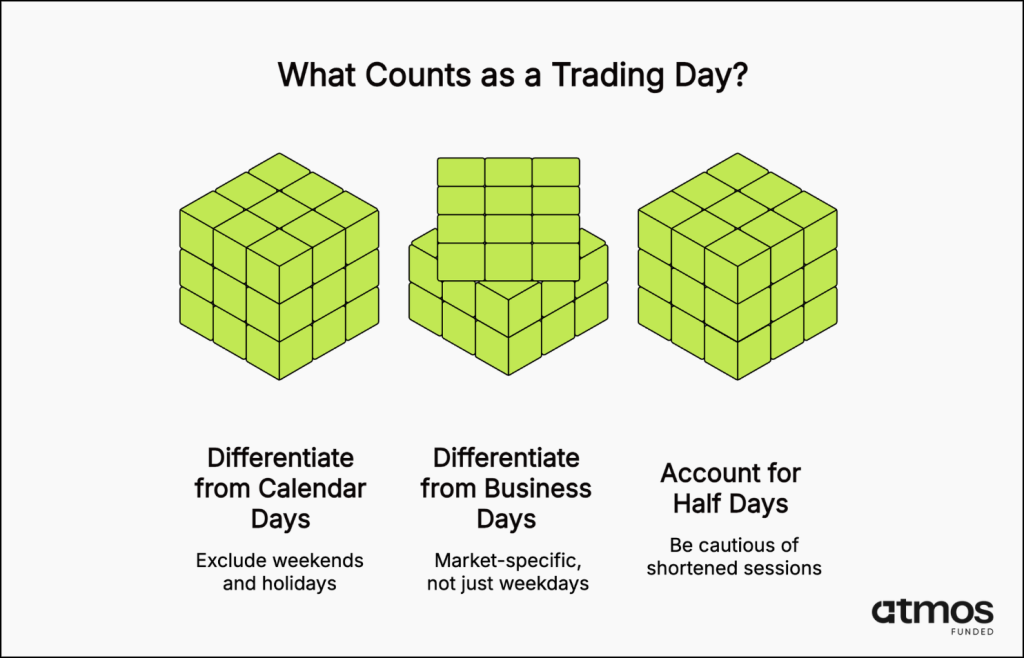
A trading day is a day when a market or platform is open for trading. That sounds simple, but traders often count days differently depending on whether they mean a full exchange session, a forex weekday, or a prop firm day that counts toward a rule.
Trading Days vs Calendar Days
Calendar days include every day of the year, including weekends and holidays. Trading days only include days when the relevant market is open. A 365-day year may only contain around 251 stock market trading days because weekends and exchange holidays are excluded.
Trading Days vs Business Days
Business days are usually Monday to Friday, excluding public holidays. Trading days are more specific because they depend on the market. A bank may be open while an exchange is closed, and a forex broker may quote prices while a stock exchange is shut.
Full Trading Days vs Half Trading Days
A half-trading day is a shortened session, often around holidays. The NYSE holiday calendar lists 2026 holidays and early closes, including early closes around Thanksgiving and Christmas Eve. For prop traders, half days should be treated carefully because liquidity can fade before the official close.
How Many Forex Trading Days Are in a Year for Prop Traders?
Forex is usually open five days per week, from Sunday evening to Friday evening in U.S. time. That means there are roughly 260 forex trading days in a year before considering low-liquidity holiday periods.
Still, the better answer for how many forex trading days in a year is not just the raw number. Many of those days are not equally useful. A Monday Asia open, a Friday afternoon, or the week between Christmas and New Year can behave very differently from a normal London-New York session.
Forex Trading Days Per Week
Most weeks have five forex trading days. The market does not trade like stocks, with one single daily open and close. Instead, it rolls through Sydney, Tokyo, London, and New York sessions. For prop traders, this creates flexibility, but it also creates a temptation to trade when the market is thin.
Forex Market Holidays and Low-Liquidity Periods
Forex may be technically open during some holidays, but liquidity can fall when banks, institutions, and major financial centers are closed. This matters because spreads can widen, moves can become less reliable, and stops may be triggered by noise rather than clean order flow.
How Many Futures Trading Days Are in a Year?
For traders asking how many futures trading days are in a year, the answer is usually close to the stock market range, but it depends on the contract. Futures holiday schedules are often product-specific because equity index futures, metals, energy, rates, grains, and crypto futures can each follow different holiday hours.
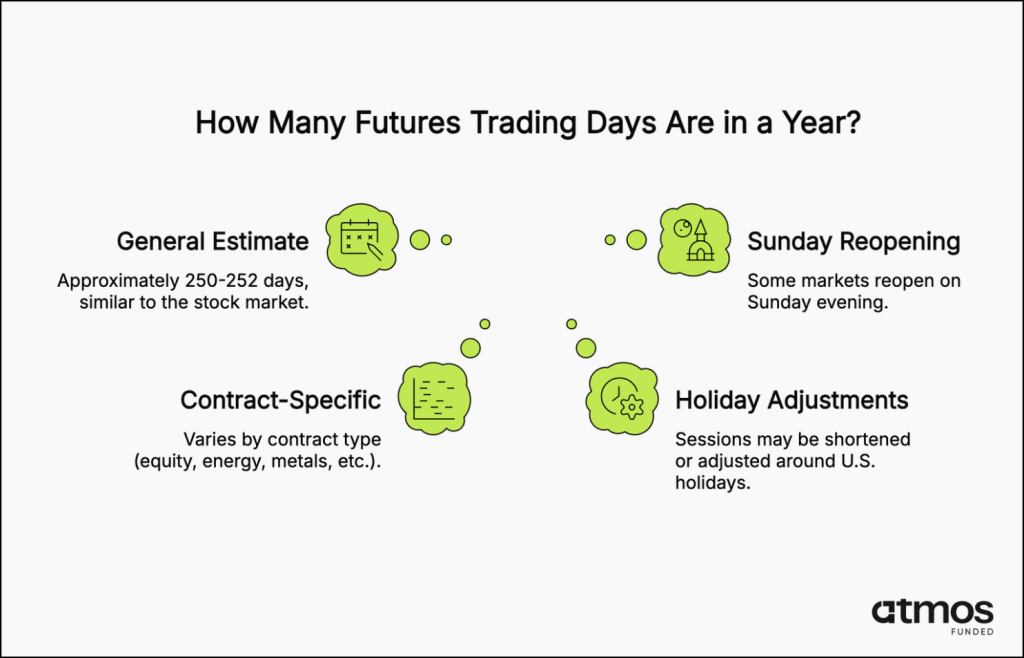
A practical estimate is 250 to 252 futures trading days per year for many major contracts, with shortened or adjusted sessions around U.S. holidays. Some futures markets also reopen on Sunday evening for the next trade date, which can make the calendar feel different from stock trading.
Futures Trading Days by Market Type
Equity index futures often follow U.S. stock market holiday patterns closely, although they may trade in extended electronic sessions. Energy and metals futures can have their own early closes. Agricultural futures can be more sensitive to exchange-specific schedules and seasonal liquidity.
Futures Holidays and Exchange Closures
Futures traders should check the exchange calendar before every holiday week. A contract may open, pause, close early, or reopen at a different time. This is especially important for prop traders because thin holiday conditions can create unpredictable fills and sharper intraday swings.
Forex vs Futures vs Stocks: Trading Days Compared
| Market | Typical Schedule | Estimated Trading Days Per Year | Main Planning Issue |
| Stocks | Weekdays, exchange hours | About 250-252 | Exchange holidays and half days |
| Forex | 24 hours, five days per week | About 260 weekday sessions | Low liquidity around holidays and session opens |
| Futures | Product-specific electronic sessions | Often about 250-252 | Contract-specific holiday schedules |
Stocks are the easiest to count because exchange holidays are clearly defined. Forex offers more access, but more access does not always mean better conditions. Futures sit somewhere in the middle because hours depend heavily on the exchange and product.
How Many Trading Days Are in a Month?
Most months have about 20 to 22 trading days. A month with several holidays may have fewer. A clean planning estimate is 21 trading days in a month, but prop traders should always check the actual calendar before setting daily targets.
This matters because a 10% target over 21 trading days is not the same as a 10% target over 15 useful sessions. The shorter the realistic window, the easier it becomes to oversize, chase, or lower setup quality.
A practical monthly plan should separate available trading days from high-quality trading days. For example, a month may have 21 open sessions, but after major news days, holiday sessions, personal schedule conflicts, and low-liquidity Fridays, you may only have 12 to 16 days where the strategy is worth full attention.
This is not a negative thing. It gives you a more honest view of the month. If the plan only works when every day is treated as a perfect opportunity, the plan is probably too aggressive for a prop account.
Why Trading Days Matter in Prop Firm Challenges
Trading days matter because prop firm challenges are built around clear account conditions. Traders need to plan around profit targets, minimum trading days, and max drawdown limits so they do not risk losing the account before reaching the funded stage.
Atmos Funded, for example, explains that some account types may include minimum trading days, drawdown limits, news trading restrictions, and funded-stage payout rules. Traders preparing to pass a prop firm challenge need to understand how the calendar affects all of those conditions.
The mistake is assuming that more trading days automatically means more chances to pass. In reality, some days are better left alone. A trader who skips bad conditions may be more disciplined than a trader who trades every available session.
This is also why minimum trading day requirements should not be treated as a box-ticking exercise. A trader can meet the calendar requirement while still trading badly. The better approach is to use those days to prove consistency: similar risk per trade, similar setup quality, and no sudden change in behavior after a winning or losing day.
How Prop Traders Can Plan Daily Targets Around Trading Days
A trading calendar helps traders turn a large target into smaller, more realistic steps. It does not mean every day must be profitable. It simply gives you a structure for pacing risk.
Daily Profit Target Formula
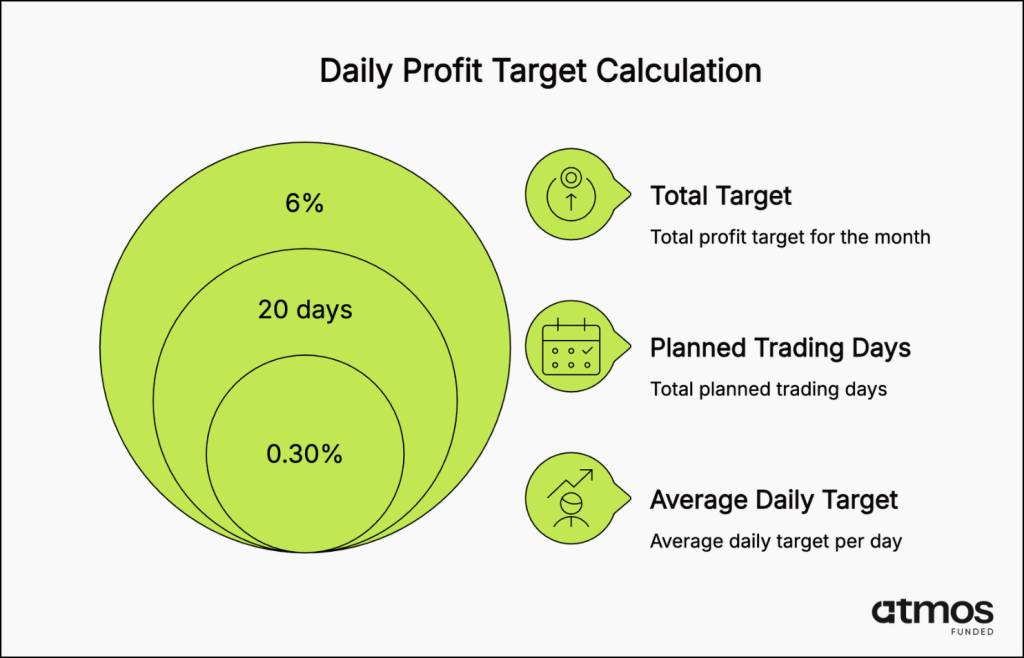
A simple formula is: total target divided by planned trading days. If a trader has a 6% target and expects to trade 20 clean days, the average target is 0.30% per planned trading day. If you only expect 12 strong sessions, the average rises to 0.50%.
6% ÷ 20 days = 0.30% per day
6% ÷ 12 days = 0.50% per day
This is where leverage and risk in prop trading need to be connected. A daily target is only useful if the risk needed to reach it still fits the account’s drawdown limits. This is especially important for accounts with trailing drawdown rules, where the loss limit can move as the account balance or equity changes.
Adjusting Targets Around Holidays and Low-Liquidity Days
Good traders reduce expectations around holiday weeks, major central bank events, and thin Friday conditions. They may still monitor the market, but they do not force normal targets onto abnormal sessions.
One simple approach is to label days before the week starts. A normal day can carry the standard risk plan. A red-news day can have reduced size or no trading. A holiday or half-day can be marked as observation only. This keeps decisions from being made in the middle of emotion.
Best and Worst Trading Periods for Prop Traders
Not all trading days deserve the same level of activity. Some periods offer clean volatility. Others create poor liquidity and messy execution.
High-Volatility Trading Periods
High-volatility periods often appear around inflation data, jobs reports, central bank decisions, market opens, and session overlaps. These periods can create opportunity, but they can also increase slippage, emotional mistakes, and execution risk. Traders can also review the most volatile forex pairs to understand which currency pairs may offer stronger price movement during active sessions.
Low-Liquidity Trading Periods
Low-liquidity periods often include late Fridays, holiday weeks, the final days of December, and quiet pre-news sessions. These are the days when traders may see movement, but not always clean movement.
For prop traders, the worst period is not always the slowest one. Sometimes the most dangerous period is a thin market that suddenly moves because there are not enough participants on both sides. The chart may look active, but the execution quality can be poor.
Common Mistakes Prop Traders Make When Counting Trading Days
The first mistake is treating 252 trading days per year as a promise instead of an estimate. The number changes depending on the market and year.
The second mistake is counting every open day as a good trading day. A market can be open but still not offer clean conditions.
The third mistake is ignoring minimum trading days. Some traders rush a challenge, hit a target, then realize the account still needs qualifying days or rule checks.
The fourth mistake is using daily targets too aggressively. If the target forces oversized trades, the calendar plan is working against you.
The fifth mistake is forgetting the funding-stage rules. Atmos Funded restricts opening or closing trades around high-impact news during the funded stage, so calendar planning should include news events, not just holidays.
Final Thoughts
So, how many trading days are there in a year? For stocks, the answer is usually around 250 to 252, with 2026 sitting at about 251 U.S. stock market trading days. Forex has roughly 260 weekday sessions, while futures depend on the contract and exchange calendar.
For prop traders, the better question is not only how many trading days per year exist. It is how many of those days are worth trading with real size.
Atmos Funded is built for traders who want structure, fair rules, fast reward processing, the Atmos community Hub, and account routes such as one-step evaluation and instant funding. That structure works best when traders use the calendar with discipline. The market may offer many trading days, but traders still have to choose the right ones.
FAQs
Are there always 252 trading days per year?
No. The 252 trading days per year figure is a useful average, not a fixed rule. The exact number changes based on weekends, holidays, half days, and the market being counted.
Do Weekends and Holidays Count Toward Prop Firm Trading Days?
Usually no. Weekends and closed-market holidays generally do not count as active trading days. Prop traders should check the specific rules for their account type because minimum trading day requirements can vary.
Can the number of trading days change each year?
Yes. The number can change because holidays fall on different weekdays each year. Leap years, observed holidays, and exchange-specific closures can also affect the total.
Do half-trading days count as trading days?
In market calendars, half days are often still listed as trading days. For planning, traders should treat them as lower-quality sessions because liquidity can fade quickly.
Should prop traders trade every available trading day?
No. Prop traders should not trade just because the market is open. The better approach is to trade when conditions fit the strategy, risk limits, and account rules.
How do trading days affect planning for prop firm challenges?
Trading days help traders pace profit targets, minimum trading day requirements, drawdown risk, and payout timing. A clear calendar plan can reduce the pressure to force trades.
Are forex trading days the same as stock market trading days?
No. Stock market trading days depend on exchange hours and market holidays, while forex is usually available five days per week across global sessions. However, some forex sessions may have lower liquidity around major holidays, bank closures, and late-week trading periods.