

If you’ve ever wondered “what is margin in forex?”, it’s essentially what allows you to control a much larger position in the market without having to put up the full amount upfront. Think of forex margin as a small deposit that gives you access to a bigger trade. Instead of paying for the entire position, you set aside a portion, and the broker temporarily covers the rest.
This is one reason margin trading is especially appealing to prop traders. With the right approach, you can participate in meaningful market moves while only using a fraction of your account.
In this guide, we’ll walk through the key questions around what margin is in forex trading, how it’s calculated, and how to manage it safely. The goal is to help traders feel more confident when opening trades, choosing position sizes, and navigating market swings.
Key Takeaways
- Margin is a small deposit traders must provide to open larger trades.
- Leverage, which is tied to margin, can magnify profits but also increases risk.
- Prop firms such as Atmos Funded apply clear rules to help traders use margin responsibly.
- Keeping an eye on your margin level helps you avoid margin calls during volatile moves.
- Effective margin management is both technical and psychological, it requires planning, discipline, and consistent execution.
What are Forex Trading Basics Before Margin?
The secret to knowing how does margin work in forex is before margin starts to make sense, it helps to get a few core forex concepts out of the way. These are the building blocks that shape how position size, risk, and costs all come together when you use margin in forex trading.
What Are Currency Pairs? (Base vs. Quote)
Every forex trade involves a currency pair, and each pair has two parts:
• Base currency – the first currency in the pair
• Quote currency – the second currency
If EUR/USD is trading at 1.0900, it simply means 1 euro (base) is worth 1.09 US dollars (quote).
When you buy a pair, you’re buying the base currency and selling the quote. When you sell, you’re doing the opposite. Understanding this relationship becomes important when calculating position value and margin later on.
What Are Pips and How Do They Work?
A pip is the basic unit used to measure price movement in forex. For most pairs, a pip is the fourth decimal place (0.0001). If EUR/USD moves from 1.0900 to 1.0905, that’s a 5-pip move.
Pips help traders measure risk, calculate potential profit or loss, and determine whether a trade fits within their overall plan.
Standard Lots vs. Mini Lots
Forex uses lot sizes to define how big your trade is.
• Standard lot = 100,000 units of the base currency
• Mini lot = 10,000 units
• Micro lot = 1,000 units
Most traders use a mix of these sizes depending on their strategy and account conditions. Larger lots create larger pip values, which can accelerate both gains and losses. Prop traders working under structured rules, like those used at Atmos Funded, often choose sizes that keep their risk steady across different market conditions.
What Is Notional Value?
Notional value is the true size of your position, even if you’re only putting up a small amount of margin.
For example, 1 mini lot (10,000 units) on EUR/USD means your notional exposure is the full 10,000 units, not just the deposit you used to open the trade.
Margin gives you access to this larger notional value without paying for it upfront. That’s why understanding your exposure matters, it’s the number behind your potential profit or loss, and it’s ultimately what margin is built around.
What Are Forex Margin Requirements and Why Do They Matter?
Margin requirements tell you how much of your own funds you need to set aside before a trade can open. It’s basically a small portion of the full trade value that your broker or prop firm keeps as a “good faith” amount while the position is active.
For example, Atmos Funded, as the best prop firm, might have specific margin thresholds based on the account size or the challenge phase you’re in, ensuring traders don’t expose themselves or the prop firm to too much risk, needed better risk management.
In general:
- Lower margin requirements allow more leverage but increase risk exposure.
- Higher margin requirements reduce risk exposure but limit potential returns.
It will be interesting to see how traders balance these considerations within prop firm challenges at Atmos Funded.
What’s the Difference Between Available Margin and Used Margin?
When trading forex on margin, it’s crucial to understand two terms clearly:
- Used Margin is the amount of your account balance currently locked to maintain open positions.
- Available Margin (also known as free margin) is the amount of money left in your account to open new positions.
Atmos Funded traders, for example, get access to clean, easy-to-read dashboards that show real-time metrics. You can see your used margin, available margin, and total equity at a glance, which removes a lot of guesswork.
It also helps you avoid those unpleasant moments where a trade can’t be opened because there isn’t enough room. The goal is simple: keep you aware of your trading capacity so you can make decisions with more confidence and fewer surprises.
Free Margin = Equity – Used Margin.
This is the number traders look at when they want to know whether there’s room to open something new. If free margin is high, you have flexibility. If it starts shrinking, your ability to place additional trades becomes limited, and you may hit a point where the platform simply won’t allow another position.
Example:
Say your equity is $5,000 and you’re currently using $1,200 in margin. That leaves $3,800 in free margin. If you open another position that requires $800, your free margin drops to $3,000. Open a few more trades in the same direction, and free margin can fall faster than expected. When it gets too low, even a good setup may be out of reach because your available room has tightened.
It’s a simple formula, but it decides how much space you really have to work with in live conditions.
What Are the Main Risks of Margin Trading and How Can You Manage Them?
Trading on margin undoubtedly offers substantial benefits, but it also carries significant risks. The primary risks include:
- Overleveraging: Using too much leverage can quickly magnify losses.
- Emotional trading: Margin pressure may lead traders to make impulsive decisions.
- Volatile markets: Rapid market movements can quickly deplete margin.
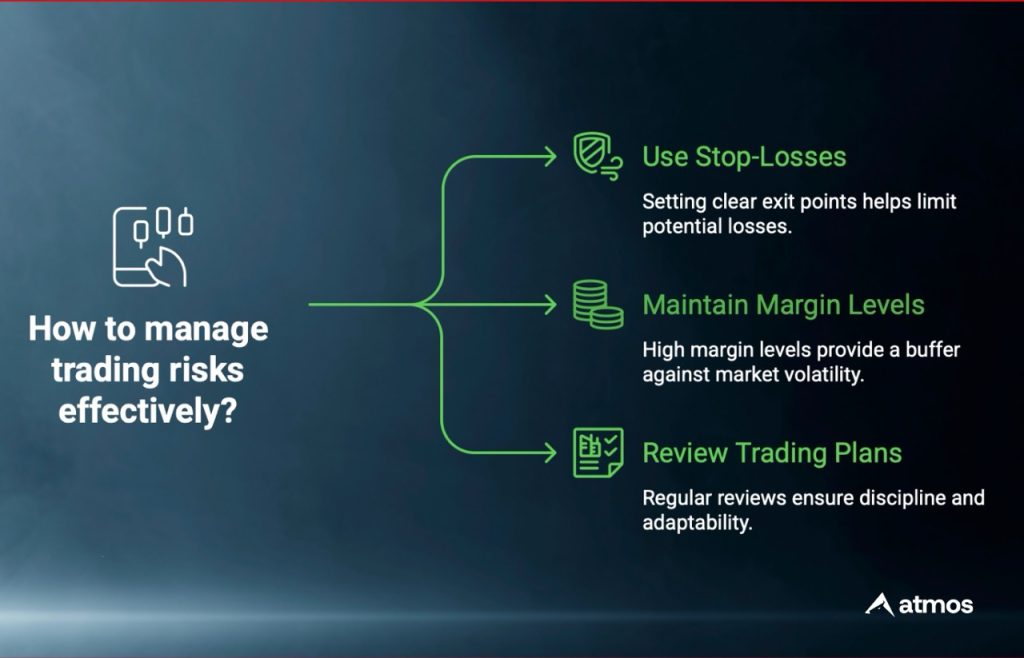
Traders can manage these risks effectively by:
- Using stop-losses: Always set clear, strategic exit points.
- Maintaining healthy margin levels: Keep available margin high enough to withstand market swings.
- Regularly reviewing trading plans: Staying disciplined under margin stress.
Atmos Funded specifically emphasizes disciplined trading through clear drawdown rules, maximum risk per trade limits, and comprehensive educational resources. Their structured approach aims to build psychological resilience and sustainable trading habits.
What Triggers a Margin Call in Forex and How Can You Avoid It?
A margin call happens when your margin level drops below the minimum threshold set by your broker or prop firm. In simple terms, your open trades are using more margin than your account can comfortably support.
When that level gets too low, some or all positions may be closed automatically to prevent further losses. It’s not a pleasant moment, of course, and most traders try to avoid ever getting close to it.
Atmos Funded, for example, uses automated alerts and clear liquidation rules that activate once your margin level reaches specific cutoffs, often around the 50% area. The idea is to protect you from a deeper drawdown and safeguard the firm’s broader risk limits. These alerts also give traders enough time to adjust exposure before the situation gets serious.
There are a few simple habits that help reduce the chance of a margin call:
- Check your margin level regularly, especially during high-volatility periods.
- Leverage conservatively so a single move doesn’t stretch your account too thin.
- Add funds promptly if your margin is getting tight.
- Make use of Atmos Funded’s dashboard alerts to stay ahead of risk.
- Know the difference between a margin call (usually around 100%, a warning) and a stop-out level (around 50% means forced liquidation).
Avoiding margin calls often comes down to staying aware of your exposure and keeping a bit of breathing room in every trade.
How Is Margin Level Calculated and What Does It Mean?

Your margin level is a vital indicator showing how well-funded your account is. It’s calculated with this simple formula:
Margin Level (%) = (Equity / Used Margin) × 100
Here’s what these numbers mean practically:
- 100% margin level: All your available equity is locked in open positions. You cannot open new trades.
- 50% margin level or lower: Often triggers forced liquidation of positions.
Atmos Funded clearly defines margin level thresholds, typically alerting traders at 100% margin level and initiating liquidation at 50% or lower, and includes visual margin level indicators directly in their dashboards, making real-time monitoring effortless.
How Do You Calculate the Required Margin for a Trade?

If you’re wondering how to calculate margin in forex trading, start by looking at the notional value of the position and the margin requirement set by the broker or prop firm. From there, the key detail is whether the pair’s base currency is the same as, or different from, the account currency.
In practice, traders usually meet three common cases:
- Example 1: Base currency = account currency (e.g., USD/JPY in a USD-denominated account)
- Example 2: Base currency ≠ account currency, but one side matches the account (e.g., EUR/USD in a USD account)
- Example 3: Neither currency in the pair matches the account currency (e.g., GBP/JPY in a USD account)
In each case, the logic is the same: determine the position’s notional value, apply the margin requirement, and, if needed, convert that margin figure into the account currency using the current exchange rate.
The required margin for a forex trade is then calculated with this straightforward formula:
Required Margin = (Trade Size × Price) ÷ Leverage
Let’s take an example:
Suppose you want to open a EUR/USD position worth €100,000 at an exchange rate of 1.10, with leverage of 1:100.
- Trade size in USD = €100,000 × 1.10 = $110,000
- Required Margin = $110,000 ÷ 100 = $1,100
Atmos Funded simplifies margin calculation by offering preset trade sizes and clearly defined leverage levels based on challenge phases, helping traders plan effectively without needing complex manual calculations.
What Is Leverage in Forex and Why Is It So Powerful?
Leverage refers to the ratio that allows traders to control larger positions with a smaller deposit. For example, leverage of 1:50 means you only need to deposit $2,000 to open a $100,000 position.
The power of leverage lies in its ability to amplify both profits and losses:
- Small market movements can translate into significant gains.
- Conversely, the same small moves can magnify losses.
Atmos Funded carefully sets maximum leverage limits, scaling these limits according to the trader’s account type or their current phase within a challenge, encouraging traders to use leverage responsibly.
How Are Leverage and Margin Different in Forex?
Margin and leverage, though interconnected, serve distinct purposes in forex trading:
| Concept | Meaning | Example |
| Margin | Collateral needed to open a trade | $1,000 deposit |
| Leverage | Ratio of exposure relative to margin | 1:100 leverage means $1,000 controls $100,000 |
Atmos Funded evaluates how traders manage both leverage and margin use, prioritizing those who maintain consistent, disciplined strategies in their trading performance.
Real-World Margin Trading Scenario: Profit and Loss Examples
Seeing how margin behaves in real market conditions often makes everything click. The numbers show how a small price change affects equity, margin level, and overall breathing room in your account. Below is a simple scenario that mirrors what many traders experience, especially when working inside a structured prop environment.
Example 1: A winning trade and how margin reacts
Imagine you open a 1 mini lot (10,000 units) position on EUR/USD at 1.0900, with leverage set at 1:50.
- Notional value: 10,000 × 1.0900 = $10,900
- Required margin: $10,900 ÷ 50 = $218
If price moves 20 pips in your favor (from 1.0900 to 1.0920):
- Profit: 20 pips × $1 per pip (for a mini lot) = +$20
- New equity: original equity + $20
- Margin level improves automatically because equity rises while used margin stays the same
You’ll notice the account feels “lighter.” More free margin becomes available, and your margin level percentage climbs. Even a modest win like this can expand trading capacity, especially when managing multiple small positions.
Example 2: A losing trade that edges toward a margin call
Now flip the scenario. You open the same 1 mini lot, but price moves 30 pips against you.
- Loss: 30 pips × $1 per pip = –$30
- Equity decreases by the same amount
- Margin level (%) = (Equity ÷ Used Margin) × 100
Here’s what happens step by step:
- As equity drops, margin level starts to compress.
- Free margin shrinks, leaving less room to open new positions.
- If the losing move continues, margin level approaches the broker or prop firm’s alert threshold.
Most traders start to feel pressure here, not necessarily because the loss is large, but because the margin level percentage is tightening. Once the margin level falls near the firm’s cutoff (for many traders this is somewhere around 100% for a warning and ~50% for liquidation), even normal price fluctuations can push the account into a forced close.
How equity and margin level change together
You can think of the margin level as a simple health gauge. When the trade is profitable, equity rises and the gauge moves higher. When the trade moves against you, even by a small amount, both equity and margin level slide downward. If too many positions are running at once or volatility spikes, this slide can happen faster than expected.
This is why many prop traders prefer consistent position sizing and clear exit rules, they help protect margin level before it reaches uncomfortable territory. Once margin is stretched too thin, the account has less room to absorb normal fluctuations, and the path to a margin call becomes surprisingly short.
What Happens During a Margin Close Out or Liquidation?
A margin close-out happens when your margin level falls below the minimum level required by the platform. When this occurs, the system begins closing your open trades. This is done to stop your losses from becoming too large and to protect the remaining equity in your account.
A close-out can happen very quickly. If the market moves fast, your margin level can drop before you have time to react. This is why checking your margin level often is important, especially during high-volatility periods. Most platforms do not wait for your approval before closing trades.
Prop traders follow similar rules but with clearer structure. At Atmos Funded, margin close-outs follow set guidelines so traders always know what to expect. The platform shows real-time alerts when your margin level becomes low, giving you a chance to reduce risk. If the level continues to fall, the system will automatically close trades to prevent further loss.
Final Thoughts on Margin in Forex Trading
Understanding margin is one of those skills that tends to separate steady traders from inconsistent ones. It gives you access to larger positions, but it also demands discipline. Even a small move can reshape your margin level faster than expected, so staying aware of your exposure becomes part of the workflow, not an optional extra.
For prop traders, this matters even more. You’re working within defined limits, and the way you use margin often influences how long you stay in the game. A structured environment helps, of course, and it’s one reason Atmos Funded builds clear margin thresholds, leverage settings, and transparent liquidation rules into its model. It keeps decision-making simple when markets aren’t.
In the end, margin isn’t just a technical concept; it’s a risk lens that helps you see how forex trading margins shift as equity, volatility, and position size change. Once you understand how it shifts with equity, volatility, and position size, you can trade with far more confidence. And if you’re looking for a prop firm that supports that kind of responsible, long-term approach, Atmos Funded offers a framework built exactly for that type of trader.
Frequently Asked Questions (FAQs)
Can margin requirements vary between forex brokers?
Yes, they do. Each broker sets its own margin rules based on liquidity, volatility, and internal risk controls, so requirements can differ even for the same pair. Instruments like gold, indices, or crypto often require higher margins because their price swings are larger.
Always check the specific margin table for your broker or prop firm, since these differences directly affect position sizing and overall risk.
What happens if my account goes into a negative balance?
If your account balance goes negative, brokers typically apply a negative balance protection policy. This ensures you won’t lose more money than you deposited. Atmos Funded, for instance, utilizes strict liquidation protocols to prevent accounts from going negative, safeguarding both the trader and the firm.
How do overnight fees (swap rates) affect margin trading?
Swap rates, also known as rollover fees, can impact margin trading by reducing available equity. These fees apply when holding positions overnight, potentially decreasing your available margin. Monitoring swap costs closely helps traders manage equity levels and margin requirements effectively.
Are margin requirements different for major vs. exotic currency pairs?
Absolutely. Major currency pairs usually require lower margins due to high liquidity and lower volatility. Exotic pairs, which are less liquid and more volatile, often have higher margin requirements, reflecting increased risk.
How do prop firms like Atmos Funded handle margin risk for traders?
Atmos Funded addresses margin risk by clearly defining margin and leverage guidelines, providing real-time platform metrics, and setting structured drawdown rules. Traders are supported with educational resources and risk-management tools, ensuring disciplined, consistent trading aligned with long-term success.