

Every FX trade carries a built-in cost: the forex spread. It’s simply the gap between the bid (what you can sell for) and the ask (what you can buy for). Think airport exchange, pay a bit more to buy, get a bit less to sell. The difference is the fee, and answers what does spread mean in forex trading in one line.
In practice, your trade opens slightly negative by the size of the spread. Formula-wise, it’s straightforward: Spread = Ask − Bid, quoted in pips (and sometimes pipettes). If EUR/USD is 1.1050/1.1052, the spread is two pips—your position needs at least two pips of favorable movement to break even.
Why it matters: spreads compound across active strategies. Scalpers and day traders feel it most, but even swing traders benefit when costs are tight and predictable. This raises the practical question of what is a good spread in forex for your system.
Prop firms like Atmos Funded are designed with that in mind, with competitive pricing and transparent rules so prop traders can plan entries around real forex spreads’ costs, not guesses.
This article explores exactly what is spread in forex and what does spread mean in forex trading, how it’s calculated, and the types available. We also cover what factors influence it, and how it can impact your forex spread trading strategies.
Key Takeaways: Forex Spread Explained
- Spread is the difference between the bid (sell) and ask (buy) price.
- It represents your primary trading cost in forex.
- Spreads can be fixed or variable, impacting your strategy and profitability.
- Factors like market volatility, liquidity, and economic events influence spreads.
- Atmos Funded may offer tools and account structures for traders seeking optimal spread conditions.
What does spread mean in forex trading?
Spread in forex is the difference between the bid price and the ask price of a currency pair, and it represents the cost of a trade.
The bid price is the rate at which a broker will buy a currency pair from you, while the ask price is the rate at which they will sell it to you. Spreads are a key cost for traders and are measured in “pips,” which are the smallest unit of price movement.
Put simply: Spread = Ask − Bid, quoted in pips (and sometimes pipettes).
Example: if EUR/USD is 1.1050 (bid) / 1.1052 (ask), the spread is 2 pips. Open and close instantly at those prices, and you’d be down 2 pips—the cost of entry.
How the Spread Affects Your Trades
Because positions start negative by the forex spread, the price must move at least that amount in your favor to reach break-even. The impact compounds for scalping and day trading, where tight targets and frequent entries make costs add up quickly.
Firms like Atmos Funded prioritize competitive, transparent pricing so prop traders can plan entries around real forex spread costs and keep more of each valid move.
Try to compare as well; eventually, you will figure out what is a good spread in forex. Knowing this is the secret to understanding what is spread in forex trading.
How is the Spread Calculated in the Forex Market?
Calculating the spread is straightforward. You subtract the bid price from the ask price. Here’s a quick example using EUR/USD:
- Bid Price: 1.1200
- Ask Price: 1.1203
- Spread: 1.1203 – 1.1200 = 0.0003 or 3 pips
A pip (percentage in point) typically refers to the fourth decimal place in most currency pairs. However, brokers now frequently quote fx spreads with an additional decimal place, called a pipette. For instance, a spread of 1.12035 (ask) and 1.12020 (bid) equals a spread of 1.5 pips or 15 pipettes, allowing traders even more precise execution.
To put the cost in dollar terms, the value of each pip depends on your trade size:
- Standard Lot (100,000 units): 1 pip = approximately $10
- Mini Lot (10,000 units): 1 pip = approximately $1
If you open a 1-standard-lot trade with a 3-pip FX spread, your immediate cost is about $30. For mini lots, it’s just $3. Atmos Funded provides MT5 with real-time pip and spread widgets, enabling you to quickly assess your true forex spread costs, adjust position sizing, and make informed decisions.

What Types of Spreads are Found in Forex?
In order to get a good grasp of what is spread in trading forex, first you need to know these two primary types of spreads in forex: fixed and variable.
Fixed Spreads
Fixed spreads remain consistent regardless of market conditions. They provide predictability, beneficial for beginners or traders who prefer stable cost structures. This model is typically offered by market-maker brokers who control their pricing, effectively serving as counterparties to your trades.
Say EUR/USD is quoted at 1.10500 / 1.10520 with a fixed 2.0-pip spread most of the day. A 1.00-lot (100k) market buy instantly “pays” about $20 in spread (2.0 pips × ~$10/pip). During a high-impact release, you might see a requote instead of a wider spread, meaning the platform asks you to accept a new price.
| Pros | Cons |
| Predictable costs | Can be higher in calm markets |
| Easier budgeting | Prone to requotes in volatility |
| Friendly for newer traders |
Variable (Floating) Spreads
Variable spreads fluctuate constantly based on market supply and demand. They are usually narrower during times of high liquidity (e.g., London–New York overlap) and wider during news events or market uncertainty. These spreads are common with ECN brokers, who pass on prices directly from multiple liquidity providers.
Say EUR/USD is 1.10500 / 1.10501 in peak liquidity (0.1-pip spread). A 1.00-lot market buy “pays” about $1 in spread (0.1 pips × ~$10/pip). Into a high-impact release, that same pair might jump to 1.10480 / 1.10485 (5.0 pips), so you pay ~$50 instead—no requote, but expect possible slippage as price updates quickly.
| Pros | Cons |
| Potentially tighter forex trading spreads during peak trading hours | Less predictable, especially around news |
| No requotes; execution at available market prices | Harder for newer traders |
| Transparency in pricing |
Raw Spreads (Optional)
Another less common but increasingly popular choice, especially among experienced prop traders, is raw spreads. Raw spreads represent extremely tight market-driven pricing with a separate commission charged per trade. This transparency can be ideal for high-volume traders.
For example, EUR/USD shows 0.0–0.2 pips during London/NY overlap, and the commission is $7 per round turn per standard lot. A 1.00-lot market buy at a 0.1-pip spread “pays” ~$1 in spread plus ~$7 commission ≈ ~$8 total—often less than a 1.0-pip all-in quote.
| Pros | Cons |
| Ultra-tight pricing in liquid hours | Costs shift with liquidity |
| Cost transparency | Requires execution discipline |
| Favorable for volume |
Atmos Funded, being one of the best prop firms, typically provides variable spreads and market-driven forex spread pricing for transparency and competitive institutional access. Depending on account type or trading platform, Atmos Funded may also structure specific spread offerings to suit different trading approaches.
Why does the Spread Change in Forex?
The forex spread isn’t static; it constantly changes based on several key factors and is the secret to knowing what is a good spread in forex. These factors can help you have a deeper understanding of what is spread in forex trading, as well as choose when and how to trade most efficiently.
Market Liquidity
High liquidity typically equals lower spreads during periods when major markets overlap, like the London–New York sessions, liquidity surges, causing spreads to tighten.
Market Volatility
Sudden price moves or volatility spikes, such as during important economic announcements (e.g., Nonfarm Payrolls), lead to wider spreads as uncertainty increases.
Economic Indicators
Significant economic data releases (e.g., GDP figures, employment data) impact spreads by influencing trader sentiment and causing rapid adjustments in bid and ask prices.
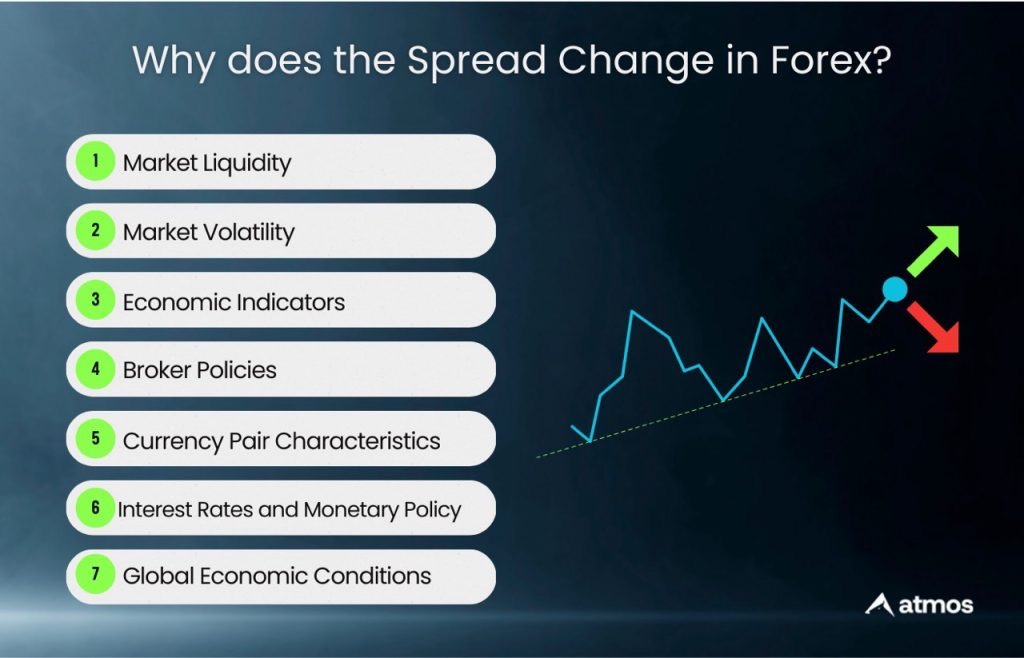
Broker Policies
Brokers control spreads within certain parameters. Some widen spreads significantly during volatile market conditions to manage their risk.
Currency Pair Characteristics
Major currency pairs like EUR/USD typically have tighter spreads compared to exotic pairs, which see lower trading volumes and liquidity. Since spreads differ by pair, traders should compare the best forex pairs for prop traders before choosing a watchlist.
Interest Rates and Monetary Policy
Central bank policy changes directly affect currency demand and liquidity, impacting spreads accordingly.
Global Economic Conditions
Geopolitical uncertainty or global economic shifts can create volatility, causing brokers to widen spreads as they account for increased risk.
Atmos Funded keeps these dynamics in mind when offering low-spread trading environments. By strategically aligning their liquidity providers and market access, they help ensure traders receive competitive spreads even during turbulent market conditions.
What are Forex Spread Trading Strategies?
Understanding how the forex spread influences your trading strategy is essential. Each trading style interacts differently with spread costs, and knowing this can significantly enhance your profitability.

Scalping
The forex scalping strategy involves rapid trades to capitalize on small price movements, typically within seconds or minutes. Tight spreads are crucial here, as even minor spread increases can quickly erode profits. Atmos Funded, recognizing this, may provide tighter spreads or special accounts for scalpers, enabling quicker profitability on short trades.
News Trading
News traders exploit volatility around economic announcements like interest rates or employment data. However, spreads usually widen significantly during these times, increasing transaction costs and potentially affecting trade profitability. Prop firms like Atmos Funded often provide traders with spread-monitoring tools to help navigate these volatile conditions strategically.
Range Trading
The range trading strategy aims to profit from price movements within defined upper and lower bounds. Since price moves are limited, wide spreads during volatile periods can pose a risk. Traders using Atmos Funded’s platform can assess real-time spreads to avoid unfavorable conditions and better manage range-trading risks.
Carry Trade
Carry traders borrow currencies with low interest rates and buy currencies offering higher returns. Given the longer-term nature of this strategy, spreads matter less per transaction but accumulate significantly over time. Competitive spreads provided by firms like Atmos Funded help minimize long-term costs, maximizing profitability.
Breakout Trading
Traders using the forex breakout strategy capitalize on significant price moves beyond support or resistance levels. Here, execution speed and tight spreads are crucial to entering positions effectively. Atmos Funded often facilitates competitive pricing during active market hours, helping traders efficiently enter and exit breakout setups.
Event-Driven Strategy
This involves trading based on specific events, such as elections or geopolitical developments. These events can dramatically widen spreads due to uncertainty. Traders can leverage platforms like Atmos Funded to monitor real-time spreads and select optimal entry points, minimizing spread-related risks.
Swing Trading
Traders using the forex swing trading strategy hold positions for several days, aiming for larger market movements. Spreads still impact profitability, but their effect is diluted over the longer holding period. Traders benefit from consistently competitive spreads, such as those Atmos Funded aims to offer, allowing cost-effective entry and exit over multiple trading sessions.
In all these strategies, prop trading firms like Atmos Funded often tailor spread conditions or provide analytical tools, enabling traders to optimize their forex spread trading strategies and enhance potential profits.
Final Thoughts on Spread in Forex Trading
Understanding what is spread in forex is one of the most critical factors affecting your trading performance. By clearly understanding spread types, fixed, variable, and raw, and learning how to calculate spreads accurately, traders can significantly reduce trading costs.
Strategically aligning your approach with spread considerations allows for better risk management, improved profitability, and more precise decision-making. Whether you’re scalping for rapid profits or swing trading for larger moves, spread-aware trading directly contributes to consistent returns.
Atmos Funded recognizes the critical role spreads play and supports traders by offering consistently competitive spread conditions, powerful analytics tools, and comprehensive risk management resources. These elements collectively help traders achieve sustainable, long-term growth and performance-based progression in their prop trading journey.
Frequently Asked Questions (FAQs)
1. How does the forex spread affect my profit and loss?
A spread represents your primary trading cost. Wider spreads increase the entry and exit costs, reducing potential profits and increasing possible losses. Tighter spreads minimize these costs, enhancing overall profitability.
2. What’s the difference between fixed and variable spreads?
Fixed spreads remain constant regardless of market conditions, providing cost predictability. Variable spreads fluctuate with market liquidity and volatility, potentially offering tighter spreads during peak market hours but wider spreads during volatile conditions.
3. Which forex pairs have the lowest spreads?
Major currency pairs such as EUR/USD, USD/JPY, and GBP/USD typically have the lowest spreads due to their high liquidity and substantial trading volume. Exotic pairs often have wider spreads.
4. Why do spreads widen during news events?
Spreads widen during news events due to increased market volatility and uncertainty. Brokers expand spreads to manage risk, reflecting rapid price fluctuations and limited market liquidity during these periods.
5. How can I reduce the cost of spreads in my trading?
Trade during high-liquidity sessions (like the London–New York overlap), select pairs with naturally tighter spreads, and use a reliable broker or prop firm, such as Atmos Funded, that provides consistently competitive spread conditions and real-time spread monitoring tools.
6. Who provides real-time spread transparency for forex traders?
Your platform is the app you use to trade. For Atmos Funded, it’s on MT5, you can watch the live Bid/Ask and enable the Spread column or widgets during sessions. ECN-style venues also publish live/average spreads from multiple liquidity providers, and our dashboard surfaces current spread alongside margin/drawdown so you can size with real costs in mind.