


Day trading in the forex market offers an exciting but demanding path for traders, especially those seeking to perform under a prop trading model. In this article, we’ll explore some of the most effective forex day trading strategies, how they apply to prop environments, and how to align them with your unique style, risk tolerance, and schedule.
For traders operating within funded programs, like Atmos Funded, the strategy you choose can directly impact whether you meet evaluation rules or hit drawdown limits. That’s why understanding not just what a strategy is, but how and when to use it, is critical.
This guide doesn’t promise quick wins. Instead, it breaks down strategies that real traders use, with structure, risk awareness, and adaptability in mind.
Key Takeaways
- Forex day trading strategies aim to capture short-term price moves within the same trading day, minimizing overnight risk while maximizing intraday opportunity.
- Popular methods include trend trading, range setups, news-based execution, and mechanical approaches like the 50-pips-a-day strategy.
- Each strategy fits different trader personalities—some favor speed and volatility, while others thrive with structure and patience.
- Atmos Funded supports day trading by offering rule clarity, structured risk limits (3%–5% daily drawdown), and multiple evaluation options with no time pressure.
- Traders should choose their strategy based on risk tolerance, time availability, preferred pairs, and compatibility with firm rules to increase their chances of success.
Key Things Every Trader Should Know About Forex Day Trading
Day trading forex means opening and closing trades within a single day, often across the most active market sessions (London, New York). Unlike a scalping trading strategy, day trading aims for quality setups rather than quantity. It rewards timing, structure, and precision.
Before diving into individual strategies, here are the key principles all day traders, especially those in prop environments, need to understand:

Volatility and Liquidity
The forex market’s high liquidity makes it ideal for day trading, but the most liquid pairs (EUR/USD, GBP/USD, USD/JPY) also move sharply during major sessions. This volatility can create opportunity or quickly hit a drawdown threshold.
At Atmos Funded, traders benefit from tight spreads and structured drawdown limits, including a 3% or 5% daily loss limit depending on challenge type. This makes high-volatility trading possible, but only when properly managed.
Timing Matters
Markets behave differently during different sessions. The London and New York overlap offers the most movement, while the Asian session may favor range setups. Some strategies (like news trading) are time-sensitive, while others (like retracements) require patience and structure.
Strategy-Rule Fit
Certain styles, like grid trading or news trading, may come with restrictions in prop trading. At Atmos Funded:
- News trading is allowed on challenge accounts but is restricted within 2 minutes before or after high-impact news on funded accounts.
- Martingale-based grid systems are prohibited, but non-martingale grids can be used.
Understanding these distinctions upfront helps ensure you don’t break rules while pursuing profits.
Top Forex Day Trading Strategies
There’s no one-size-fits-all when it comes to strategy. Below are the most commonly used and time-tested forex day trading strategies, broken down by approach, timing, risk level, and compatibility with prop firm conditions.

Trend Trading
What is trend trading in forex? It’s a strategy that aims to profit from the dominant direction of price movement by entering trades that follow the trend. The goal is to ride the “mini trends” that emerge intraday.
- Tools used: Moving averages, RSI, price structure (higher highs/lows).
- Best when: Market shows directional strength, usually during London/New York sessions.
- Atmos Fit: Fully allowed; works well with rules-based structure and avoids risky over-leverage.
This strategy suits traders who prefer a more structured approach and can wait for confirmation signals. Entries often occur on pullbacks to moving averages or breakouts from prior highs/lows.
Tip: Multi-timeframe confirmation (e.g., 1H trend + 15M entry) improves entry quality and aligns with structured prop challenges like those at Atmos.
Range Trading
Range trading focuses on buying at support and selling at resistance during consolidating periods, especially when markets move sideways.
- Tools used: Support/resistance zones, ADX to confirm low trend strength, oscillators like RSI.
- Best when: During quiet sessions (late Asia, early Europe) or before news events.
- Atmos Fit: Allowed, and often less risky due to lower volatility, but drawdown control is still required.
This strategy favors traders who thrive in calm, repetitive price environments. It also works well when you’re short on screen time or prefer fewer trades with clear parameters.
Note: Avoid forcing range setups during high-volume breakouts. The risk of drawdown violation increases sharply.
News Trading
What is news trading in forex? It’s a strategy that reacts to economic events like NFP, central bank meetings, or CPI data, aiming to capture sharp price moves caused by breaking news.
- Tools used: Economic calendar, volatility filters, stop orders above/below breakout zones.
- Best when: During high-impact scheduled events.
- Atmos Fit: Permitted on challenge accounts only. On funded accounts, you must avoid trading 2 minutes before and after high-impact releases.
News trading offers quick gains, but also risks slippage and spread spikes. It’s not suited to those with low stress tolerance or poor trade execution discipline.
Risk Tip: Always use stop-limit orders and avoid market orders during peak volatility windows.
Retracement Trading
Retracement trading involves entering positions during a temporary pullback in the direction of the overall trend.
- Tools used: Fibonacci levels (38.2%, 61.8%), trendlines, moving averages.
- Best when: In strong trending environments where price frequently re-tests key levels.
- Atmos Fit: Fully allowed; aligns well with rule-based risk systems.
This strategy rewards patience. Traders wait for prices to “breathe” before entering, reducing the risk of chasing tops/bottoms.
For prop traders, this approach helps preserve daily drawdown limits by offering tighter stop placements and better entries.
Grid Trading
What is grid trading in forex? It’s a volatility-based strategy that places a grid of buy/sell orders at fixed intervals, regardless of trend, to capture profits from price swings.
- Tools used: Price levels spaced in intervals, no directional bias.
- Best when: In ranging or choppy conditions, or when anticipating whipsaw volatility.
- Atmos Fit: Allowed only if not martingale-based. Risk compounding or hedging across accounts is prohibited.
While this strategy can create consistent results in low-trending markets, it carries higher risk and is not suited for traders who struggle with fast-changing drawdown exposure.
Rule reminder: Using grid strategies in combination with news or aggressive lot sizing is not permitted at Atmos.
Carry Trades
What is a carry trade in forex? It’s a strategy where traders buy higher-yielding currencies and sell lower-yielding ones to profit from the interest rate difference (known as the carry).
- Tools used: Fundamental analysis, interest rate differentials, long-term bias.
- Best when: In low-volatility markets where trends align with rate spreads.
- Atmos Fit: Allowed in principle, but often less practical for day trading due to the short holding period.
Though traditionally a swing or position trade, some day traders attempt intraday carry setups by aligning macro bias with short-term signals. This hybrid approach is niche but valid in prop trading models.
50-Pips-a-Day Strategy
This rules-based strategy aims to capture early session momentum by setting pending orders above/below the 7 AM GMT candlestick.
- Tools used: 1-hour candles, buy/sell stop orders, 50-pip TP, 5–10 pip SL.
- Best when: Trading highly liquid pairs like GBP/USD or EUR/USD at the London open.
- Atmos Fit: Fully compliant; aligns with structured execution and risk management rules.
It’s a straightforward, mechanical method—ideal for traders who want to remove discretion and test consistent entries.
Keep in mind that this strategy has a capped upside, so consistency and tight execution matter more than win rate alone.
One-Hour Strategy
Similar to the 50-pip model, the one-hour strategy uses breakouts from the previous hour’s high/low to trigger entries.
- Tools used: 1-hour chart, high/low levels, 20-pip TP, calculated SL.
- Best when: Volatility picks up in early trading hours.
- Atmos Fit: Compliant; great for traders who value simplicity and structure.
It offers short bursts of opportunity without needing to monitor multiple setups or indicators.
Tip: Combine this with momentum filters (like RSI or volume spikes) to reduce false breakouts.
How to Choose a Forex Day Trading Strategy
There is no “best” forex day trading strategy, only what fits your unique trader profile. Choosing the right approach means aligning your strategy with your temperament, preferred instruments, available time, and risk boundaries. Here’s how to narrow it down:
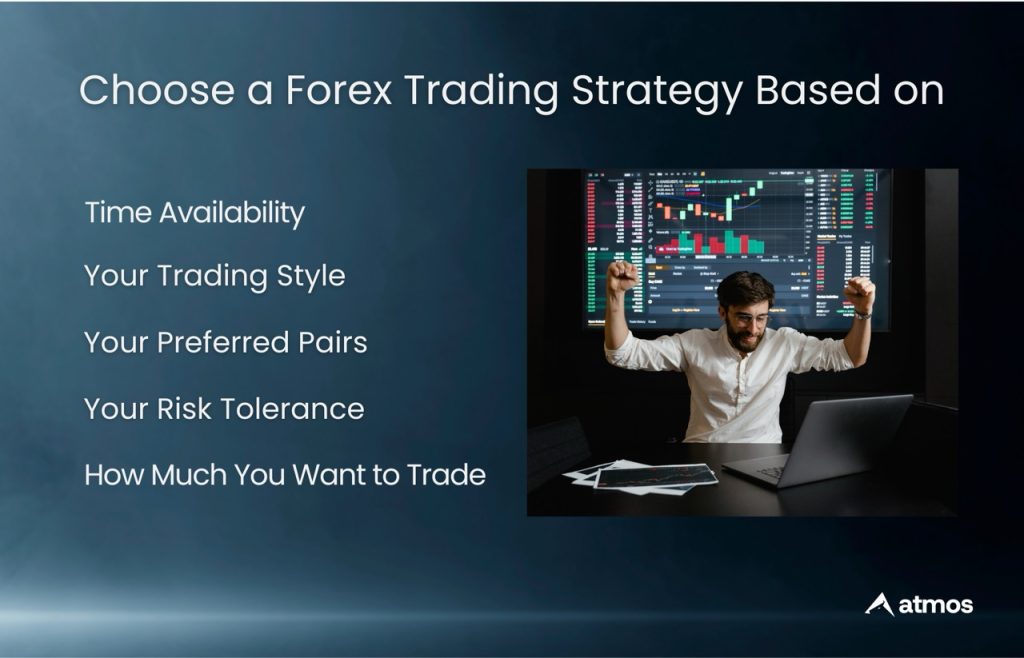
How Do You Choose a Forex Trading Strategy Based on Your Style?
Are you methodical and patient, or quick-thinking and reactive?
- If you prefer precision and structure, trend or retracement trading may suit you.
- If you thrive on volatility and speed, strategies like breakouts or the 50-pips-a-day method could be a better fit.
- Discretionary traders may enjoy range setups, while rule-based personalities often lean toward mechanical strategies.
Atmos traders can pass with just three trading days and no time limit, so there’s room to test different styles at your own pace.
Choose Based on Your Preferred Pairs
Some pairs behave differently depending on liquidity, volatility, and news sensitivity.
- EUR/USD and GBP/USD are ideal for trend, news, or breakout strategies.
- AUD/JPY or NZD/JPY may offer better carry trade or mean reversion setups.
- Exotic pairs can spike unexpectedly. Best avoided unless your system accounts for slippage and wide spreads.
Always choose pairs that fit both your strategy and the execution environment of your prop firm.
Choose Based on Your Risk Tolerance
Different strategies carry different risk profiles:
- Trend trading and retracements allow tighter stop placement and cleaner structure.
- News trading and grid setups require more risk appetite and advanced execution control.
- Atmos Funded offers structured rules, like 3% or 5% daily drawdown, which favor strategies that limit overexposure.
If your temperament leans conservative, stick with defined risk setups and avoid overtrading.
Decide How Much You Want to Trade
- Do you want 1–2 high-quality setups per session? Try trend or range trading.
- Do you prefer automated execution or rule-based repetition? Look into the 50-pips-a-day strategy.
- If you want maximum trade frequency, consider light scalping, though this must stay within risk parameters set by your prop firm.
More trades don’t always mean more success—what matters is repeatability and discipline.
Which Forex Strategy Fits Your Daily Schedule or Time Availability?
- Full-time traders may prefer discretionary or multi-session setups.
- Part-time traders should focus on structured or rule-based methods with defined triggers.
- Strategies like the one-hour breakout offer limited-time engagement with potential for consistent testing.
At Atmos, the absence of time pressure means your strategy doesn’t need to force daily entries. Pass at your own pace.
Know When to Trade
Markets behave differently at different times:
- London open (7–9 AM GMT): Best for momentum and volatility-based strategies.
- Mid-session: Favors range trading or retracement entries.
- Pre-news windows: Work for breakout or fade setups—but require timing discipline.
Time your strategy around when your edge is most likely to show up.
Tips for Forex Day Trading
Success in day trading doesn’t come from a secret setup—it comes from structure, self-awareness, and execution. Here are some practical tips that support both strategy building and long-term performance:
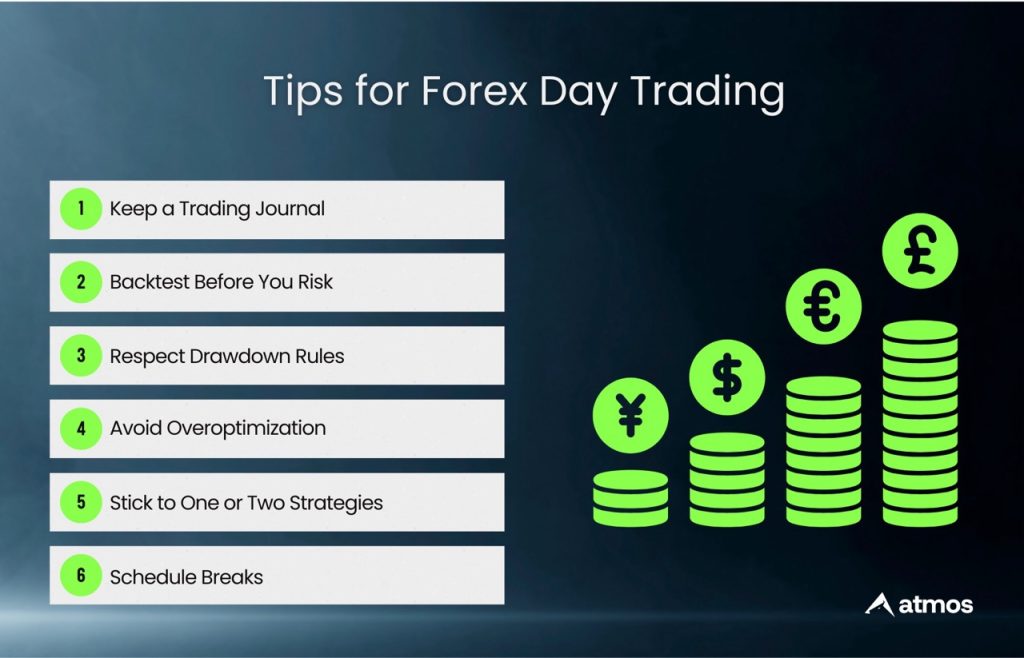
Keep a Trading Journal
Log your entries, exits, setups, emotions, and outcomes. Over time, this helps identify what works and what doesn’t.
Backtest Before You Risk
Use demo accounts or past data to test your strategy over multiple conditions. Atmos Funded allows simulated performance in the challenge phase, giving you a structured environment to validate ideas.
Respect Drawdown Rules
Prop trading is as much about risk control as it is about profitability. Daily loss limits and max drawdown at Atmos mean your strategy needs to avoid overexposure, revenge trading, or “doubling down” mistakes.
Avoid Overoptimization
Don’t chase perfection. A good strategy with solid discipline outperforms a perfect system that breaks down under pressure.
Stick to One or Two Strategies
Jumping between methods prevents consistency. Choose one that fits your time, risk profile, and market understanding—and go deep.
Schedule Breaks
Day trading is mentally taxing. Set pre-determined stop times or break windows so fatigue doesn’t impact your decision-making.
Final Thoughts on Forex Day Trading Strategies
Day trading can offer control, flexibility, and defined intraday opportunities. But it also demands structure, discipline, and clarity. There are many strategies—trend, range, retracement, breakout, grid—and each has its time and place.
Not every method will suit your psychology or your environment. That’s why trading within a structured model like Atmos Funded offers a unique advantage: you can test, adjust, and grow without the pressure of risking personal funds.
With no time limits, no lot size rules, and a minimum of only three trading days, Atmos gives you the room to develop and prove your trading style—your way.
Whether you favor breakout momentum or steady retracement entries, the goal isn’t to find the “perfect strategy.” It’s to find your repeatable edge—and to apply it within rules that protect and reward serious traders.
Frequently Asked Questions (FAQs)
1. Is Forex Day Trading Profitable?
It can be, with strong discipline and a tested strategy. Profitability in day trading comes from consistent execution, proper risk control, and sticking to a repeatable method under defined conditions. Many prop traders scale their profitability gradually over time.
2. What is the 5-3-1 Forex Trading Strategy?
This rule suggests focusing on:
- 5 currency pairs
- 3 trading sessions
- 1 strategy
The 5-3-1 approach works better when traders choose the best forex pairs for prop trading instead of watching too many markets.
It’s designed to build consistency and prevent overexposure by limiting distractions. Many prop traders use this to simplify their trading framework.
3. Who Can Become a Day Trader?
Anyone with market knowledge, discipline, and a structured routine can become a day trader. However, it’s best suited for traders who can monitor markets actively and stick to risk guidelines—traits often required by prop firms like Atmos Funded.
4. Is Day Trading Risky?
Yes. All trading involves risk, but day trading adds time pressure and execution challenges. That’s why drawdown limits, strategy fit, and proper planning are essential. Prop firms help by capping downside risk—Atmos, for example, offers a fixed-loss structure with a one-time fee.
5. What Tools Do Day Traders Need to Succeed?
Essential tools include:
- A reliable charting platform (e.g., MT4/MT5)
- Economic calendar (for news awareness)
- Trading journal
- Clear risk management rules
- Optional: technical indicators like moving averages or Fibonacci tools
Atmos traders operate in a simulated environment during the challenge phase—an ideal setup to master these tools without real-money pressure.