

A prop firm trading challenge is an evaluation that tests whether a trader can meet a profit target while staying within risk rules. If the trader passes, the firm offers access to funded accounts of up to $200k, where profits are shared according to the program terms, usually 70 to 80% going to the trader.
For traders looking at the best prop firm like Atmos Funded, the point is not just about making money quickly. It is about proving that the trader can manage risk, follow rules, and repeat a process without turning one account into a gamble.
That is why the best question is not only, ‘what is a prop firm challenge?’ A better question is: does the challenge structure fit the trader’s strategy, schedule, risk tolerance, and account size?
Key Takeaways
- A prop firm challenge is a structured evaluation with a profit target, drawdown rules, and account conditions.
- Most challenges test risk control as much as trading skill.
- A prop challenge can be one-step, two-step, instant funding, or a lower-cost route such as Nova.
- Traders should compare account size, fee, profit target, daily loss, maximum drawdown, minimum trading days, and payout rules before joining.
What Is a Prop Firm Challenge?
A prop firm challenge is a test used by a proprietary trading firm to evaluate traders before giving them access to a funded account. The broader idea of proprietary trading is that a firm uses its own capital or trading structure instead of asking the trader to build a large personal account first.
In modern online prop firm challenges, you start on an evaluation account. The prop firm lets you choose the account size, but they choose the target/s, drawdown limits, trading rules, and reward terms. By taking a challenge, you simply try to trade profitably without breaking those rules.
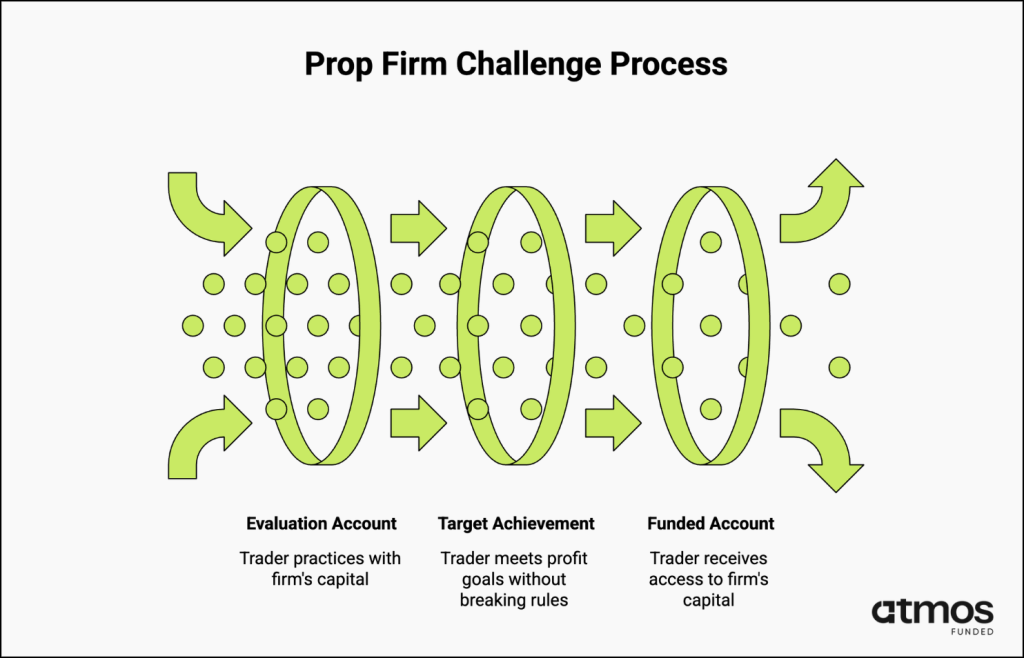
Once you reach specific targets with the challenge account while not breaking rules, you are immediately given the funded account you opted in for. Profit share depends on the prop firm, but usually 70-90% goes to you, the trader.
There is this one different account; it may not even be called a challenge. It is the Instant Funding path. Once chosen, you are immediately given the funded account. This account is designed for time-sensitive trades. Instead of waiting to pass your evaluation/ challenge, your trades directly impact your rewards with this path. Take note, though, that this path is only for experienced traders already used to trading under prop firm rules.
Why Do Prop Firms Use Challenges to Evaluate Traders?
Prop firms use challenges because trading capital needs risk controls. Prop firms don’t want to reward gambling actions, but instead focus on offering funded accounts for those who act professionally and consistently in trading.
A challenge tests if the trader can do three things at the same time: reach a target, protect the account, and stay profitable under prop firm rules. This matters because many traders can find entries, but fewer can size correctly, stop trading after a bad day, avoid emotional recovery trades, etc.
For the trader, the challenge can also be useful. It creates structure. It shows if your strategy works under rules, not only in theory. The important part is choosing the right challenge that gives you a solid path that is designed for your setup.
How Does a Prop Trading Challenge Work? A Step-by-Step Guide
A prop trading challenge usually follows a clear process, from selecting the right account type to meeting performance targets and following risk rules. Each stage is designed to assess whether the trader can remain profitable while managing the account consistently and responsibly.
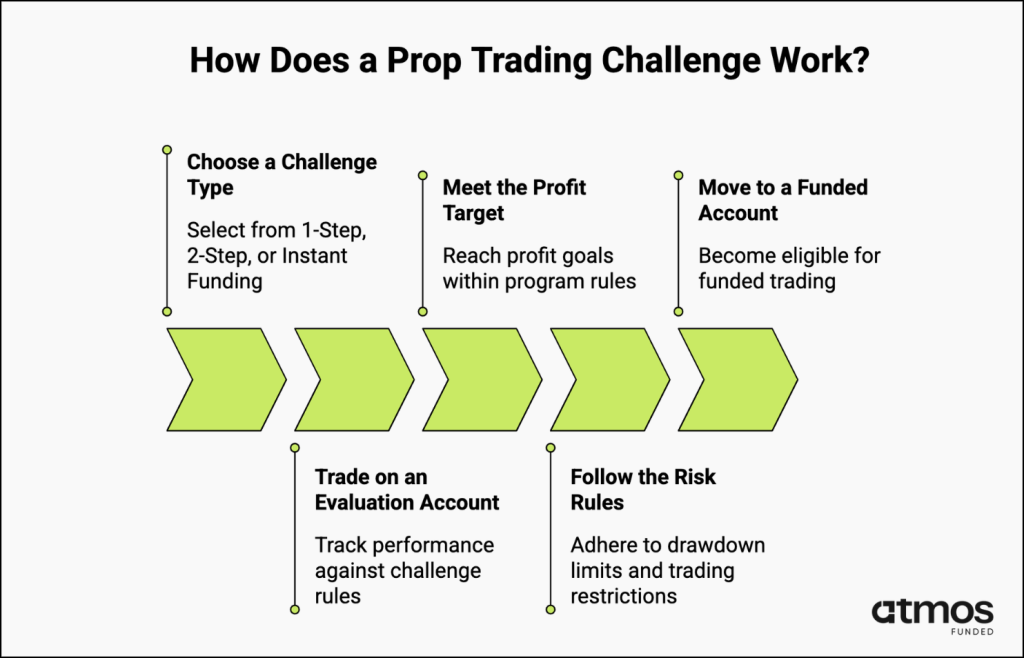
Choose a Challenge Type
The trader first chooses the challenge type. Check out our in-depth guide to choosing the right challenge for you here. Generally, there are 3 main ones: 1-Step, 2-Step, and Instant Funding.
Some traders prefer 1-Step evaluations because they want a shorter route. Others prefer 2-Step evaluations because they prefer slower processes in exchange for beginner-friendly rules. Lastly, experienced traders pay a higher entry point for Instant Funding in exchange for speed.
Atmos Funded also offers a $5 challenge, the Nova Challenge. It is a 1-Step evaluation, but you only pay once you are guaranteed the full funded account. It is built for 3 types of traders: A beginning trader looking to start with very low upfront cost, a trader who wants to upskill and learn how trailing drawdown in prop trading works, and traders who trade with high risk-to-reward ratio strategies since it has no consistency rules.
For traders looking for paths with static drawdown, Atmos Funded has 2 paths: 2-Step Standard and 2-Step Plus. 2-Step Standard is focused on providing better scalability, while 2-Step Plus has a faster road to your first payout.
Trade on an Evaluation Account
After purchasing your challenge of choice, you will receive your account with the set balance. This account is used to track performance against the challenge rules. You should treat it seriously, because the habits built during the challenge often continue into the funded stage.
Meet the Profit Target
These challenges require the trader to reach a profit target. In general, the target ranges from 3-10% depending on the program. Although the target is not the only obstacle. You need to reach the target within the rules of the program. Also, if you chose 2-Step, you will need to reach the target twice.
Follow the Risk Rules
Risk rules usually matter more than the target. Daily loss limits, maximum drawdown, open risk, news trading rules, and prohibited strategies can all decide whether the trader passes or fails.
Before starting, traders should read the exact rule page and understand how drawdown is measured. Atmos Funded’s Help Center explains that profit targets, drawdown limits, minimum trading days, news trading rules, leverage, and funded account payouts can vary by account type.
Move to a Funded Account
When you complete the challenge without breaking the rules, you become eligible to move on to the funded account stage. At that point, there’s no more profit target, and you can now focus on getting your rewards. But drawdown rules and other restrictions still matter. The funded phase is where the process becomes more important than speed.
What Common Rules and Restrictions Do Prop Firm Challenges Have?
Prop firm challenges use specific rules to measure both profitability and risk management. Before joining, traders should understand how account size, fees, loss limits, targets, trading days, and profit splits affect the difficulty and overall value of the program.
Account Size
Account size is the notional balance used for the challenge. Larger accounts can offer more opportunity, but they also create more emotional pressure. A trader should choose a size that matches their normal risk, not just the biggest number available.
Challenge Fee
The challenge fee is the amount paid to enter. Lower fees can be helpful, especially for traders still testing their strategy, but price alone is not enough. A trader comparing the cheapest prop firm challenges should also compare drawdown room, phase count, time limits, minimum trading days, and payout access.
Profit Target
The profit target is the return needed to pass the phase. A high target with tight drawdown can push traders into riskier decisions. A lower target may feel easier, but the trader still needs clean execution.
Daily Loss Limit
The daily loss limit caps how much the account can lose in one trading day. This rule is designed to stop one bad session from turning into an account breach.
Maximum Drawdown
Maximum drawdown is the total loss limit for the account. It may be static or trailing, depending on the program. Traders should understand the calculation because drawdown confusion is one of the most common challenge mistakes.
Minimum Trading Days
Some challenges require a minimum number of profitable trading days. This rule is meant to encourage consistency and not one-trade gambling. Not every Atmos account has the same requirement, so traders should check the product details.
Profit Split
The profit split is the percentage of eligible profits paid to the trader after the funded stage. A strong split is useful, but payout speed, rule clarity, and account stability matter just as much.
1-Step vs 2-Step Prop Firm Challenges
| Challenge Type | Structure | Typical Fit | Atmos Example |
| 1-Step Standard | One evaluation, higher target, direct path after passing | Traders who want a straightforward single phase and scalability | 10% target, 3 minimum trading days |
| 1-Step Plus | One evaluation with a lighter target and faster path to rewards | Traders who want a lower target and lower upfront cost | 6% target, 3 minimum trading days |
| 2-Step Standard | Two phases with beginner-friendly rules | Traders who prefer a classic prop firm challenge model with scalability | 10% target, then 5% target |
| 2-Step Plus | Two phases with lighter targets | Traders who want lower phase targets, low entry cost, and faster rewards | 6% target, then 6% target |
How to Join a Prop Firm Trading Challenge
Joining a prop firm trading challenge involves more than selecting an account and paying the fee. Traders should compare the available programs, review the rules carefully, choose an appropriate account size, and prepare a clear trading plan before starting the evaluation.
Compare Challenge Options
The first step is to compare available challenge options. Traders should look at phase count, target, loss limits, leverage, eligible instruments, reward terms, and if the rules create unnecessary pressure.
Review the Rules and Fees
The trader should review rules before paying the fee. This includes drawdown calculation, news restrictions, prohibited strategies, EAs, holding rules, payout timing, and reset terms – to see what fits better your style. Atmos Funded’s rules are fully published in their Help Center.
Select the Right Account Size
The right account size is not always the largest one. A trader who normally risks 0.25% to 0.50% per trade may not need the biggest account to prove discipline. A smaller account can be a cleaner test if it keeps emotions under control. Also, starting with lower account sizes and seeing consistency is the road to proper scalability.
Register and Start the Evaluation
Once the account type is chosen, the trader registers, pays the one-time challenge fee, receives the account, and starts the evaluation. The best traders do not change their plan just because the challenge begins. They already know what setups they will take and what conditions they will avoid.
How to Prepare for a Prop Firm Trading Challenge
Preparing for a prop firm trading challenge requires a tested strategy, defined risk limits, and a consistent review process. Traders should know how they will approach each setup, manage losses, and track performance before the evaluation begins.
Build a Trading Plan
A trading plan should define the markets, setups, sessions, entry rules, stop placement, position size, and conditions for stopping. A vague plan usually becomes weaker under pressure. With no time limits on any Atmos Funded programs, traders enjoy the flexibility for their A+ setups.
Set Risk Per Trade
Risk per trade should be small enough to survive losing streaks. Many traders fail because their normal stop size does not fit the challenge drawdown. The trader should know how many full-risk losses the account can absorb before the daily or total limit becomes uncomfortable.
This is especially important in leveraged markets, where small price moves can have a larger account impact. Traders need to set in place their risk-reward ratio before committing to a trade entry.
Practice Before Starting the Challenge
Practice matters because a prop challenge is not the place to discover if the strategy works. Traders should test their rules in similar market conditions and track how the strategy behaves around news, spreads, and emotional periods. Many successful Atmos Funded traders state that back-testing hundreds of times has gotten them to the consistent rewards they receive.
Track Performance With a Trading Journal
A journal helps traders see if losses come from the strategy or from behavior. Entries should track setup quality, risk used, rule compliance, emotional state, and whether the trade followed the plan.
Common Mistakes Traders Make in a Prop Challenge
The first mistake is treating the prop challenge like a race. A fast pass feels good, but a rushed pass can create habits that fail later. Look for prop firms that have no time limit rules.
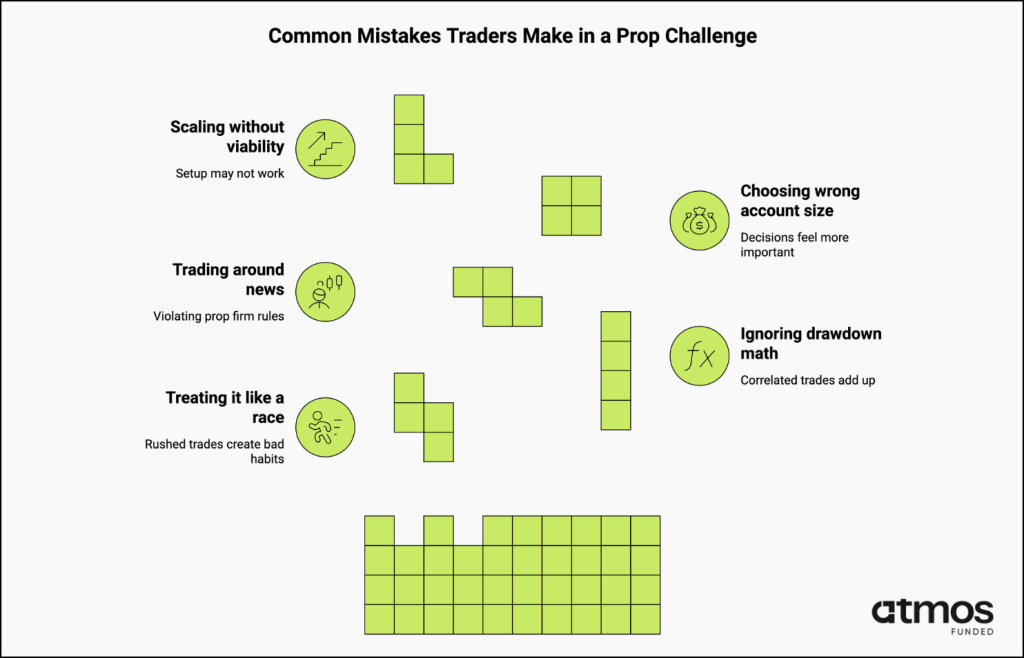
One more mistake is ignoring drawdown math. A trader may think they are risking only a small amount, but several correlated trades can add up to one oversized position.
Another common one is trading around the news without understanding the rules. Atmos Funded restricts opening or closing trades around high-impact news 2 minutes before and after during the funded stage, so traders should build news awareness into the plan early. Other prop firms have these rules as well, up to 5 minutes before and after the high-impact news.
Lastly, choosing the wrong account size. Hastily changing to a larger account can make the trader feel like every decision matters more, which can lead to hesitation, revenge trading, or poor exits.
Scaling doesn’t simply mean going up an account after a successful run on a lower account size. Before committing to a larger account, study if your setup can still be viable for the larger account.
Pros and Cons of a Prop Firm Challenge
The main thing of a prop firm challenge is to guarantee access to trading without risking the trader’s own capital. Traders also get clear rules, performance feedback, and a defined route toward rewards.
The trade-off is that the prop firm applies its own rules to guarantee the trader is trading in a professional way. A trader can be profitable and still fail by breaking a drawdown rule, trading prohibited strategies, or misunderstanding the funded-stage conditions. That is why rule clarity matters so much.
How to Choose the Right Prop Firm Challenge
The right challenge should match the trader’s actual strategy. A scalper, swing trader, news-aware trader, trader with a high-skew strategy, or low-frequency trader may all need different structures.
A good comparison should include the total cost, not just the entry fee. It should also include drawdown room, target difficulty, minimum trading days, time limits, payout timing, support, community, and whether the firm explains rules clearly.
Atmos Funded is strong here because it gives traders several routes instead of forcing one structure onto everyone. That makes it easier to choose a path based on trading style, not just marketing noise.
What Challenges Does Atmos Funded Offer?
Atmos Funded offers multiple account routes for different trader styles. The 1-Step Standard gives a straightforward single evaluation built for scalability. The 1-Step Plus has a lighter 6% target with reset mechanisms for faster rewards, plus a lower upfront cost.
The 2-Step Standard has a 10% then 5% target and has a beginner-friendly model. The 2-Step Plus uses 6% and 6% targets, a lower upfront cost, and a faster reward structure.
Atmos also offers Instant Funding for traders who want to skip the evaluation stage and start building towards rewards from day one.
For traders who want a lower-cost entry, the Nova Challenge starts from $5, uses a 1-Step structure with a 5% profit target, has no minimum trading days in the challenge phase, and offers on-demand rewards.
This gives Atmos a strong position for traders who want choice. The best choice depends on how your strategy is set up to handle targets, drawdown, and reward timing. Compare and learn the path that is built for you.
FAQs
What is a prop firm challenge?
A prop firm challenge is an evaluation where a trader tries to reach a profit target while following risk rules. Passing can lead to a funded account stage or simulated funded trading environment, depending on the firm and program.
How does a prop firm trading challenge work?
A trader chooses an account type, trades an evaluation account, aims to reach the target, avoids rule breaches, and then moves to the funded stage if all conditions are met.
How do I join a prop firm trading challenge?
To join a prop firm trading challenge, you should first have a strategy in place, then compare options, review the rules and fees, choose an account size, register with the firm, and start the evaluation account.
What are the key components of a prop challenge?
The key components are account size, fee, profit target, daily loss limit, maximum drawdown, minimum trading days, eligible strategies, payout terms, and profit split.
What is the difference between a one-step and a two-step prop challenge?
A one-step challenge has one evaluation phase. A two-step challenge has an evaluation phase and a verification phase. One-step can be faster, while two-step can feel more structured in exchange for more beginner-friendly rules.
What happens after passing a prop challenge?
After passing, you move to a funded account stage. The profit target no longer applies, but drawdown rules, strategy restrictions, and payout conditions still matter. This is where your profits can be built up and split with you for up to 90%.
What happens if a trader fails a prop firm challenge?
If a trader breaches a rule, the account usually closes. At Atmos Funded, there is no time limit, so traders can wait for their A+ setup regardless of how long it takes. So having a profitable system in place is encouraged instead of failing multiple times without progress. At Atmos Funded, failure can be progress.
Can beginner traders join a prop firm challenge?
Beginner traders can join, but they should not rush. A beginner should practice first, understand drawdown, and choose a challenge size that does not create emotional pressure. Atmos Funded offers a challenge for only $5, the Nova Challenge. This creates a space that does not build pressure for beginner traders due to the very low entry cost.
Is a prop firm challenge real trading or just a simulation?
Many online prop firms, such as Atmos Funded, use simulated or demo environments. Traders should review each firm’s legal terms, because the trading environment and payout structure can vary.
How hard is it to pass a prop firm challenge on the first attempt?
It can be difficult because the trader must be profitable and rule-compliant at the same time. Many failures come from risk errors, not from a lack of trade ideas. So back-testing under the account rules is highly encouraged before committing to a challenge account.